Annotated transcription · 42 min read
Does Starship HLS Really Require 15+ Launches to Reach the Moon?
A deep dive into the engineering challenges, mission architecture, and refueling requirements of SpaceX's human lunar lander.
Introduction: A Skyscraper on the Moon
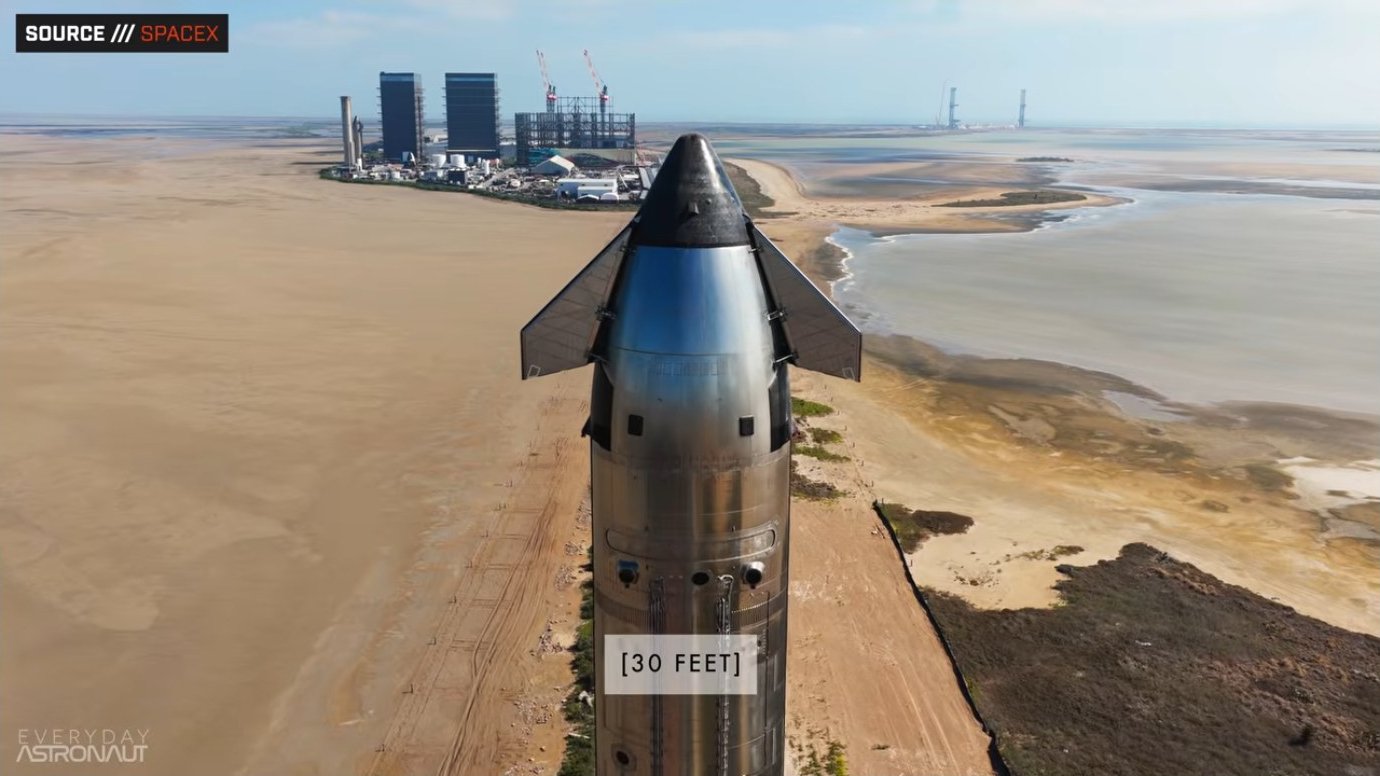
SpaceX's Starship is massive. It's 9 meters wide and just the upper stage is over 50 meters tall, weighing over 100 metric tons dry. While its enormity is incredible, it makes for an unwieldy—and frankly ridiculous—lunar lander.
In 2021, NASA chose Starship to be one of the Human Landing Systems (HLS) for their Artemis program. This behemoth is over seven times taller, probably about 100 times heavier when landed on the moon, with over 100 times more internal volume than the Apollo lunar lander.
With this enormous lander comes huge challenges. Just look at how tall this thing is—doesn't that make it super prone to tipping over? It's also going to use cryogenic methalox propellant that will boil off and is more difficult to ignite than the conventional hypergolic propellants often used on long-duration missions. And what about its biggest problem? The fact that it's going to require a dozen or more launches to fill it up in low Earth orbit in order to get it out to the moon.
Understanding the Hardware
The current plan is to launch the HLS Starship into LEO, which replaces the standard Starship upper stage. It'll arrive into orbit basically empty. It's going to lack the signature flaps and heat shield, but it will have a massive pressurized crew compartment with two massive air locks that sit near the top of the vehicle. These will require an elevator to get down to the surface.
It'll also require enormous self-leveling landing legs to hopefully help it stay upright on the unprepared and uneven lunar terrain. And don't forget, it'll feature landing thrusters that are unique to the HLS variant. They're pressure fed and they sit near the top of the vehicle, so they don't disrupt the lunar surface too much when trying to land a vehicle that weighs hundreds of tons on that loose lunar regolith.
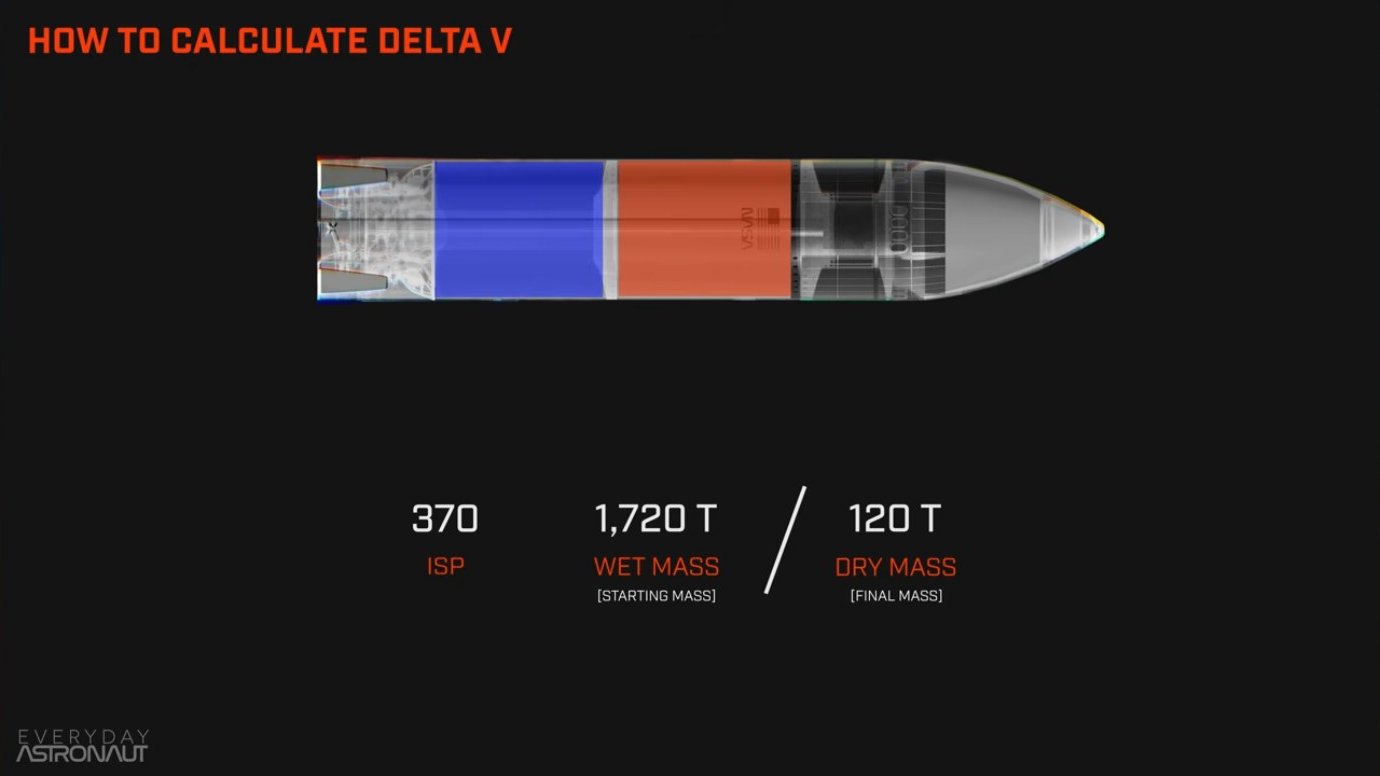
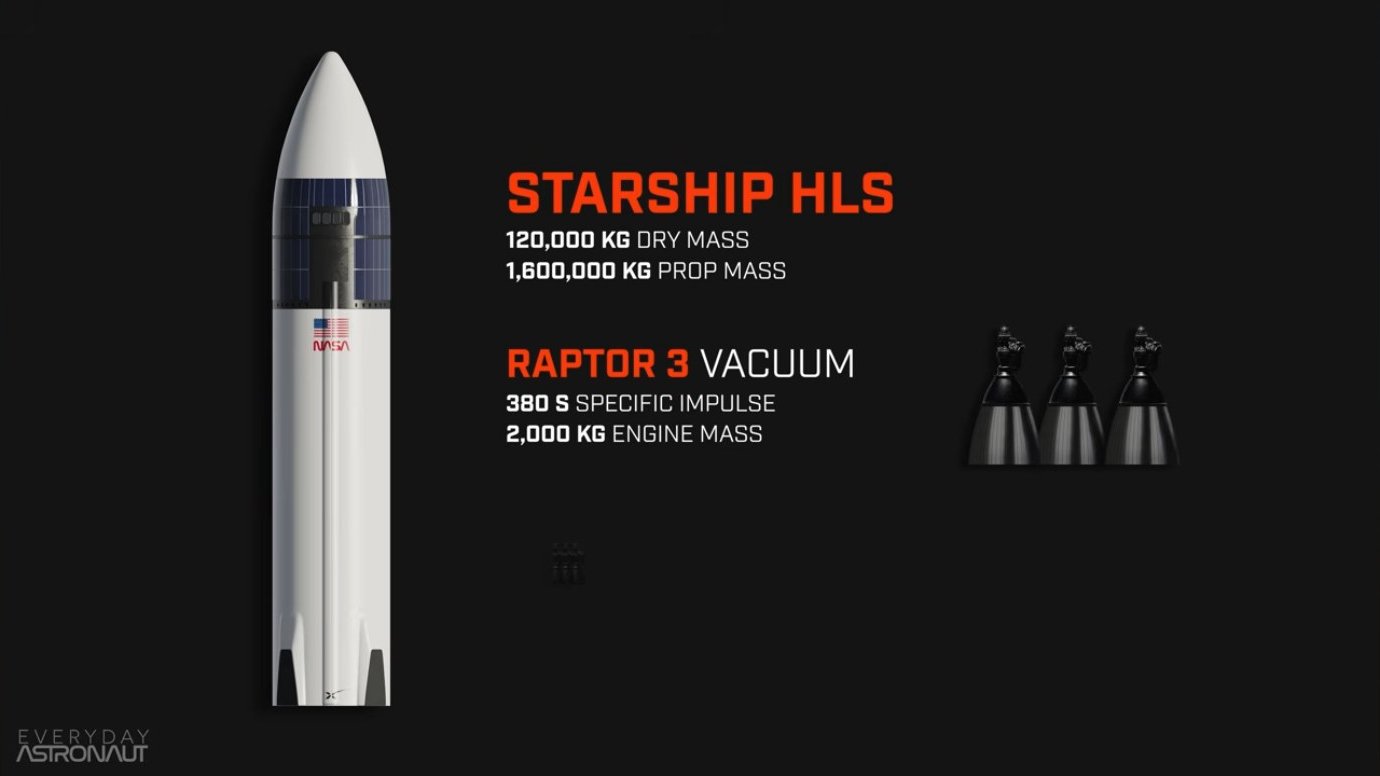
Before we dive deeper, let's establish some baselines. These numbers won't be perfect, but this video is about teaching you how to calculate this stuff and what variables make what impact. The dry mass of HLS is probably somewhere around 120 tons. This is a rough estimate given the amount of hardware necessary for life support, the cabin, landing legs, air locks, those landing thrusters, boiloff mitigation, solar panels, and so on.
Mission Profile Overview
The mission profile involves several key phases. First, HLS must get filled up once it's in low Earth orbit. SpaceX will have to get 1,200 or 1,500 tons—or however much, we'll calculate that later—into low Earth orbit to fill it up. That means with Starship's 100-ton payload capacity, that would be 12 or 15 or more launches of Starship tankers to get enough propellant into a depot that has minimum boiloff.
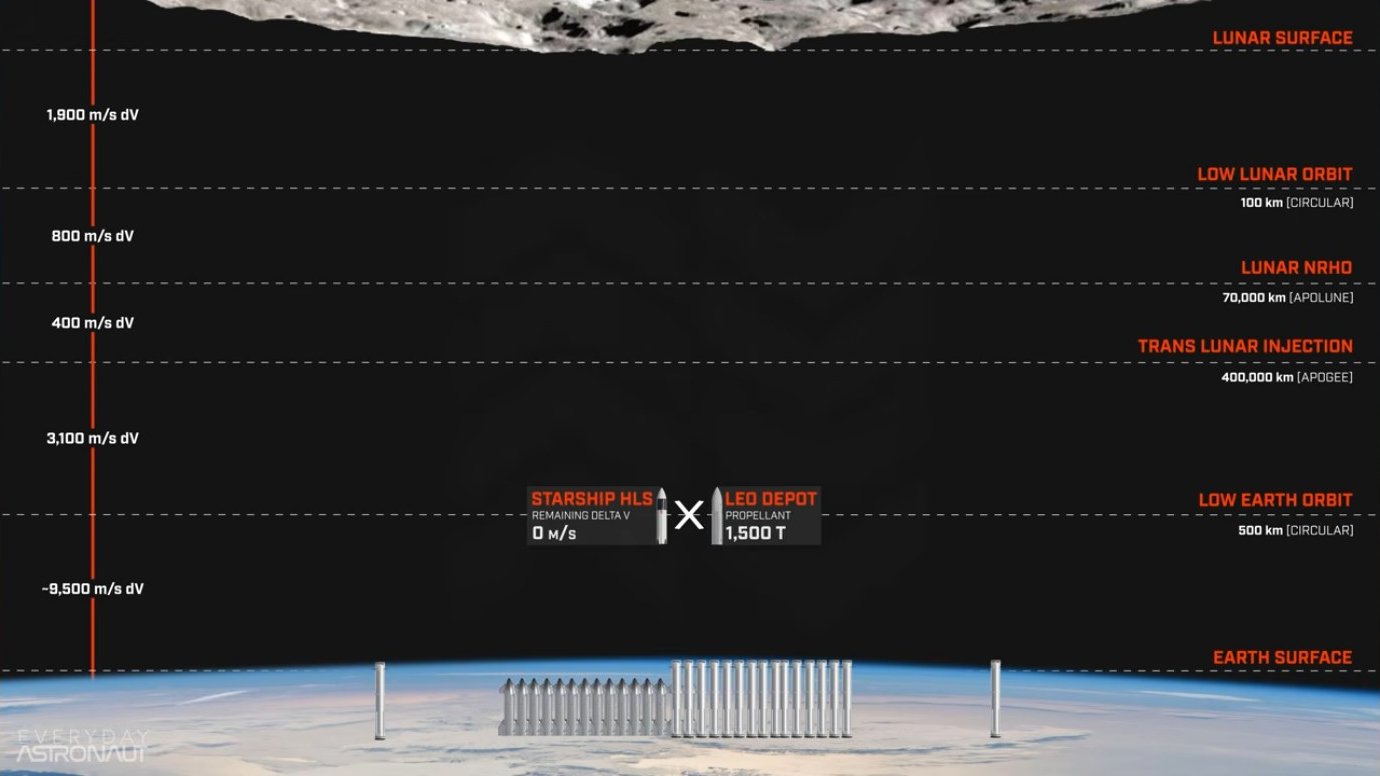
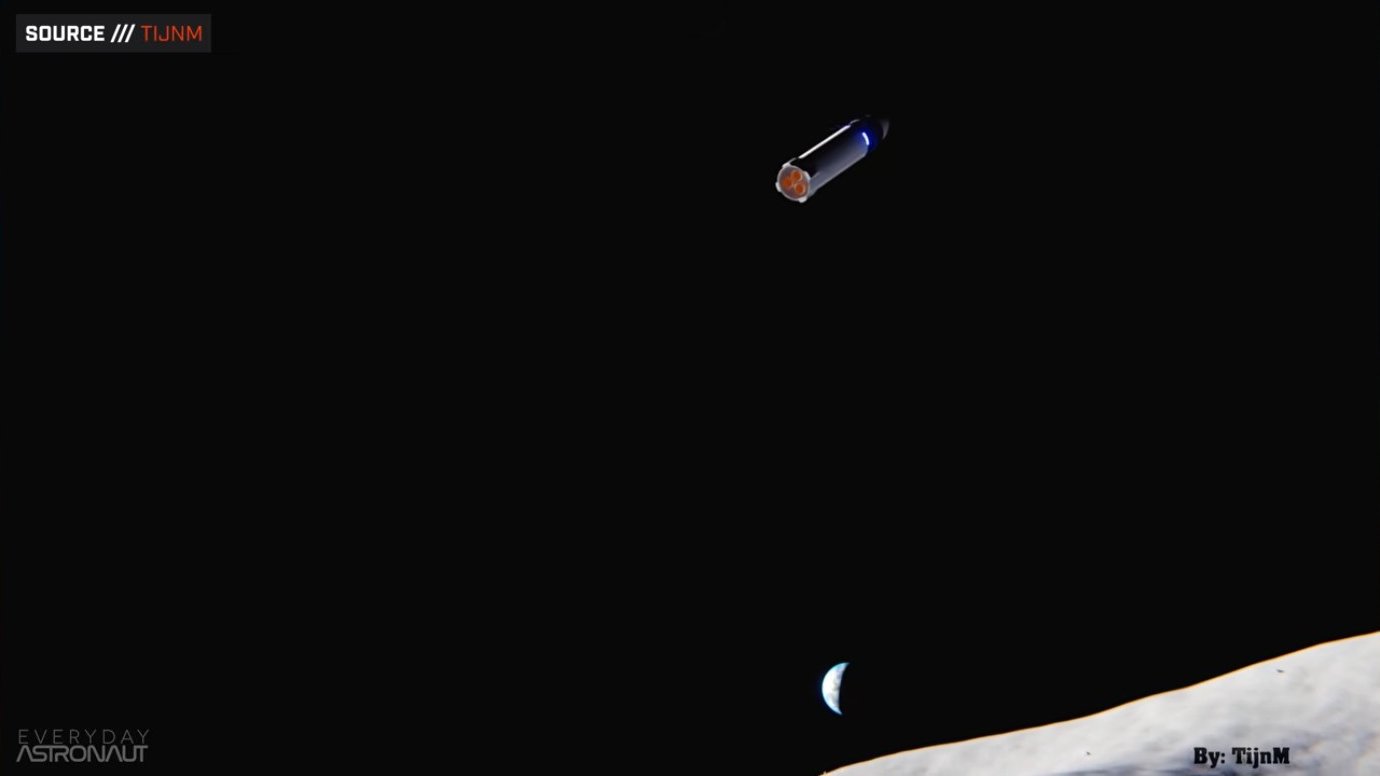
After the trans-lunar injection (TLI), HLS will get into Near Rectilinear Halo Orbit (NRHO) to meet up with Orion. They'll dock in NRHO and then the crew will transfer over into HLS from Orion. Then it will need to lower its orbit from NRHO down to low lunar orbit and then land on the moon. After the surface mission, it has to have enough propellant left over to do the ascent back from the moon up into lunar orbit, then into NRHO so it can meet back up with Orion.
Why So Many Refueling Launches?
You might be asking yourself: why on Earth does it require all these refueling launches when the Apollo program not only launched the lunar lander, but also the command and service module in a single launch? What happened?
HLS is massive. They're trying to land something like 500 tons on the surface of the moon—nearly 100 times the mass of the Apollo lunar lander with 100 times the internal volume. SpaceX is trying to cheat the rocket equation here.
When the Apollo LM landed on the moon, it was only about 7 or 8 tons depending on the mission. So 7 or 8 tons out of a rocket that weighed almost 3,000 tons. That's only about 0.25% of the liftoff mass that actually landed on the moon. And that was despite using super-efficient architecture like separate ascent and descent staging, expending all the hardware including the Saturn V rocket, and lunar rendezvous.
Because Starship HLS is something like 500 tons when it lands on the moon, they're trying to get more like about 8% of the takeoff mass of Starship to the moon. If you were to use the same convention as Saturn V to land a vehicle the size and mass of HLS on the moon, the rocket lifting off from Earth would have to be something more like 200,000 tons—about 67 times more massive.
By reusing hardware, in theory, nothing should be thrown away except for propellant. It's not like each launch is billions of dollars worth of hardware—it should someday just be a few million dollars worth of propellant. Hopefully. At least that's the big eventual bet here.
Challenge #1: The Height Problem
Starship is over 50 meters tall and 9 meters wide—a height-to-width ratio of over 5:1. Compare that to the stout Apollo lunar lander that was actually wider than it was tall. It was 7 meters tall and 9.4 meters wide, more like a 1:1.3 ratio.
Some of us might have recency bias here because of NASA's Commercial Lunar Payload Services (CLPS) program. Two of these three landers have tipped over and only one has landed successfully. So, is Starship doomed to tip over?
We need to keep a few things in mind. If they do self-leveling landing legs, that'll sure help. But we also need to know where the center of mass is. For this, I broke out Kerbal Space Program to demonstrate the landing dynamics.
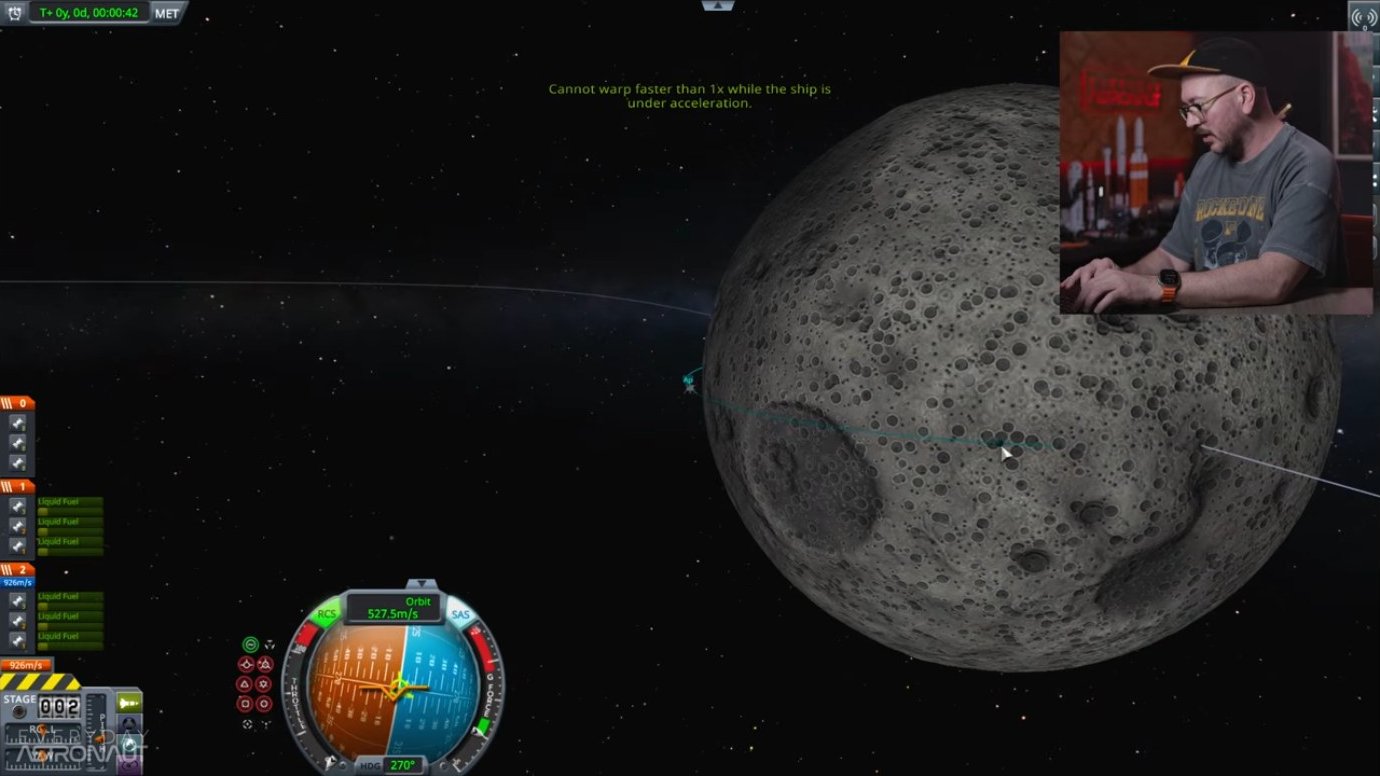
In the simulation, I showed that even landing on quite steep slopes—steeper than anything NASA and SpaceX would actually land on—with self-leveling landing legs, the vehicle can successfully touch down and remain stable. The computer will be able to do an even better job using radar, lidar, cameras, and all the sensors to look for slope and boulders.
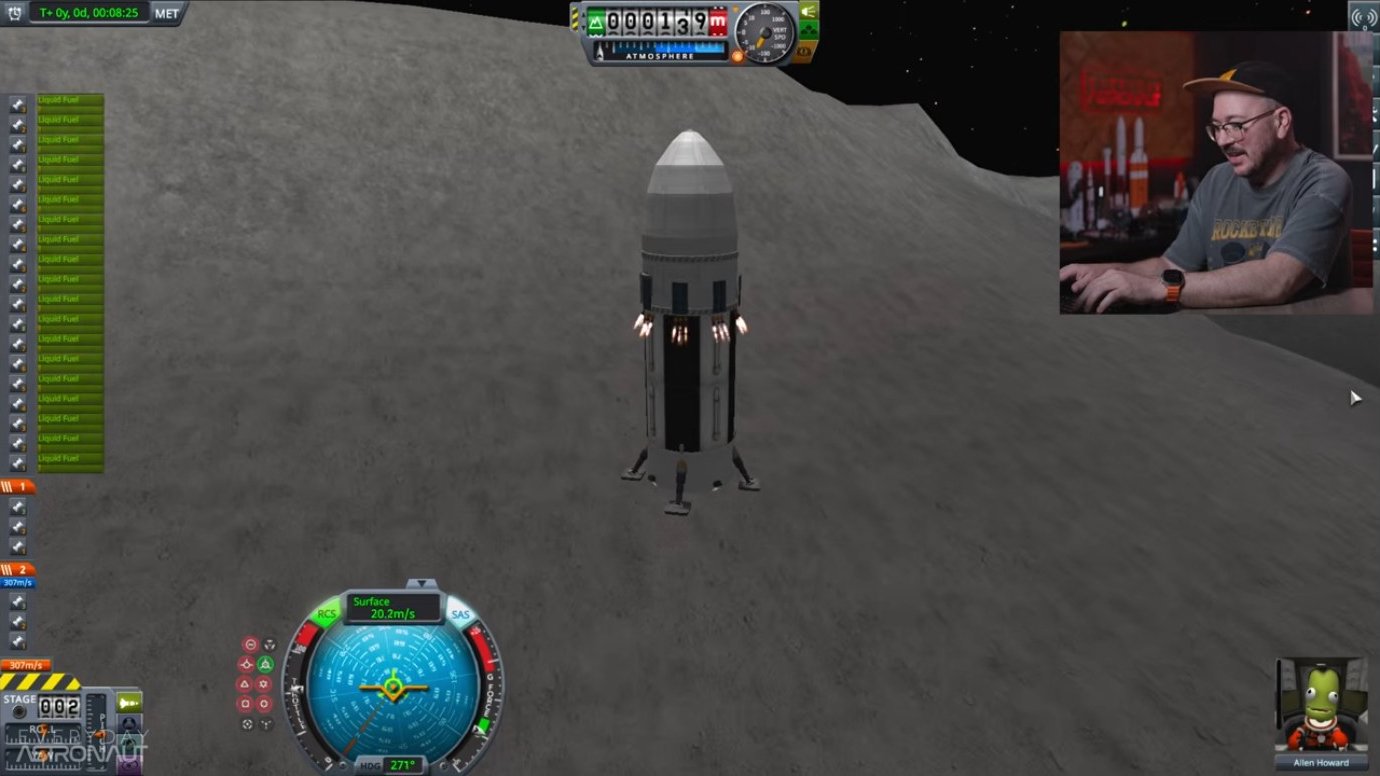
The reality is I'd probably prefer a wider set of landing legs or a shorter HLS. Either would make me feel better. However, let's not forget the Falcon 9. When they were first trying to land, everyone was saying those landing legs were way too small compared to how tall it is. They were never going to be able to land that thing. But now they land like every other day and they don't tip over.
Challenge #2: Landing Thrusters and Ground Effects
Those landing thrusters near the top of the vehicle are there for a very specific purpose. They're way up there to basically prevent creating a giant crater that Starship would have to try and land in, because firing up Raptor engines right above the surface of the moon would definitely be a bad idea.
The Apollo lunar lander only had a little over 45 kilonewtons of thrust at full throttle, and it was closer to half throttle when touching down. A single Raptor engine at minimum throttle still produces about 1,500 kilonewtons of thrust. And don't forget, you'd want to have two of them running to provide roll control. That's over 65 times more thrust than the descent stage at maximum throttle—probably more like 100 times more thrust.
Having landing thrusters near the top helps in a few ways. First, by being high up, the exhaust spreads out over a much greater area, leading to less ground disruption. It's diffused through several chambers in nearly 360° around the vehicle, which helps prevent the exhaust from being localized on one small area.
Challenge #3: The Propellant Problem
Starship uses methalox—liquid methane for fuel and liquid oxygen for oxidizer—which has two problems that make it not a great choice for a lunar lander. First, unlike the Apollo lunar lander and lots of other spacecraft on long-duration deep-space missions, Starship isn't using hypergolic propellants.
Hypergolic propellants spontaneously combust when the fuel and oxidizer come in contact with each other. This makes ignition inside an engine or thruster extremely reliable and simple. As long as both propellants arrive in the combustion chamber at the right time, you will have ignition. Period.
In my opinion, the bigger issue with using methalox is the boiloff. Methalox is a cryogenic propellant, meaning both the fuel and oxidizer are only liquid when stored at extremely cold temperatures. For methane, its boiling point is -161°C. For oxygen, it's -183°C.
When these liquid propellants warm up beyond their boiling point, they turn into gas and expand. Because a rocket is a giant sealed container, when these propellants boil off, you have to vent them out so they don't raise pressure beyond the constraints of the tanks. This means each day you lose some of your propellant to boiloff—propellant that was inside the tank and now just isn't part of what you can use for your mission. This amount is non-trivial. It can be as bad as 1% per day.
So what's the solution? How do we prevent Starship from losing all its propellant to boiloff? The easiest solution is orientation. If you orient the vehicle so its engines are pointing at the sun, you greatly reduce the cross-section exposed to the sun—from about 450 square meters down to only about 64 square meters.
The next easiest solution is insulation. Multi-layer insulation (MLI), like the sun shade of the James Webb Space Telescope, can effectively cut heat flow to just 1%. You can also put solar panels in front of an MLI sun shade to reject heat while capturing electrical energy to power an active cooling system. Combine all these forces and you can literally effectively solve boiloff.
Calculating the Refueling Requirements
Does Starship really require a dozen or more tankers to fill up its HLS for a single moon landing mission? To answer this, we need to crunch some numbers.
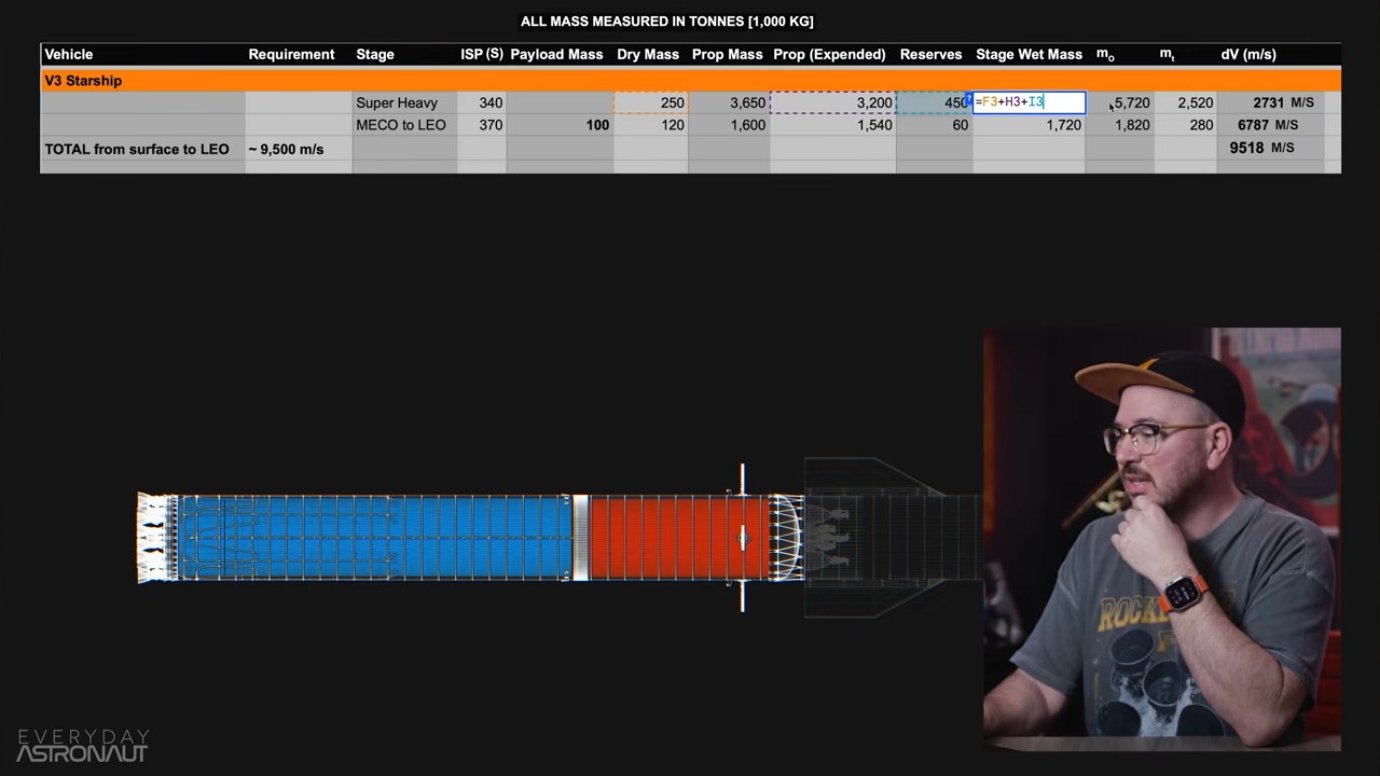
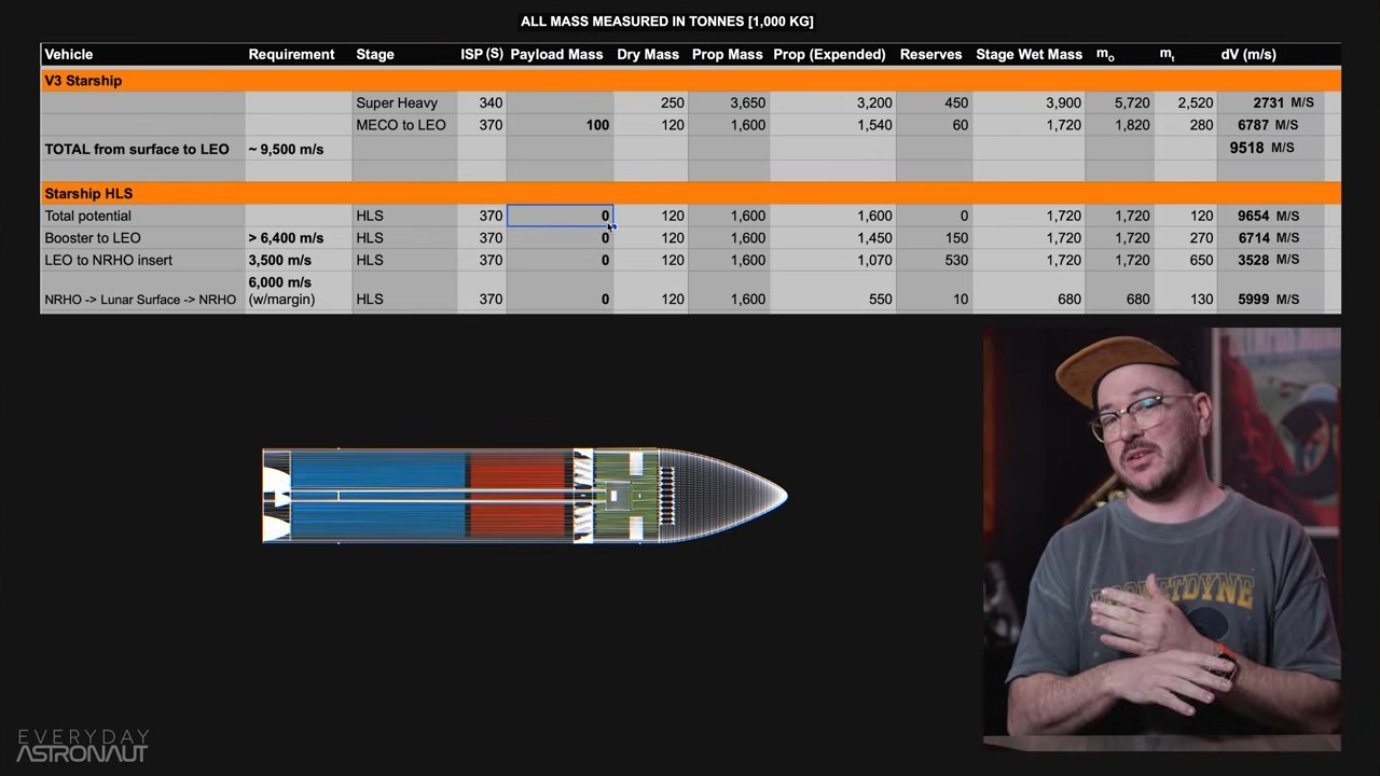
Starting with the full-stack Starship and Super Heavy booster, we need about 9,500 meters per second of delta-V to get from Earth's surface into low Earth orbit. The booster can provide about 2,700 m/s of that, which means Starship has to provide about 6,800 m/s—and that becomes our big target number.
If we assume HLS has a dry mass of roughly 120 tons, propellant mass of about 1,600 tons, and leaves 60 tons for reserves (for deorbit and landing burns), that means it'll expend 1,540 tons of propellant. With a 100-ton payload capacity, that gives us a starting mass of 1,820 tons and an ending mass of 280 tons—achieving the required 6,787 m/s.
If we top it all the way back off to 1,600 tons in LEO and then do the trans-lunar injection and NRHO insertion burn (about 3,500 m/s total), we'll burn about 1,070 tons and end up in NRHO with 530 tons of propellant left over.
Technically, that would almost be enough to go from NRHO down to the surface and back to NRHO on that first mission. You really only need about 5,400 m/s to do that. But when you factor in boiloff, go-around opportunities, rendezvous and docking, and all the other margins you want baked in, we're going to aim for 6,000 m/s—which requires about 555 tons of propellant.
Options to Reduce Refueling Trips
Is there really nothing SpaceX can do to cut that number down? Actually, there are a few ways we could do this, and some are easier and less painful than others.
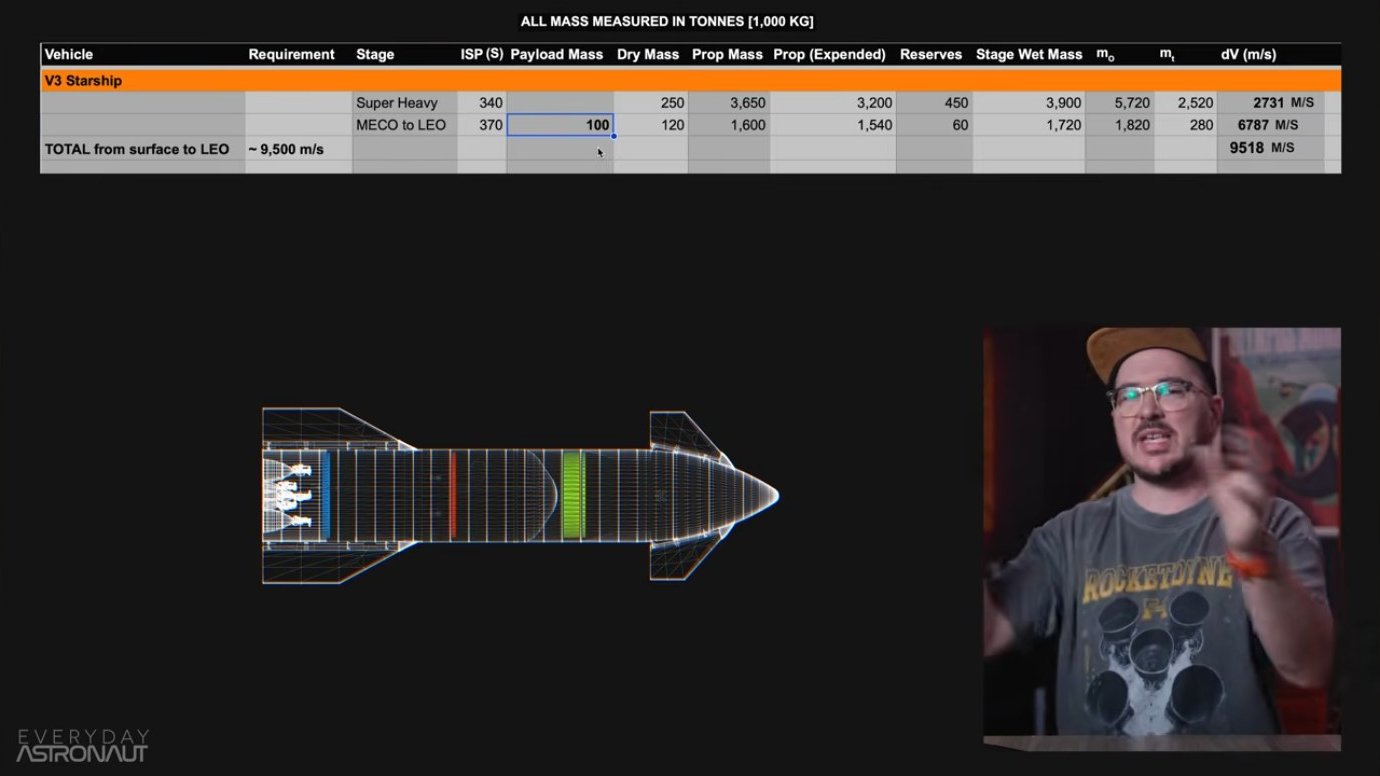
Perhaps the first and easiest thing SpaceX could do would be to simply expend a few upper stages for refueling. By expending Starship, you can basically double the payload capacity by reducing the dry mass and using up any propellant margin saved for landing. Obviously not ideal, but it would be a solution if launch cadence is the limiting factor.
The next easiest thing would be to wait until Starship matures and can take something more like 150 or 200 tons of propellant per launch with future upgrades. When this will happen, no one knows—it'll be version 4 or later. But I do think it's inevitable that someday Starship will carry more than 200 tons to LEO.
But can't we make modifications to Starship HLS to make it simpler or smaller? I explored several options: a staged stubby that ditches Raptor engines after TLI, a drop-tank version with extra tankage on top of the crew cabin, and a stubby-from-the-start design that's optimized from day one.
The drop-tank option is particularly interesting. It would ditch about 35 tons of hardware after the trans-lunar injection while keeping the full 370 seconds of specific impulse from the Raptor engines. This configuration only needs about 425 tons of propellant for the NRHO-to-surface-and-back mission, and crucially, it would have enough propellant on the very first mission to complete the entire landing without refueling at the moon.
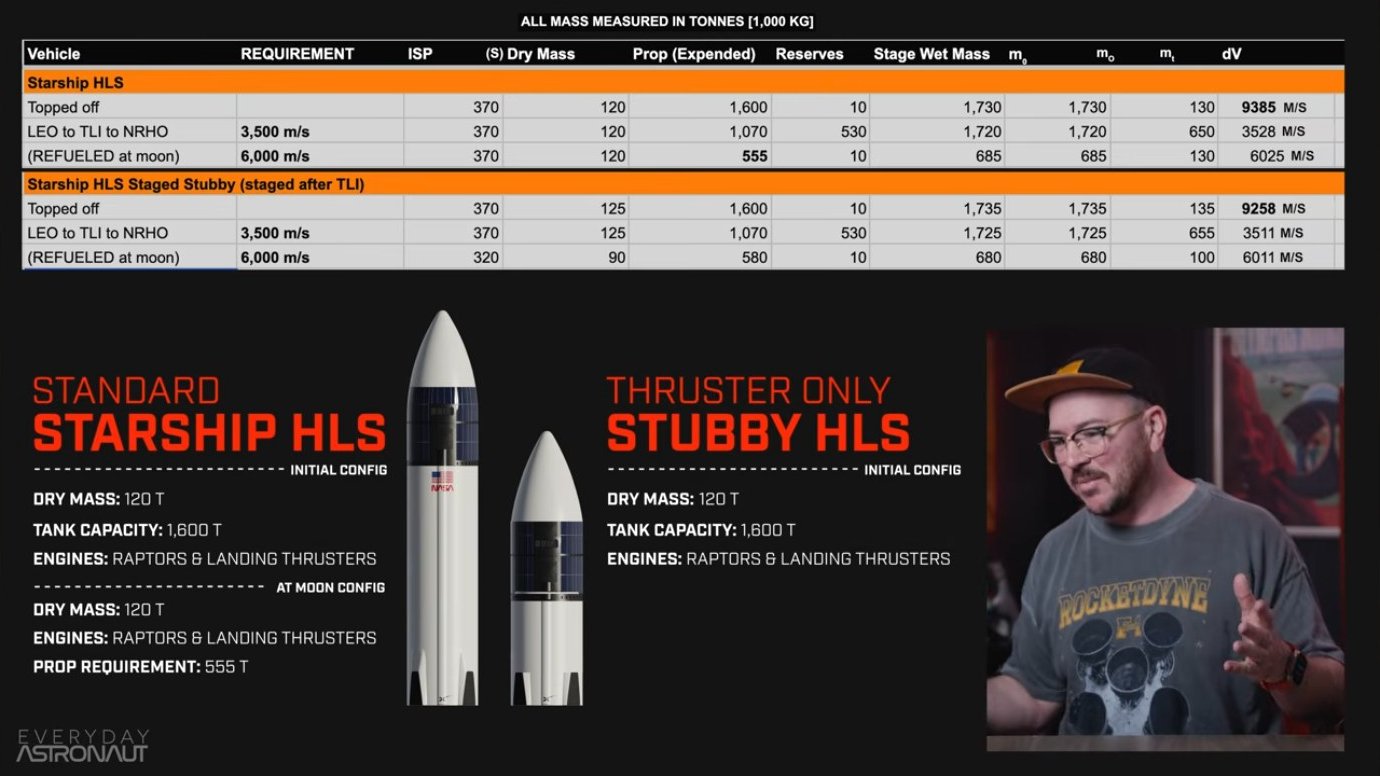
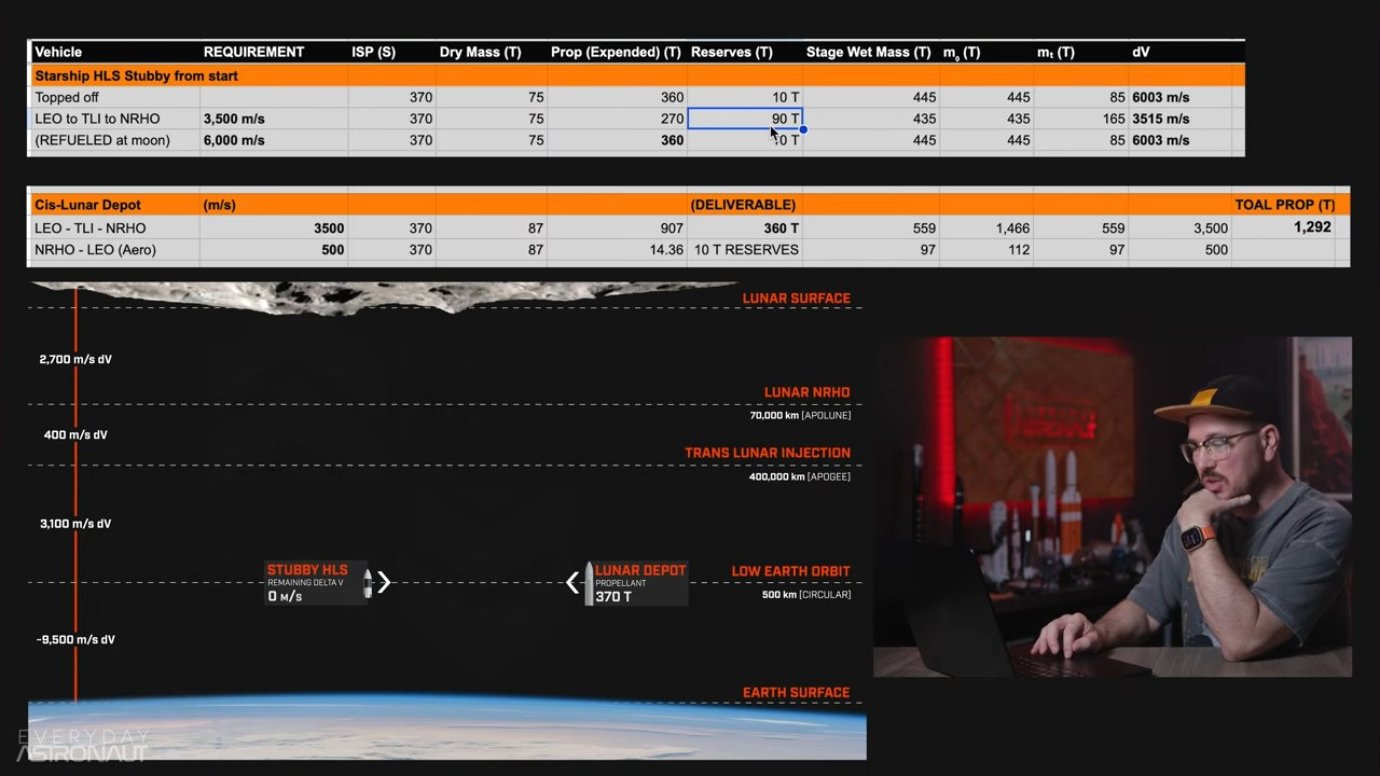
The stubby-from-the-start design is even more interesting. If we build it with only enough tank capacity for the biggest burn (the LEO insertion), we can drop the dry mass to about 85 tons. The magic number here: it only needs about 400 tons to top it back off for each subsequent mission. However, it does require refueling at the moon on the very first mission, which is a significant operational complexity.
The Cis-Lunar Depot Challenge
For subsequent missions, we need to figure out how much propellant to get into a cis-lunar depot while it's in low Earth orbit, so it can deliver enough propellant out to the moon to refill these Starship variants.
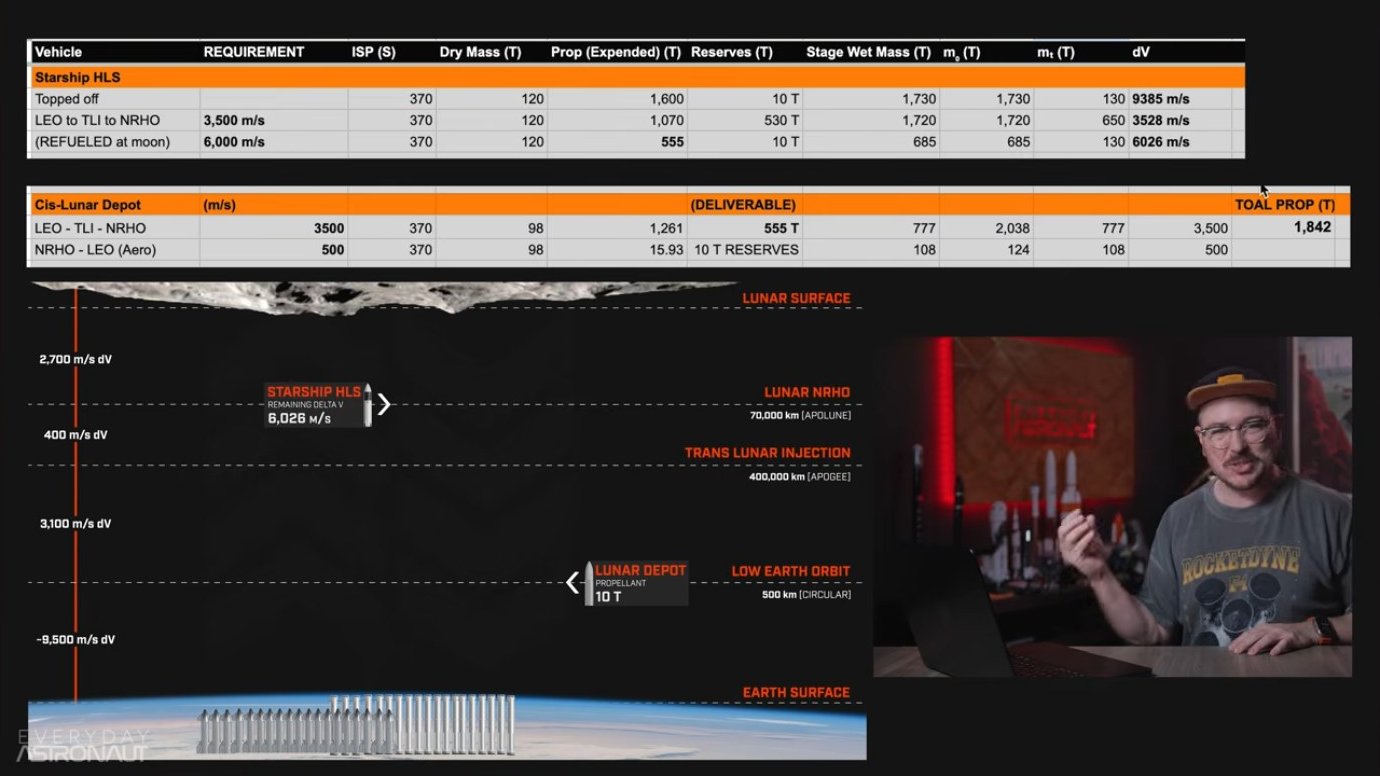
Starting with the standard Starship that needs 555 tons delivered to NRHO: the depot would need 1,842 tons of propellant to accomplish this. That's 18 or more of those 100-ton tanker launches just to do each subsequent mission—actually more than the initial mission!
The drop-tank version requiring 425 tons gets us down to about 1,475 tons (less than 15 tankers). The optimized stubby requiring 360 tons still needs 1,292 tons (almost 13 tankers). But here's the catch: on that first mission, the stubby still needs to be refilled at the moon, requiring almost 1,000 tons in the cis-lunar depot—so it's almost as many total tankers as the standard Starship.
Targeting Low Lunar Orbit Instead
What happens if we change which lunar orbit we target? Instead of NRHO, what if we just targeted low lunar orbit? This could be a later possibility when either we're no longer using Orion or if Orion has a different ride capable of getting it down to LLO.
Now the lander only needs roughly 4,500 m/s of delta-V for each mission from low lunar orbit down to the surface and back (with margin baked in). While we do require more delta-V for the lunar orbital insertion burn (900 m/s versus 400 m/s for NRHO), in total we would save roughly 200 m/s due to complicated orbital mechanics.
With low lunar orbit targeting, the standard Starship only needs about 325 tons for each subsequent mission. The drop-tank version needs 250 tons, and the optimized stubby needs only 210 tons. That's about 40% less propellant—a substantial and noticeable change.
However, the depot now has to do more work—it has to get into low lunar orbit (requiring a bigger burn) and then do a bigger trans-Earth injection. It's kind of picking up the slack. For the standard Starship, this brings the cis-lunar depot requirement down to 1,471 tons (down from 1,842). The drop-tank version needs 1,220 tons.
The Game-Changer: Lunar Oxygen Production
There's actually one more thing we could do to reduce the number of refilling trips for each subsequent mission: just take methane on the cis-lunar depots. That's it. Don't even worry about taking oxygen out to the moon from Earth.
Now, this might be one of the more far-fetched futuristic things we're going to talk about, but you can actually get oxygen from the moon. It's not even that sci-fi or unrealistic. There's a huge amount of oxygen on the moon, but it's trapped in the regolith and in subsurface ice.
Extracting from regolith requires a large amount of energy, but it's doable. Extracting from subsurface ice is less energy-intense—it basically requires melting the ice, purifying the water, and electrolyzing it. Then you just capture the oxygen and cool it down to recondense it back to a liquid.
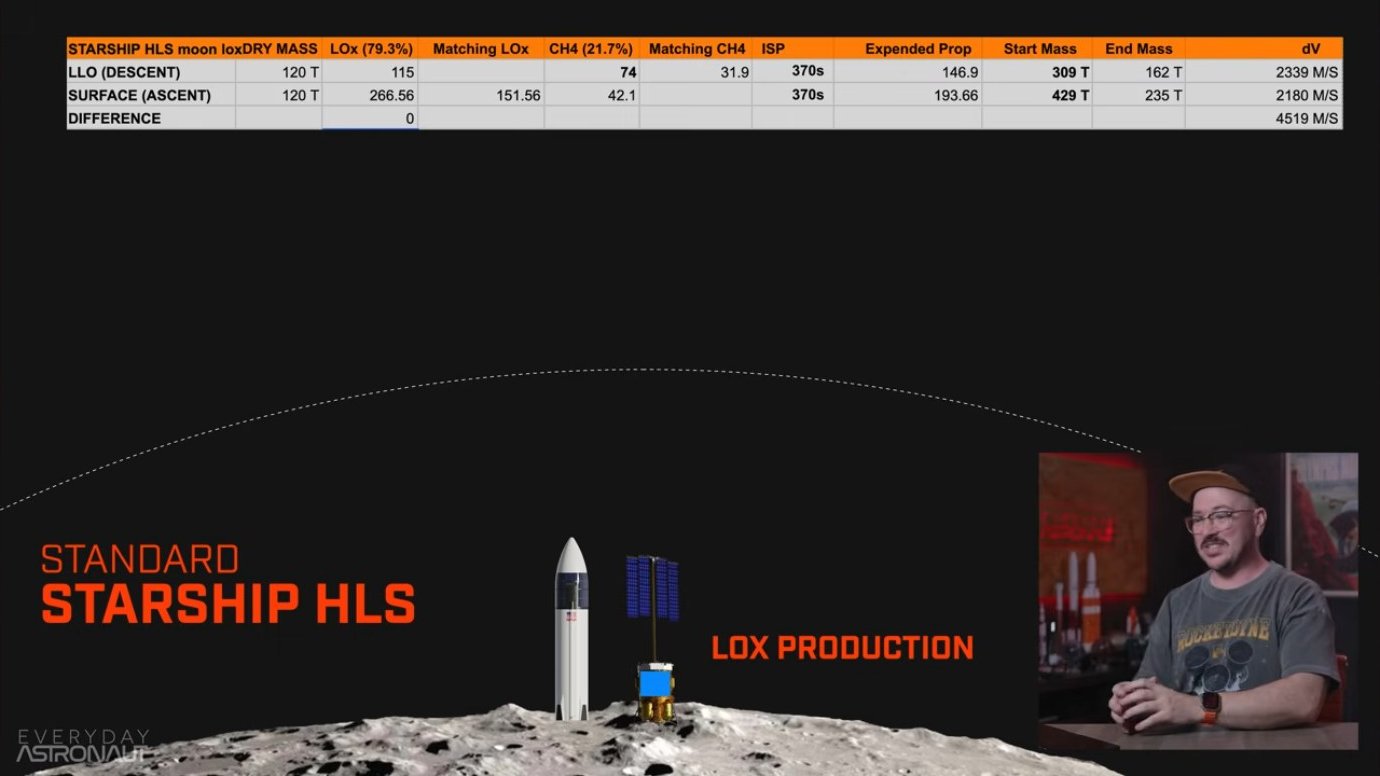
If we don't have to take oxygen to the moon, we can greatly reduce the mass needed to be delivered. The standard Starship would need only 74 tons of methane delivered to low lunar orbit. For descent, you'd burn 31.9 tons of methane with 115 tons of oxygen (at the 3.6:1 ratio). Then on the moon, you'd fill up with 266.56 tons of liquid oxygen to burn off the remaining 42.1 tons of methane for ascent.
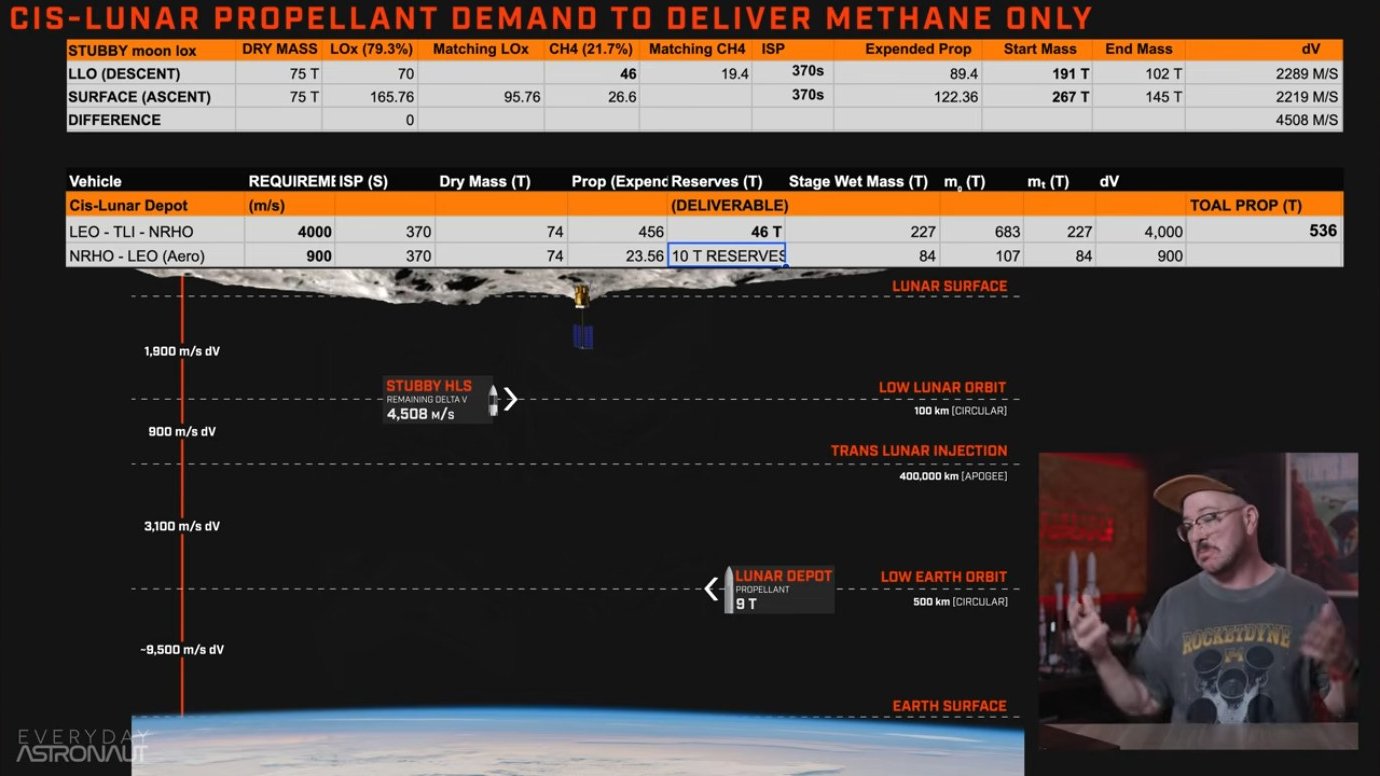
With this architecture, delivering just 74 tons of methane to the moon requires only 630 tons of propellant in the cis-lunar depot. That's down to maybe only six launches if it's version 3, or potentially just four launches if it's a future version 4. Even the standard Starship in this case only needs a little over 600 tons—not bad at all.
Our worst-case scenario was up to 1,842 tons of propellant needed for the cis-lunar depot. We could probably get that down to about 630 tons for the standard Starship with lunar oxygen production. That's our absolute best-case far-future example.
The Propellant Supply Challenge
If we're potentially needing to launch five or ten or twelve or maybe even over eighteen fully-fueled Starship rockets, do we even have the propellant capacity to keep up with all that demand here on Earth?
With Starship requiring almost 6,000 tons of propellant per launch, you need an absurd amount of trucks delivering all that propellant to the launch site. In total, we're talking about something like 250 trucks for liquid oxygen, nearly 100 trucks of liquid methane, and over 150 trucks of liquid nitrogen per launch. That's over 500 trucks per launch—and that's only for version 3.
SpaceX is already consuming a very large portion of the available liquid oxygen in the southern half of the United States—and that's just for Falcon 9. Once Starship starts flying regularly, won't they quickly hit a bottleneck? The answer is yes. Right now, with the systems in place at the moment, 100% yes.
Beyond that, there are already companies building new ASUs near the launch sites at Brownsville, near McGregor, and out at the Cape. There's even an environmental document mentioning building on-site propellant generation capability that would include both liquid oxygen and liquid methane right there at the Cape. There's also been talk about bringing methane in directly on a pipeline.
Despite this being a massive demand on a scale no one's ever remotely seen before, they're at least working on it. By the time HLS is flying, hopefully they have some of these on-site productions online to help keep up with the thirsty demand of this beast.
Comparison with Apollo
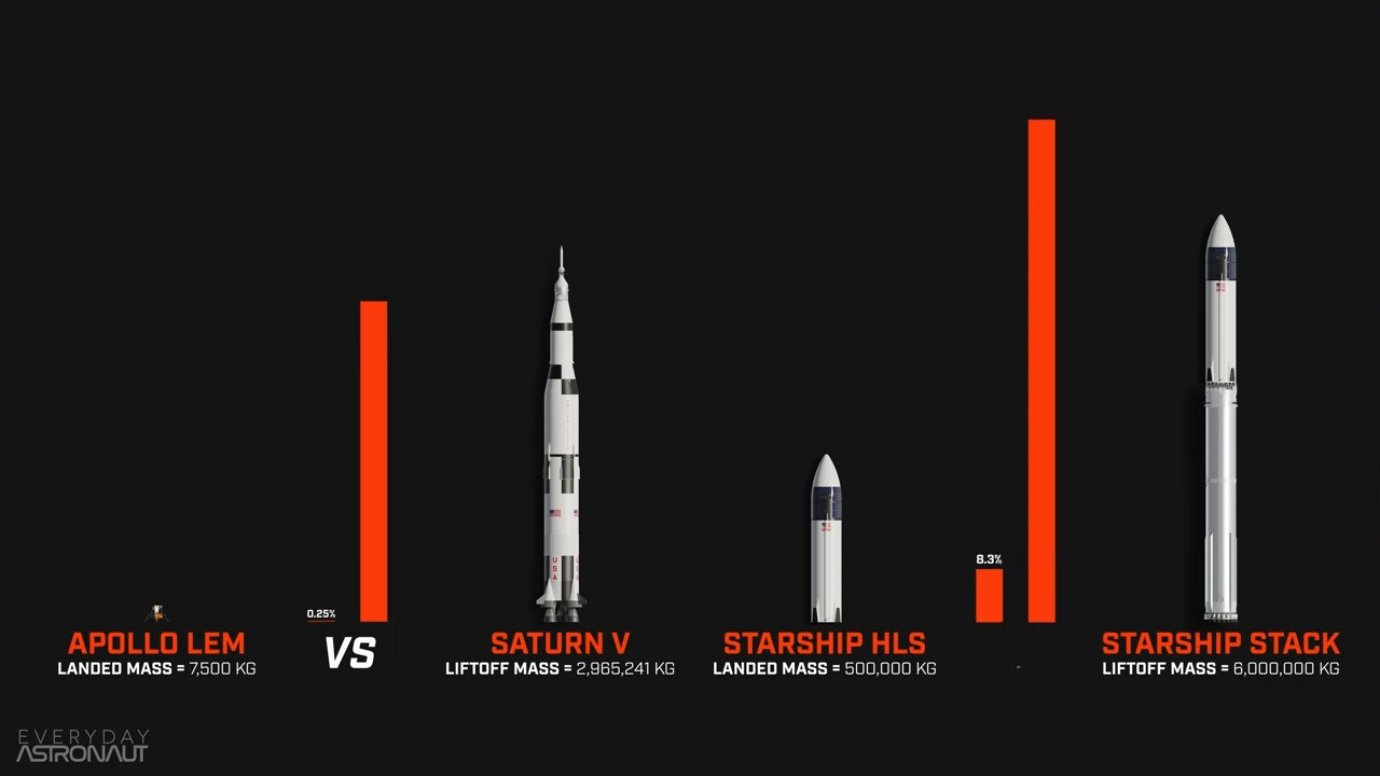
Let's put this all in perspective. When the Apollo Lunar Module landed on the moon, it was only about 7 or 8 tons out of a rocket that weighed almost 3,000 tons. That's only about 0.25% of the liftoff mass. And that was despite using super-efficient architecture like separate ascent and descent staging, expending all the hardware including the Saturn V rocket, and using lunar rendezvous.
Because Starship HLS is something like 500 tons when it lands on the moon, they're trying to get more like 8% of the takeoff mass to the moon. If you used the same architecture as Saturn V to land a vehicle this size, the rocket would have to be about 200,000 tons—67 times more massive than Saturn V.
Summary and Final Thoughts
So to summarize: Starship is ridiculously tall, and to not tip over on the moon, SpaceX is going to have to rely on self-leveling landing legs. They could also lower the height with some shorter vehicle options that I personally would love to see.
SpaceX is continuing to use methalox as their propellant of choice despite it not being hypergolic and despite it being cryogenic and prone to boiling off. They can and will need to address these issues, neither of which are physically impossible.
And the dozens of refueling tankers? Yep, that's going to have to work with this current plan. Are there ways to reduce that number? Yes—by expending hardware and shrinking the vehicle. Will SpaceX do that? If things work out how they want to, no.
Eventually, there could be ways to reduce the number of launches by harvesting oxygen from the moon and by targeting low lunar orbit, skipping over NRHO completely. This could help reduce the number of full-stack launches here on Earth—maybe a long ways in the future, but it would hopefully get better instead of worse.
Is Starship HLS even feasible? Technically, yes. Is it the easiest solution for a lunar lander? Absolutely not. However, by keeping it based on the full Starship design, they're greatly reducing the engineering workload. In some ways, they're actually simplifying it. They're trading engineering a new vehicle with bespoke engines and propellant and unique structures for refilling tankers and more launches.
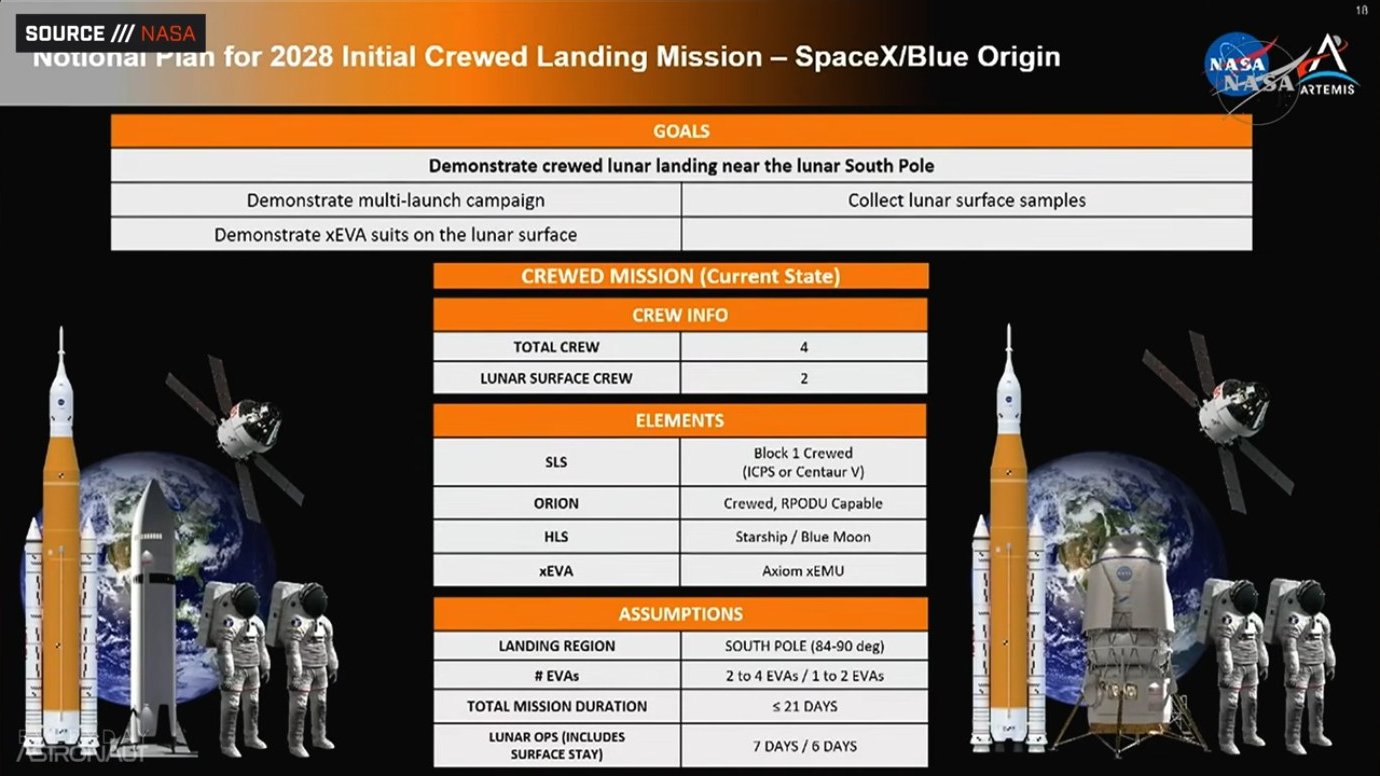
"We've also heard that simplifying the mission requirements for this initial mission while maintaining their long-term capability is also a strong desire. We want to simplify, but we also want to make sure we're building towards the future. It's important to assure that whatever architecture we're using for Artemis 4 feeds forward to what's going to be needed in the future."
To SpaceX, I think if the solution is either engineer an entire new system or just fly a few more tankers, they'll choose to fly a few more tankers every single time.
As I'm sitting here right now, this all sounds impossible. It sounds like the much harder option. And personally, having watched many Starship prototypes blow up with my own eyeballs, it feels like a terrible idea.
But let's flip this around. What happens when they do get Starship to orbit? When they do land both the booster and the ship? When they do reuse them, and when they do dock two of them together and transfer propellant? And then when they do that again and again?
Why would you do it any other way if you have the option to just refuel in orbit and launch absolutely absurdly massive and capable vehicles to the moon? And why waste the resources to build a system that you'd be eager to replace, that could basically immediately after the first or second launch become completely obsolete?
I do wish that NASA and more specifically SpaceX had aimed at a smaller size and target in the very first place to ensure that humans get to the moon sooner rather than later. But then again, within a few landings, everyone would just be anxious to move on to a sustainable and larger architecture. And all that time, money, and development would be for naught.
Imagine if we just rebuilt the Apollo lunar lander. Everyone would be yelling, 'Wait, it's been over 50 years later and this is still the best we can do?' We need to be aiming big.
That's what SpaceX is aiming for. But will this really be a thing by 2028? I mean, who knows? Probably not. Because in my opinion, Starship landing on the moon by 2030 is still quite ambitious.
Key takeaways
- → Starship HLS requires 12-18+ tanker launches to fill up in LEO for its first mission, primarily because it expends about 1,450 tons of propellant just getting itself into orbit
- → Self-leveling landing legs and high-mounted landing thrusters are essential to prevent the 50-meter-tall vehicle from tipping over and avoid creating a crater on the lunar surface
- → Methalox propellant presents challenges with boiloff and ignition, but these can be mitigated through multi-layer insulation, orientation, active cooling, and extensive testing
- → Targeting low lunar orbit instead of NRHO could reduce propellant requirements by roughly 40%, though it shifts more work onto the depot vehicle
- → Producing oxygen on the moon could be the game-changer, potentially reducing cis-lunar depot requirements from 1,842 tons down to just 630 tons per mission
- → The full-size Starship HLS trades engineering complexity for operational complexity—it requires more launches but avoids developing an entirely new vehicle
- → Once orbital refueling is proven, the architecture becomes increasingly practical as reusability means only propellant costs are incurred per launch
- → Shorter stubby variants look promising on paper but often require refueling at the moon on the first mission, adding operational complexity without necessarily reducing total launches