Annotated transcription · 12 min read
Building Ultra-Lightweight Delivery Drones: The Engineering Behind 10₹/km Logistics
How advanced composite manufacturing and fixed-wing VTOL design are making affordable drone delivery a reality in India.
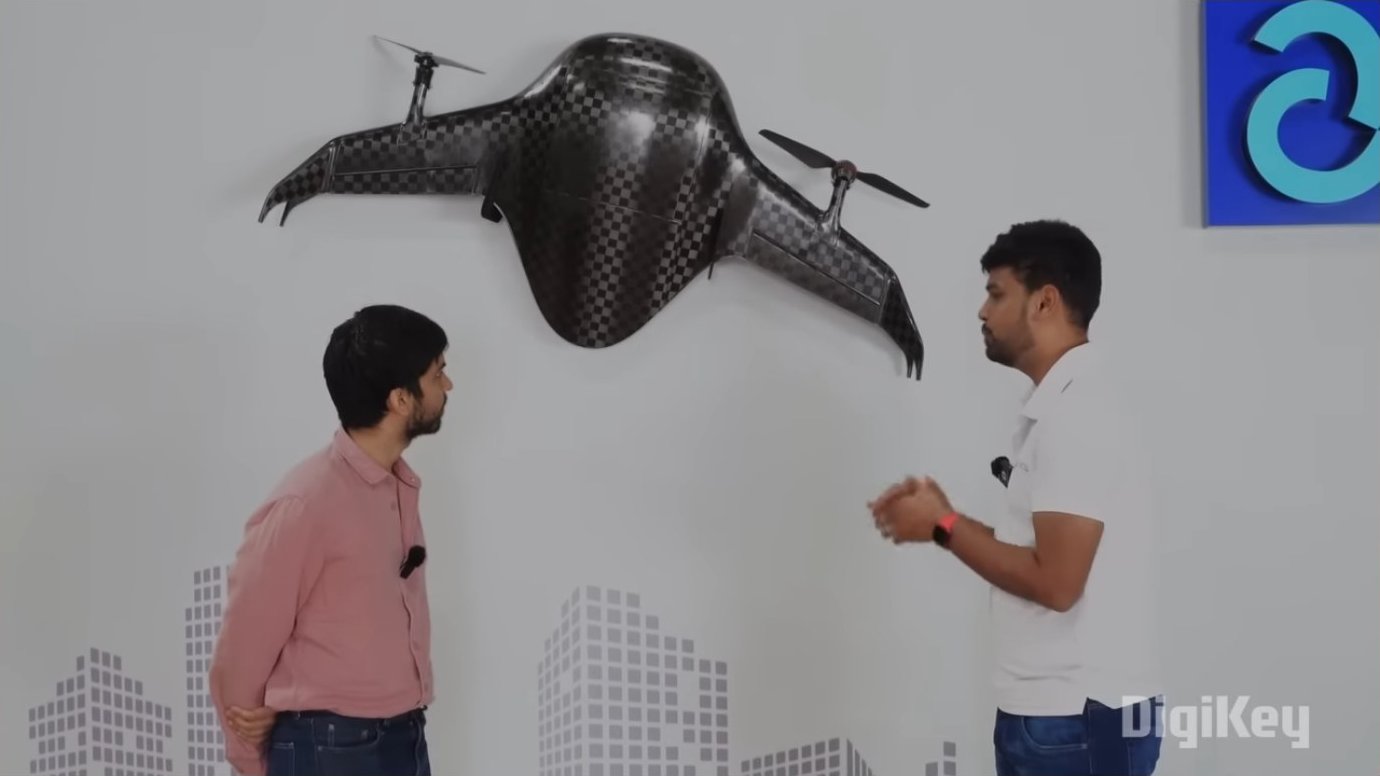
Rethinking the Drone: Fixed-Wing VTOL vs. Multicopters
When most people imagine a drone, they picture a quadcopter hovering overhead with four spinning rotors. But the aerial vehicle sector is actually split into two fundamentally different categories that operate on entirely separate principles. The distinction is similar to comparing bicycles and motorcycles — both have two wheels, yet drawing industry conclusions by lumping them together would be misleading.
The first category consists of multicopters: quadcopters, agricultural sprayers, camera drones, and toys. The second encompasses fixed-wing aircraft — machines that resemble miniature airplanes more than traditional drones because they rely on the same aerodynamic principles that make full-scale aircraft fly. Fixed-wing drones generate lift through forward motion over wing surfaces, achieving dramatically different performance characteristics than their multicopter cousins.
The critical innovation bridging these two worlds is VTOL — vertical takeoff and landing. A VTOL fixed-wing aircraft launches vertically like a rocket, rotates in midair, then transitions to efficient forward flight. After completing its mission, it reverses the process to land. This eliminates the runway requirement of conventional planes while preserving the efficiency advantages of wing-borne flight. The result is an aircraft capable of operating from confined spaces yet covering distances that would drain a multicopter's battery in minutes.
Performance Through Extreme Weight Reduction
The key to unlocking affordable drone delivery lies in a single principle: moving less mass requires less energy. Current delivery drones designed for one-kilogram payloads often weigh five to ten kilograms or more. This weight penalty translates directly into energy consumption, operating cost, and ultimately the price per delivery. Breaking this pattern demands rethinking aircraft construction from first principles.
Consider a delivery drone that carries one kilogram of cargo but weighs only 1.5 kilograms fully loaded. The airframe itself — everything visible except motors and propellers — accounts for just 350 grams, roughly the mass of a smartphone. Achieving this requires moving beyond conventional manufacturing approaches and embracing advanced composite structures designed specifically for the unique properties of carbon fiber and aramid fabrics.
Comparing this to ground transportation illuminates the economics. An electric scooter moving a person costs approximately 1.5–2 rupees per kilometer in energy and amortization. That scooter is transporting roughly 150 kilograms of combined rider and vehicle mass. Reducing the mass by a factor of thirty — from 150 kg to 5 kg — cuts energy costs by a factor of twenty. For small-package delivery, the physics simply favors aircraft purpose-built for the task over repurposed ground vehicles or oversized drones.
Carbon Fiber and Sandwich Structures
Carbon fiber has been used in aerospace for decades, yet most drone manufacturers treat it as a drop-in replacement for aluminum or plastic rather than a material with fundamentally different characteristics. Carbon fiber is woven cloth, not metal. The manufacturing processes that work for metals — machining, stamping, welding — don't translate. But carbon's fabric nature enables structural approaches impossible with rigid materials.
The parallel to steel is instructive. Humanity discovered iron smelting around 4,000 years ago, but advanced metal manufacturing only emerged during the Industrial Revolution two centuries ago. Carbon fiber composites are on a similar trajectory: the material exists and sees niche application, but scalable processes optimized for its properties remain underdeveloped. Building those processes from scratch — rather than adapting metal-working techniques — is what allows dramatic improvements in strength-to-weight ratio.
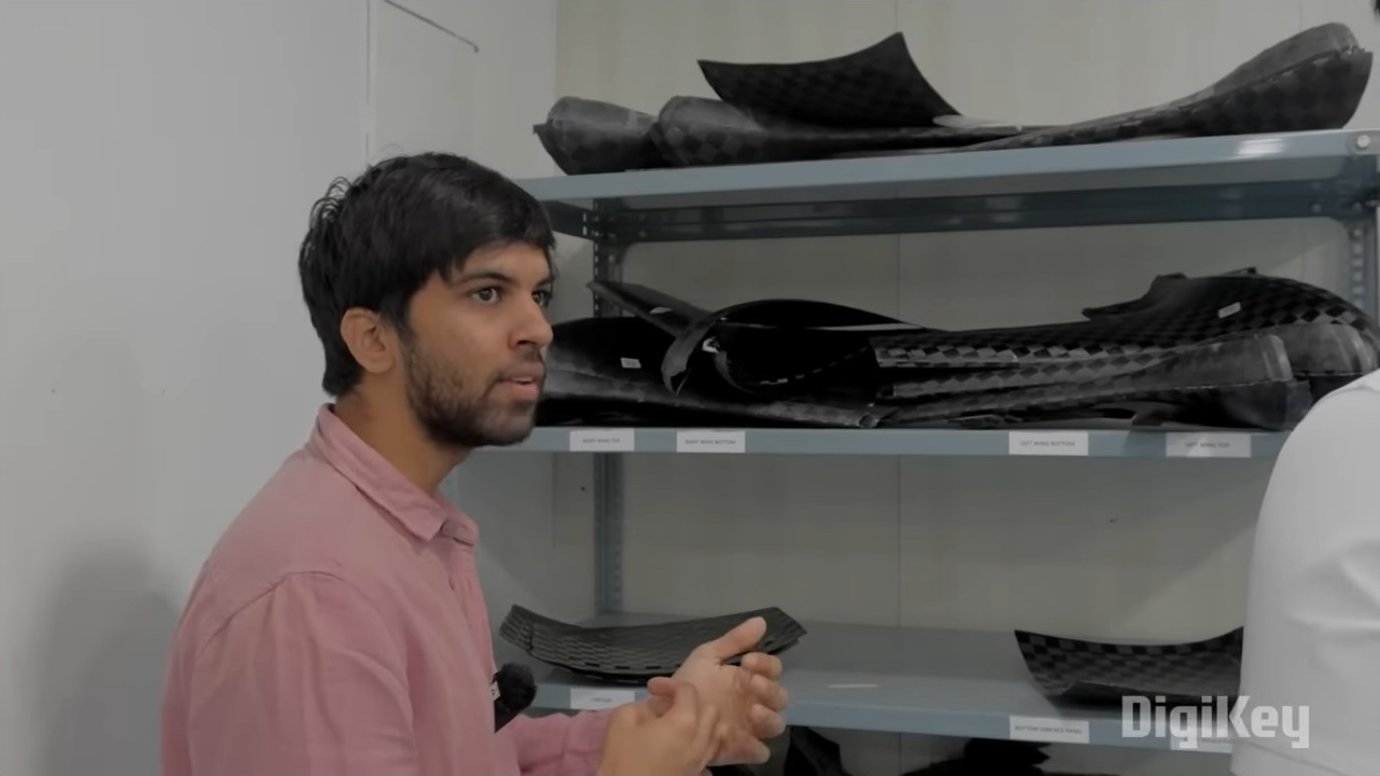
A sandwich structure exemplifies this thinking. Rather than stacking multiple carbon fiber layers, engineers place a lightweight foam core between two thin carbon skins. The foam maintains separation between the load-bearing skins while adding minimal mass, dramatically increasing bending stiffness for a given weight. It's the same principle that makes an I-beam more rigid than a solid bar of equivalent mass. Applying this concept to every structural element — wings, fuselage, control surfaces — compounds the weight savings across the entire aircraft.
Material selection extends beyond carbon alone. Radio-transparent sections like nose cones use aramid fiber (Kevlar) instead, allowing GPS signals to penetrate while maintaining structural integrity. Kevlar also simplifies laser cutting for complex internal frames where carbon's conductivity would interfere with the process. The result is a composite airframe where every material choice serves a specific function rather than defaulting to a single substance for all applications.
Manufacturing: Molds, Vacuum Bags, and Precision Layup
Composite manufacturing begins with creating molds for each part. Because left and right wing halves are mirror images, they require separate molds — four distinct tools just for the wings. Upper and lower surfaces need their own molds as well. This tooling investment is substantial but necessary for producing repeatable, high-quality structures. The molds themselves are often composite, built using the same processes they enable.
The layup process involves cutting fabric to pattern, then arranging layers in the mold according to the designed laminate schedule. For a sandwich panel, the sequence typically runs: carbon fiber skin, foam core, carbon fiber skin. Each fabric layer is pre-impregnated with resin or wet out during layup. Once the stack is complete, a vacuum bagging film seals the mold. Drawing vacuum applies atmospheric pressure — roughly one ton per square meter — consolidating the layers and driving out entrapped air.

Curing transforms the wet layup into a rigid structure. Depending on the resin system, this may occur at room temperature or require elevated temperature in an oven or autoclave. Heat accelerates the chemical crosslinking that hardens the resin matrix, bonding the fibers into a monolithic laminate. After curing and demolding, parts undergo trimming, drilling, and surface finishing before assembly. An aircraft comprises roughly eighteen distinct composite parts, each progressing through this sequence.
Quality control is critical because composite defects can be invisible. A poorly consolidated region or contaminated bond surface may show no external sign yet compromise structural strength. Process discipline — clean molds, proper resin mixing, correct vacuum levels, verified cure cycles — prevents these failure modes. As production scales, this discipline must scale with it, which drives investment in fixturing, tooling, and operator training.
Electronics Architecture and Component Selection
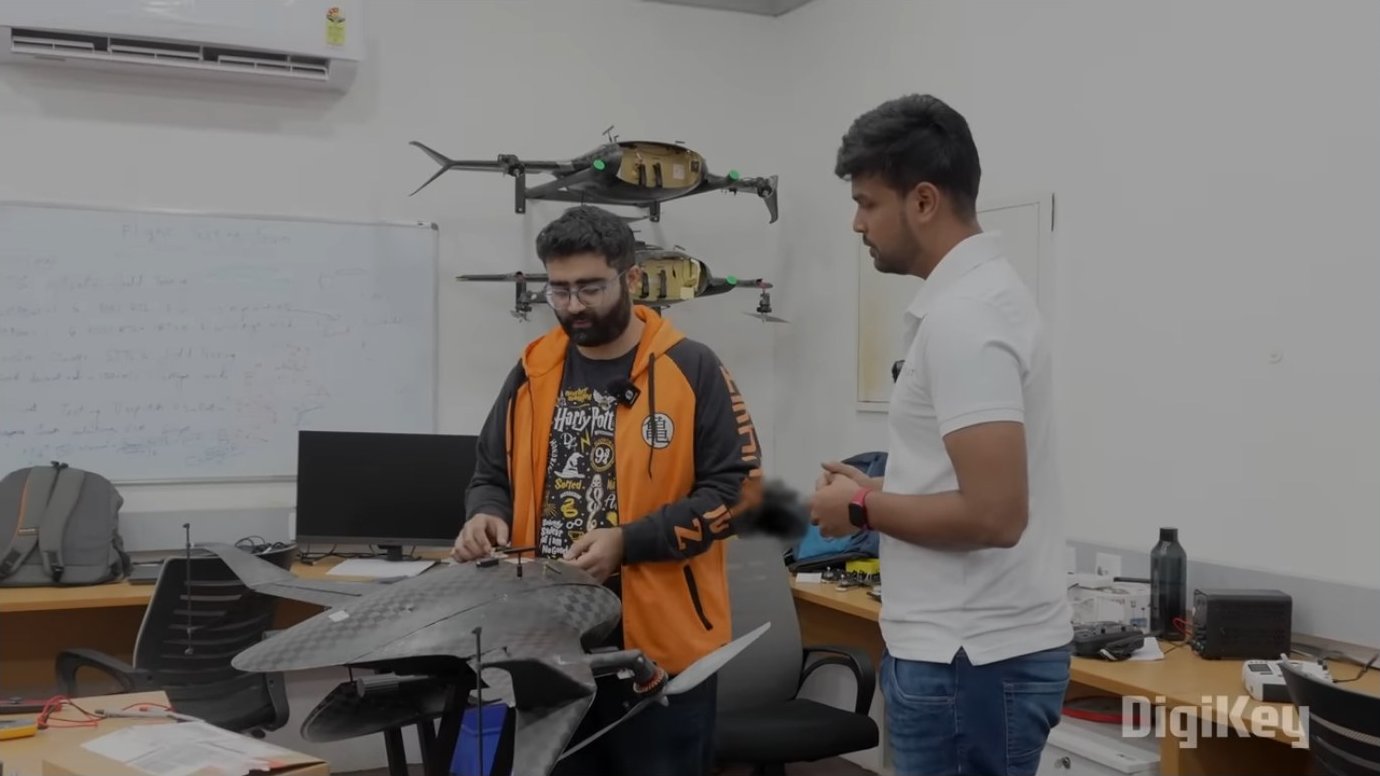
A fixed-wing VTOL drone has a simpler electronic architecture than a multicopter in some respects: only two main motors instead of four or more. However, the hybrid flight mode introduces complexity elsewhere. Thrust vectoring requires servo actuators to tilt the motor nacelles for vertical versus forward flight. Additional servos drive control surfaces — elevons that combine elevator and aileron functions, rudders, and flaps that open to release payload. All these actuators must coordinate precisely during the transition between hover and wing-borne flight.
The power system centers on a six-cell lithium-ion battery pack. Voltage regulators step down battery voltage for electronics and servos. Electronic speed controllers (ESCs) modulate motor power. The flight controller — the computational brain — runs sensor fusion algorithms combining GPS, accelerometers, gyroscopes, and compass readings to estimate aircraft state. This state estimate feeds control loops running at 200 Hz, adjusting motor thrust and control surface angles to maintain stable flight.

Communication systems include multiple antennas: two for telemetry linking the aircraft to ground control, one for manual RC override allowing pilot intervention, and dual GPS modules — one optimized for vertical flight, another for forward flight. This redundancy is deliberate. If the primary GPS loses lock or a telemetry link fails, backup systems maintain control authority. Safety-critical functions demand this layered approach.
Component procurement presents challenges at low production volumes. Hobby-grade parts provide an initial supply chain but lack the reliability standards required for commercial operations. A hobby servo might last 500 cycles; a commercial delivery drone needs 10,000. This gap drives the strategy of bringing electronics manufacturing in-house or working with domestic contract manufacturers to produce components meeting aerospace durability requirements. The goal is not exotic performance but consistent, predictable longevity.
Flight Control Software and Autonomy
The firmware running on the flight controller handles the majority of flight stability and control. Operators and mission planning software provide only high-level commands: waypoints, altitude, speed. The low-level task of translating these commands into motor speeds and servo positions — while compensating for wind, turbulence, and aerodynamic coupling — falls to the autopilot software executing in real time aboard the aircraft.
State estimation algorithms fuse sensor data to determine the aircraft's position, orientation, and velocity. GPS provides position updates at a few hertz. Inertial sensors deliver acceleration and rotation rate at hundreds of hertz. A Kalman filter or similar estimator blends these measurements, exploiting each sensor's strengths while compensating for weaknesses. The result is a smooth, accurate state estimate updated at the control loop frequency.
Control algorithms consume this state estimate and compute actuator commands to follow the desired trajectory. For a VTOL aircraft, this includes managing the transition between vertical and horizontal flight modes — a period where the aircraft is neither hovering nor fully wing-borne. The transition demands careful coordination of motor tilt angle, airspeed, and control surface deflection. Poorly tuned transition logic can lead to altitude loss or unstable attitudes.
Ground station software monitors multiple aircraft simultaneously, displaying telemetry streams showing attitude, speed, battery state, and mission progress. Operators can select an individual aircraft for detailed inspection or issue high-level interventions: return to launch (RTL), parachute deploy, or emergency motor disarm. These commands bypass normal mission logic, giving human operators ultimate authority to override autonomous behavior if circumstances demand.
Development increasingly relies on software-in-the-loop simulation. Simulated physics engines model aircraft dynamics, aerodynamics, and sensor behavior, allowing firmware engineers to test changes without risking hardware. Simulation accelerates iteration — what once required building, crashing, and rebuilding a prototype now happens in software. Hardware testing validates simulation models and uncovers edge cases, but the bulk of algorithm development occurs in the virtual domain.
Testing Regimens and Reliability Validation
Before an aircraft enters operational service, it undergoes extensive flight testing. Current practice requires at least ten flights per airframe to verify behavior and catch manufacturing defects before deployment. These flights stress different aspects of performance: takeoff and landing in varying wind, payload release, battery endurance, GPS handoff between antennas, and transition stability. Only after clearing this validation sequence does an aircraft qualify for delivery operations.
Component-level testing isolates subsystems for focused evaluation. Motor mounts endure extreme forces during vertical flight and transition. A test rig subjects the mount to repeated loading cycles, measuring deflection and inspecting for cracks or delamination. Discovering a weakness here prevents a mid-flight failure that could destroy the entire aircraft and compromise safety.
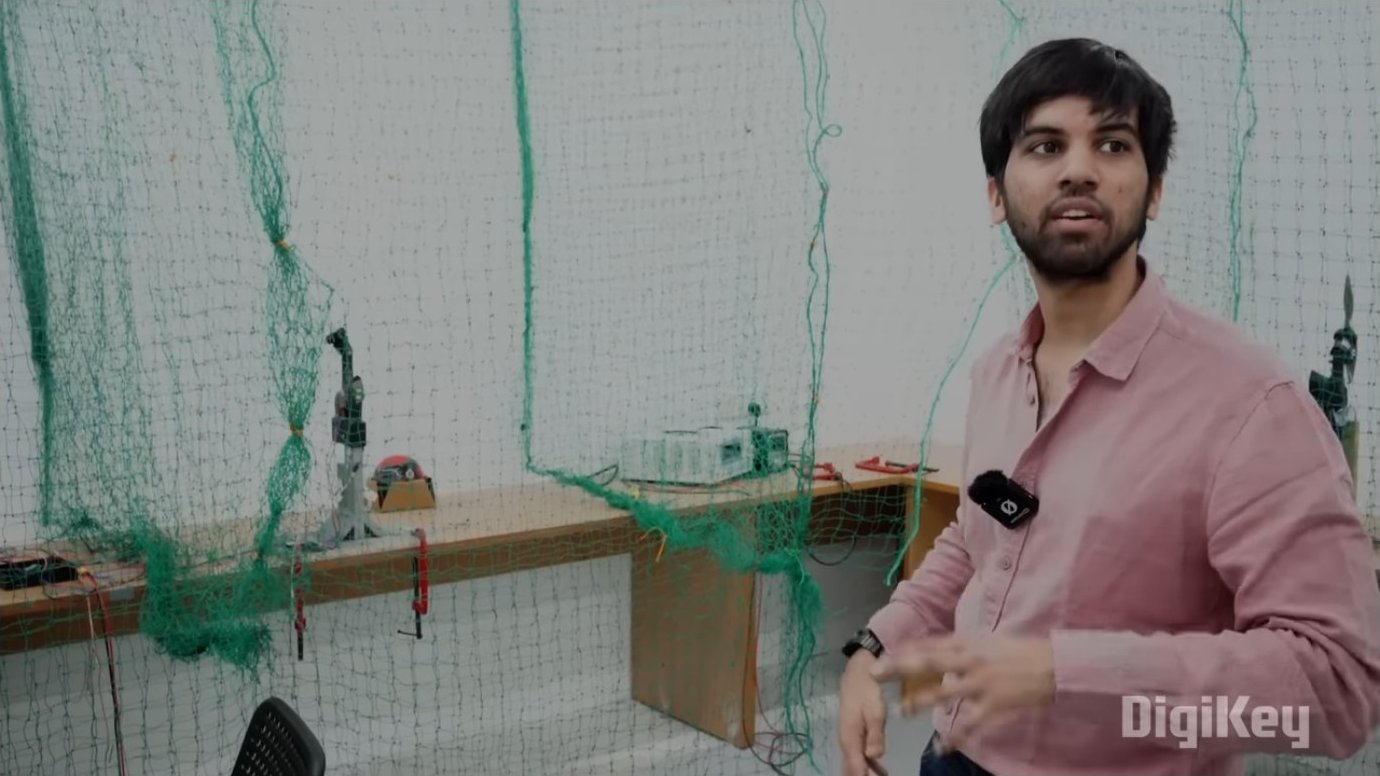
Field testing exposes aircraft to real-world conditions: wind gusts, temperature variation, rain, and dust. These environmental factors reveal issues that laboratory testing cannot. Does moisture infiltrate electronics enclosures? Do control surfaces bind in cold temperatures? Does the GPS maintain lock near power lines? The answers come from accumulating flight hours in diverse conditions.
Failure analysis closes the loop. When a component fails or an aircraft exhibits unexpected behavior, engineers trace the root cause. Was it a design flaw, a manufacturing defect, or an operational scenario outside the envelope? The answer informs design revisions, process improvements, or updated operational limits. Over time, this feedback cycle converges on a mature, reliable system.
Economics: The Path to ₹10 per Kilometer
The target cost of ten rupees per kilometer flown is not arbitrary marketing rhetoric but a consequence of energy physics. An electric scooter transporting a rider achieves 1.5–2 rupees per kilometer including amortization and battery replacement. That vehicle moves roughly 150 kilograms. A delivery drone carrying a three-kilogram payload in a five-kilogram aircraft reduces the mass by a factor of thirty. Energy consumption scales with mass, so this reduction cuts costs by approximately a factor of twenty — landing near ten rupees per kilometer.
Achieving this number in practice requires optimizing several variables simultaneously. Airframe cost decreases with production volume, improved supply chains, and manufacturing efficiency gains. Lower unit costs allow amortizing fixed expenses over more deliveries. Reliability determines operational lifespan: an aircraft lasting 1,000 flights spreads its initial cost over five times more deliveries than one lasting 200 flights. Battery longevity similarly affects operating cost, since battery replacement is a recurring expense.
Component durability plays an outsized role. Motors and servos are moving parts subject to wear. Hobby components may survive hundreds of cycles; commercial operations require tens of thousands. Achieving this demands either sourcing industrial-grade components or manufacturing purpose-built actuators designed for longevity. The latter path offers more control over specifications and cost structure but requires upfront investment in tooling and process development.
Battery management extends beyond cell chemistry to operational strategy. Shallow discharge cycles — using only 80% of battery capacity per flight — significantly extend cycle life compared to deep discharge. This means sizing batteries larger than the minimum required for a single flight, trading some weight penalty for vastly improved lifetime economics. Thermal management, charge rate control, and storage protocols further influence longevity.
Applications: Platform Generality Over Vertical Specialization
A common question about delivery drones is: what specific niche do they target? Medical supplies? E-commerce? Food? This framing misunderstands the value proposition. Nobody asks whether a delivery motorcycle is optimized for food or pharmaceuticals — it's a general-purpose vehicle that moves packages. Drones become economically transformative when they achieve similar generality: a platform capable of delivering any small package at lower cost than alternatives.
Testing reflects this philosophy. Rather than optimizing for a single application's unique requirements, validation focuses on the core capability: reliably transporting one-kilogram payloads across specified distances in varying conditions. Success means proving the aircraft can execute this mission repeatedly, safely, and cost-effectively. Application-specific adaptations — insulated containers for temperature-sensitive cargo, for instance — become modular additions to a proven base platform.
Volume matters more than any single high-value application. Logistics economics favor scale: fixed costs amortize over deliveries, supply chain efficiency improves with order volume, and operational expertise compounds with flight hours. A platform executing millions of generic deliveries beats one optimized for thousands of specialized missions. This dictates prioritizing reliability and cost reduction over niche feature development.
Software Ecosystem: Ground Control and Traffic Management
Ground control software provides operators visibility into fleet operations. A central dashboard displays all active aircraft, showing position, altitude, speed, battery state, and current waypoint. Operators can select individual aircraft for detailed telemetry or issue intervention commands. The architecture supports multi-aircraft monitoring by a single operator, essential for scaling beyond one-to-one pilot-aircraft ratios.

Safety interventions give operators override authority. Return-to-launch (RTL) commands the aircraft to navigate back to its takeoff point autonomously. Parachute deploy releases a ballistic recovery parachute, arresting descent if the aircraft cannot land normally. Emergency disarm cuts motor power immediately — a last resort when ground proximity makes other interventions unsafe. These controls ensure humans retain ultimate authority even as autonomous systems handle routine operations.
Future development targets UAV traffic management (UTM) capabilities. As drone density increases, coordinating flight paths becomes critical. UTM systems check planned routes for conflicts, manage airspace allocation, and track aircraft broadcasting identification over radio. Integration with these systems will be necessary for scaling operations beyond a few aircraft in controlled areas to fleets operating in shared airspace.
Mission planning tools allow operators to define routes, waypoints, altitudes, and speeds without manually programming flight parameters. High-level mission specification — 'deliver package from point A to point B' — automatically generates a flight plan accounting for airspace restrictions, terrain, and aircraft performance limits. This abstraction layer makes operations accessible to personnel without deep technical expertise in flight dynamics.
Pathways for Engineers Entering Drone Development
Aspiring drone engineers often perceive hardware cost as a barrier to entry. Building and repeatedly crashing physical prototypes is expensive. However, modern simulation environments largely eliminate this constraint. Software-in-the-loop (SITL) simulation allows developing and testing flight control algorithms, mission planning software, and autonomy features without hardware. Open-source autopilot projects provide well-documented starting points with active communities.
Simulators model physics, aerodynamics, sensor behavior, and environmental factors. Gazebo, SimNet, and similar platforms enable testing aircraft designs and control logic in realistic scenarios — wind, sensor noise, GPS dropouts — before committing to hardware. This development cycle matches software engineering practice: iterate rapidly in simulation, then validate with physical testing. The barrier to entry is time and learning, not capital.
Contributing to open-source autopilot projects offers structured learning. ArduPilot and PX4 are mature codebases with extensive documentation, simulation support, and contribution pathways. Working on a specific feature or bug fix provides hands-on experience with real-world flight control software under mentorship from experienced developers. Many contributors participate through programs like Google Summer of Code, which provide funding and structure.
For those interested in novel aircraft configurations — thrust-vectoring tail-sitters, for example — simulation becomes essential. These designs exhibit complex dynamics that make flight testing risky and expensive without validated models. Developing accurate simulation models is itself a valuable skill. Once simulation matches hardware behavior, rapid iteration becomes possible, compressing the development cycle for unconventional designs.
Key takeaways
- → Fixed-wing VTOL drones combine the efficiency of airplane flight with the convenience of vertical takeoff and landing, eliminating runway requirements while achieving far greater range than multicopters.
- → Ultra-lightweight composite construction using carbon fiber sandwich structures enables a 5:1 total-to-payload weight ratio, directly translating to lower energy costs and sub-₹10/km delivery economics.
- → Advanced composite manufacturing requires purpose-built processes optimized for fabric materials rather than adapting metal-working techniques, involving vacuum bagging, curing, and precision mold-making.
- → Flight control firmware manages complex state estimation and control loops at 200 Hz, autonomously handling transitions between vertical and horizontal flight modes while ground stations provide monitoring and intervention capabilities.
- → Reliability validation demands accumulating thousands of flight hours across diverse environmental conditions to prove safety and durability before regulatory approval and commercial deployment.
- → Component longevity — particularly motors, servos, and batteries — determines operating economics as much as initial airframe cost, driving in-house component development for aerospace-grade durability.
- → Software-in-the-loop simulation eliminates hardware as a barrier to learning drone development, enabling engineers to iterate on flight control algorithms and novel aircraft designs before physical testing.