Annotated transcription · 9 min read
Prandtl's Lifting Line Theory: Predicting Finite Wing Performance
How a century-old vortex model continues to shape aircraft design and performance analysis.
The Challenge of Finite Wings
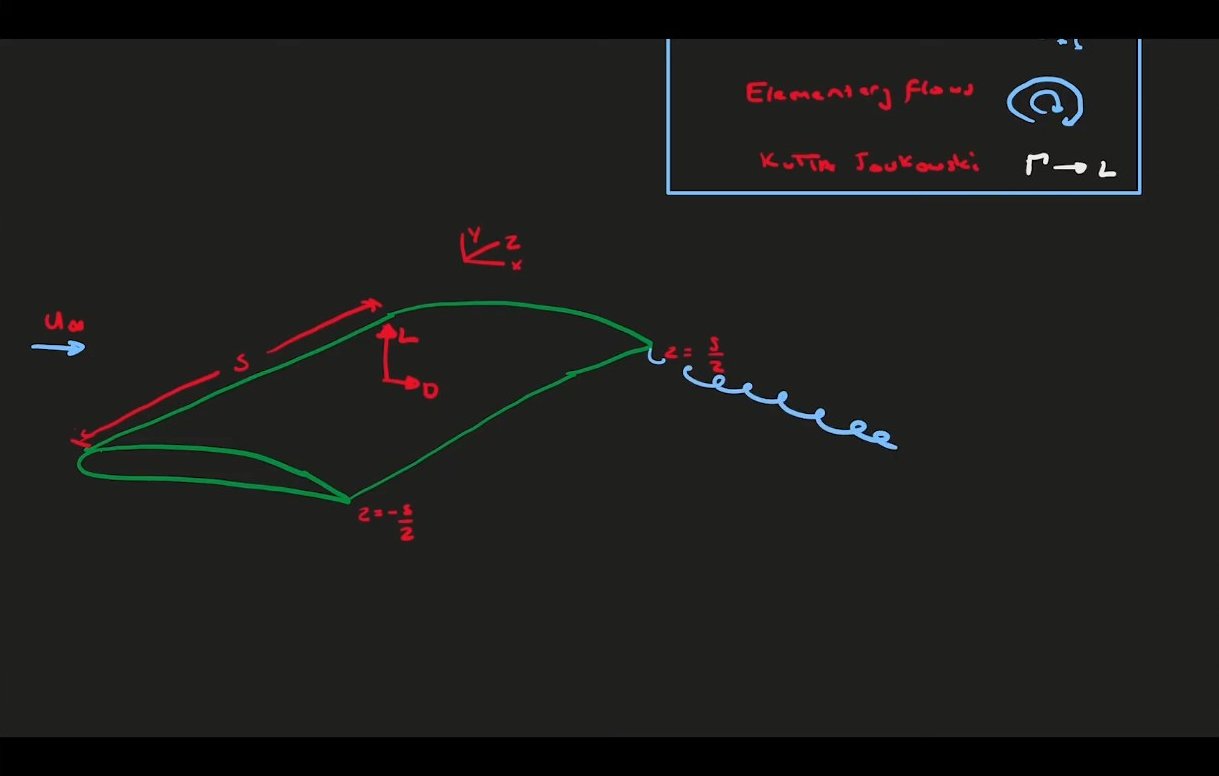
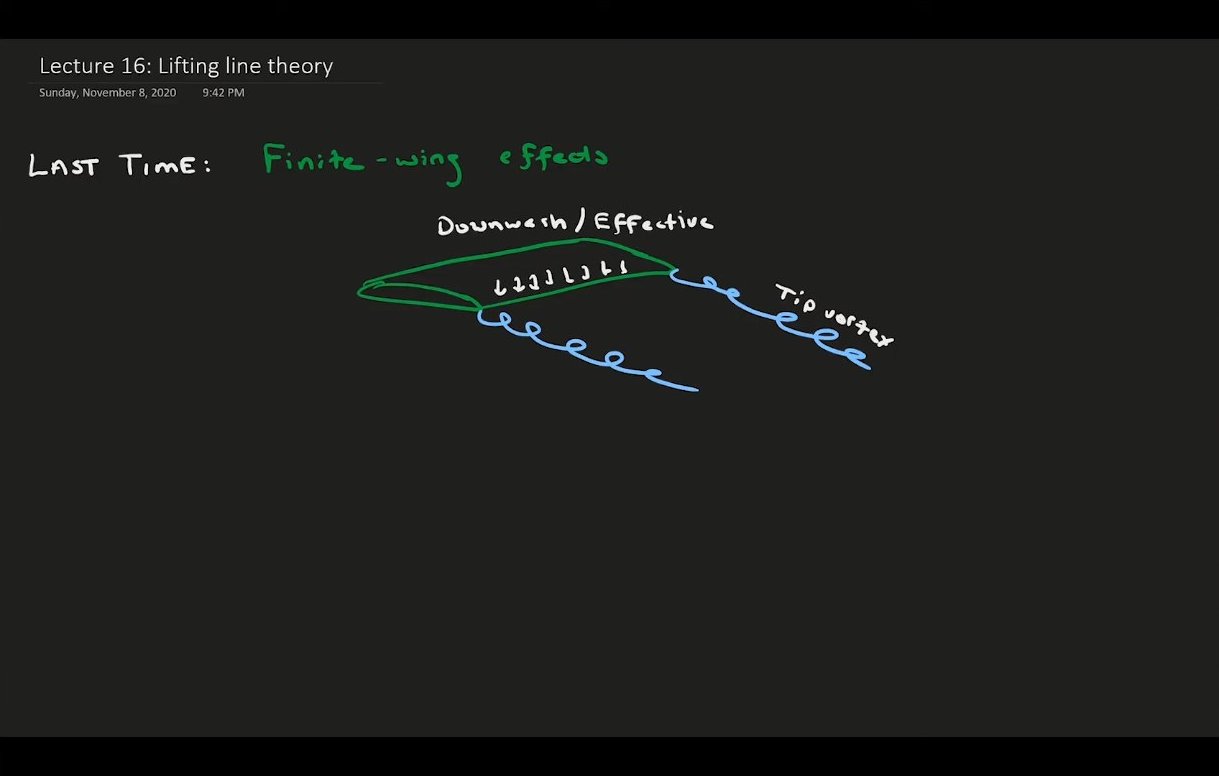
Real aircraft wings differ fundamentally from the idealized two-dimensional airfoils studied in classical aerodynamics. While infinite-span airfoils provide useful theoretical insights, actual wings terminate at tips—and those tips introduce complications that degrade performance. Tip vortices generate downwash over the wing surface, altering the effective angle of attack and producing an entirely new category of drag that doesn't exist in two-dimensional flow.
Engineers need methods to predict these losses before building expensive prototypes. The question becomes: how can we estimate the aerodynamic behavior of a finite wing, accounting for three-dimensional flow effects, without resorting to costly wind tunnel tests or complex computational simulations?
The Horseshoe Vortex Model
Prandtl's solution, developed around 1911 and refined during World War I, was elegant in its simplicity: replace the physical wing surface with an arrangement of vortex filaments. The key insight came from the Helmholtz vortex theorems, which state that vortex lines cannot begin or end in a fluid—they must either form closed loops or extend to boundaries.
This constraint led Prandtl to model the wing as a 'horseshoe vortex': a bound vortex segment representing the wing itself, connected to two semi-infinite trailing vortices representing the tip vortices that stream downstream. The bound vortex carries circulation proportional to the local lift, while the trailing vortices induce the downwash field that affects wing performance.
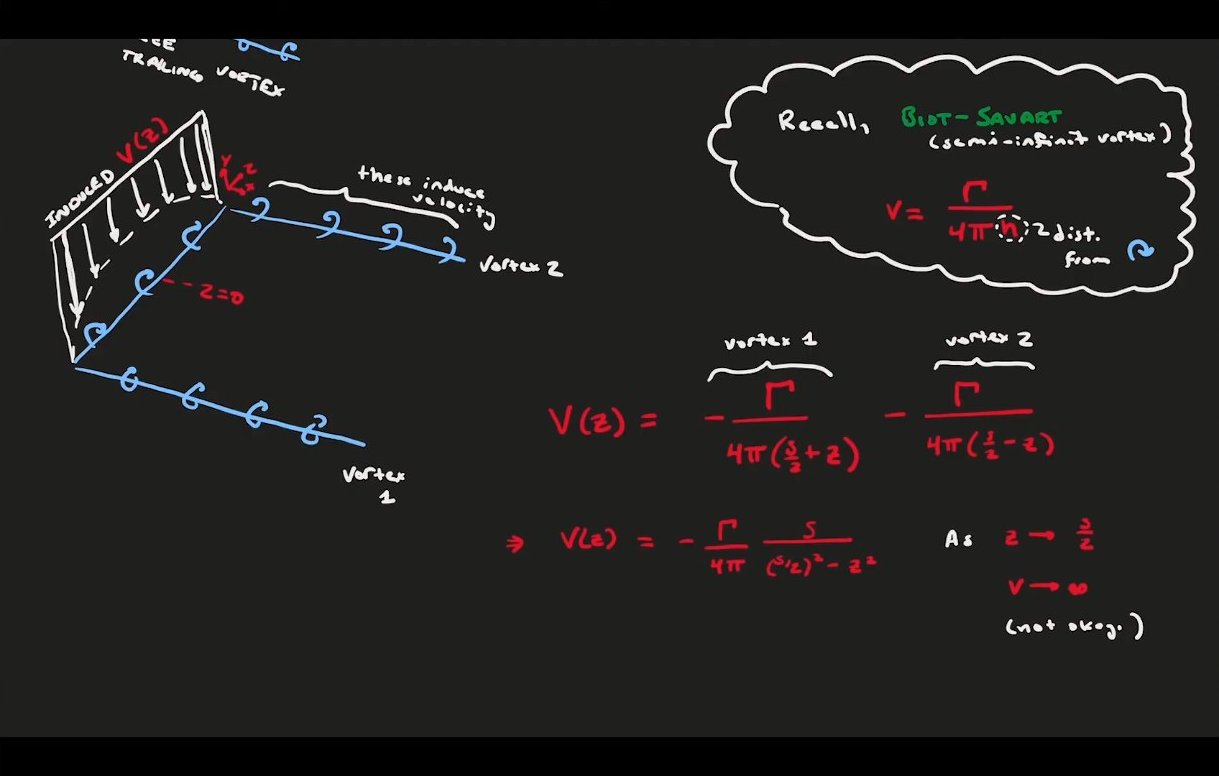
Using the Biot-Savart law—the same principle that governs magnetic fields around current-carrying wires—one can calculate the velocity field induced by these vortex lines. The vertical component of this induced velocity represents the downwash that reduces the wing's effective angle of attack.
From Single Horseshoes to Continuous Distribution
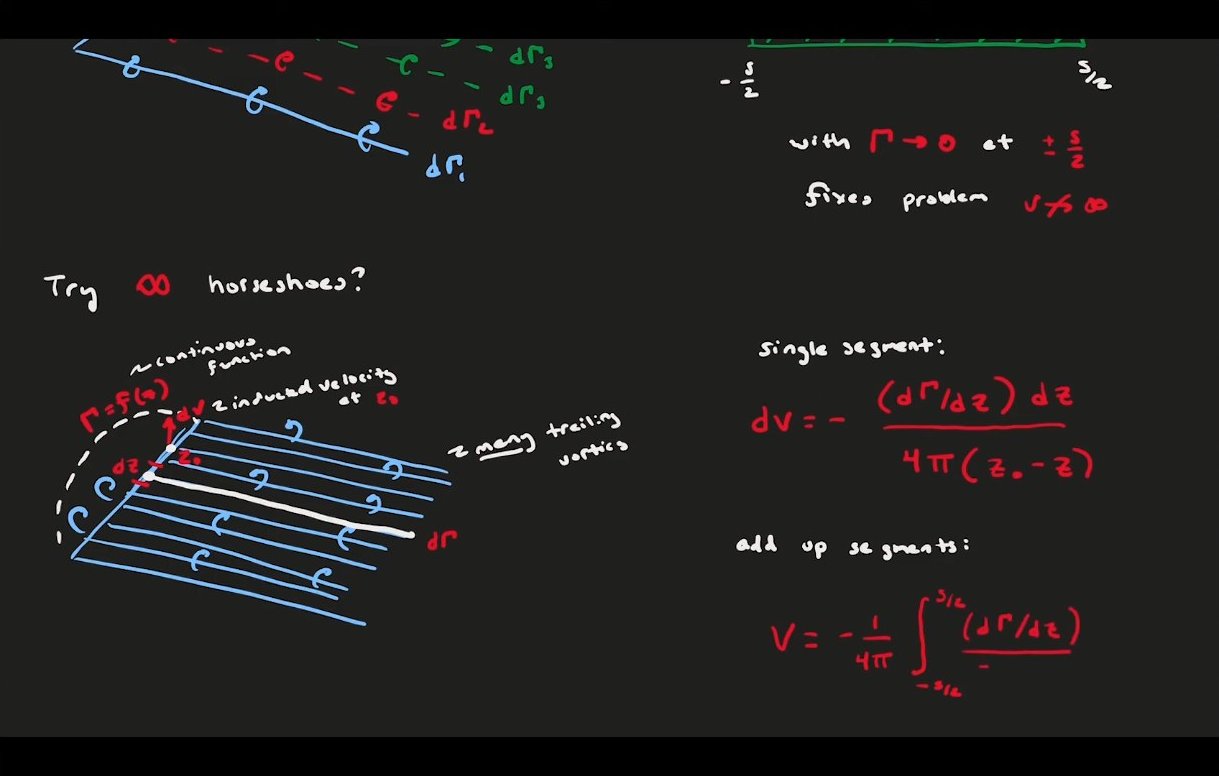
A single horseshoe vortex presents a mathematical difficulty: the induced velocity becomes infinite at the wing tips where the trailing vortices originate. This singularity makes the model physically unrealistic. Prandtl's breakthrough was to recognize that multiple overlapping horseshoe vortices, each with infinitesimal strength, could represent a smooth, continuous distribution of circulation along the span.
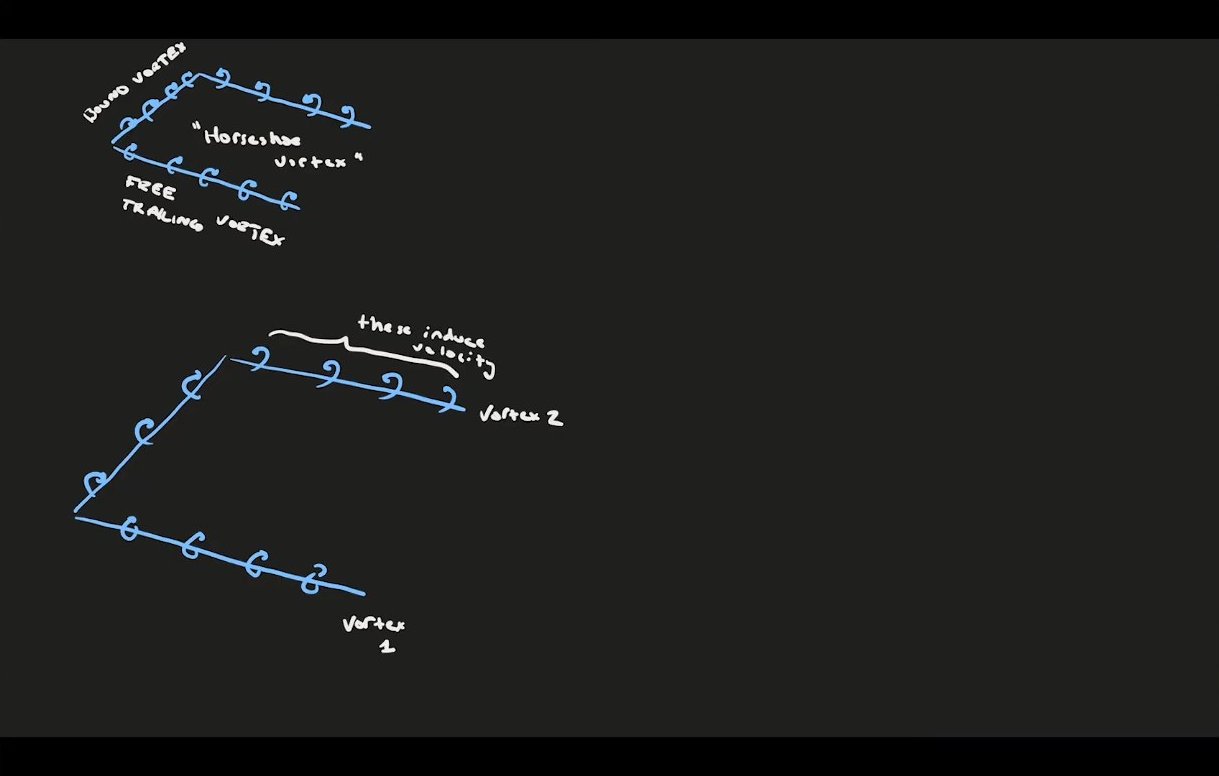
As more horseshoe elements are added, their bound vortices overlap in the middle sections of the wing, creating regions of higher circulation strength. At the tips, only a single vortex element remains, allowing the circulation to taper smoothly to zero. This distribution—denoted Γ(z) as a function of spanwise position z—becomes the central unknown in the lifting line problem.
The trailing vortices from all these elements form a continuous vortex sheet behind the wing. While this sheet eventually rolls up into discrete tip vortices far downstream, the lifting line model captures the essential physics near the wing itself where the flow field matters most for performance prediction.
The Fundamental Equation
The power of lifting line theory emerges when three classical results combine: the Biot-Savart law for induced velocities, the Kutta-Joukowski theorem relating circulation to lift, and thin airfoil theory's prediction that lift slope equals 2π for most airfoils. Together, these allow construction of an integro-differential equation whose solution yields the circulation distribution.
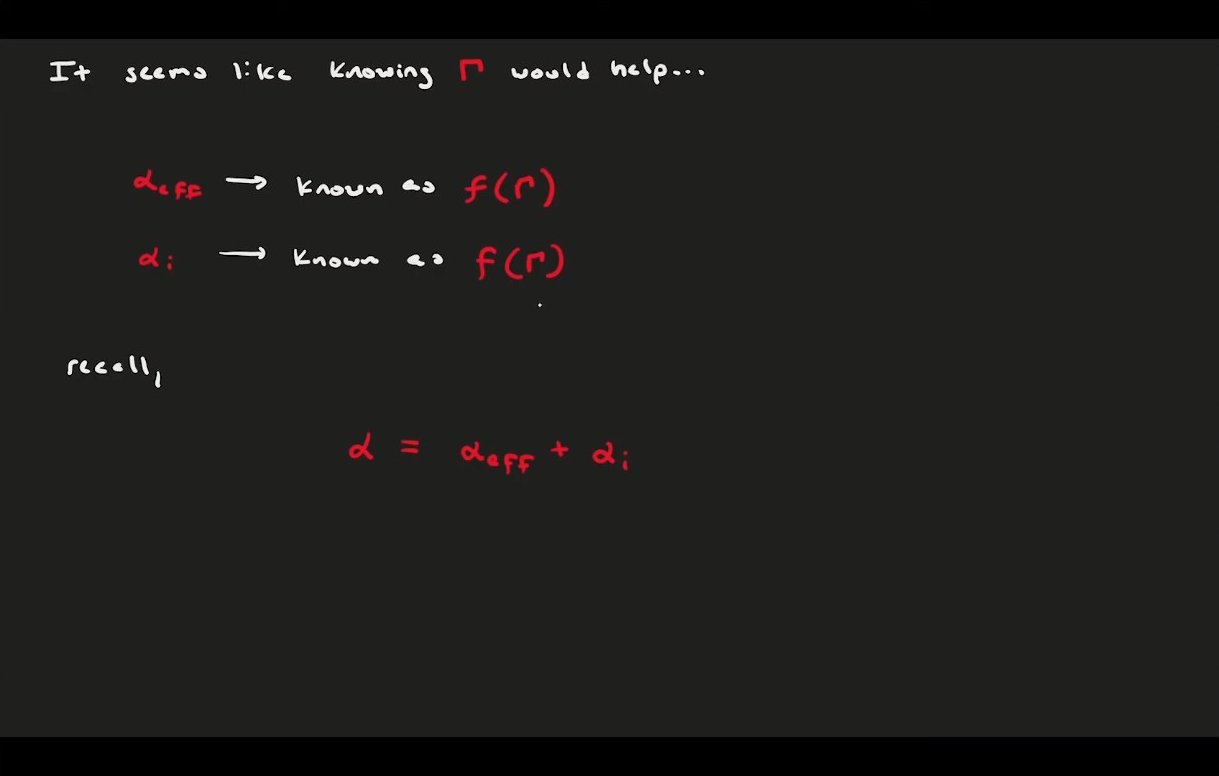
The induced downwash velocity at any spanwise location depends on an integral over the entire circulation distribution. This downwash creates an induced angle of attack that subtracts from the geometric angle of attack to give an effective angle. Thin airfoil theory then relates this effective angle to the local lift coefficient, which through Kutta-Joukowski determines the circulation—closing the mathematical loop.
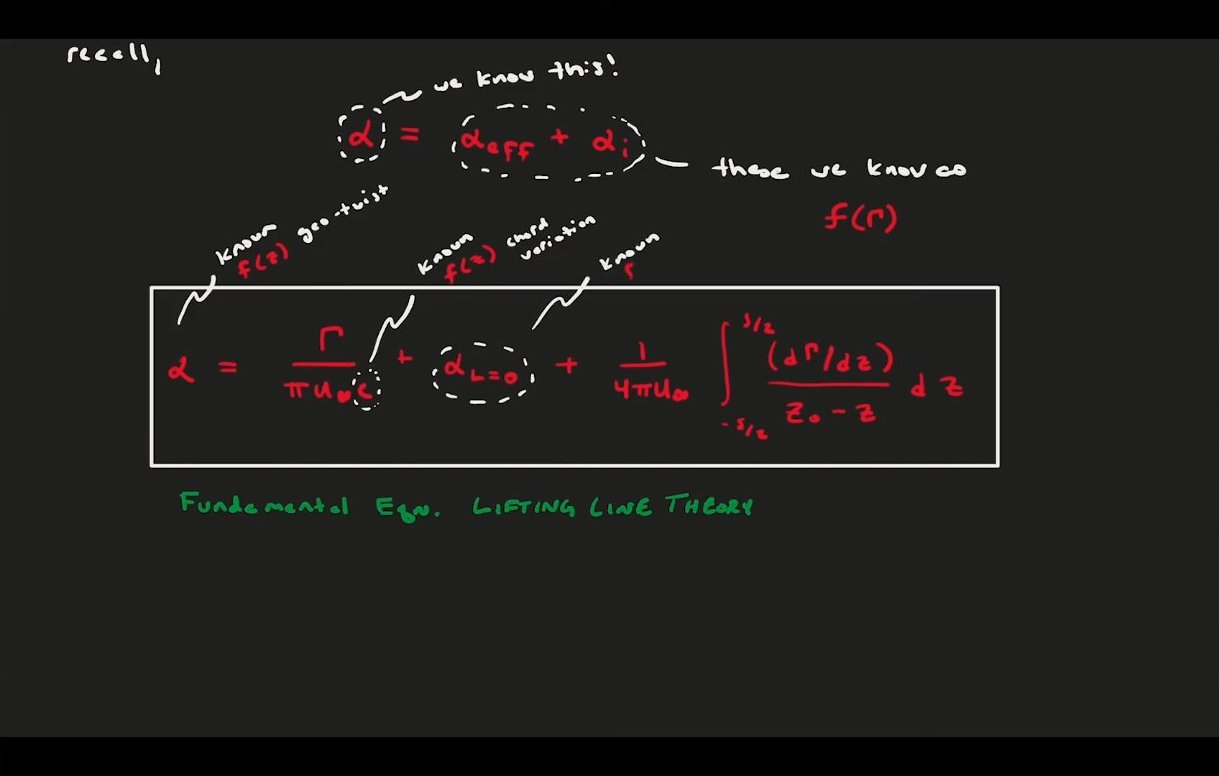
The result is an equation expressing the geometric angle of attack α(z) as a function of the unknown circulation Γ(z), the wing geometry (chord and span), and airfoil properties. Mathematically, it takes the form of an integral equation where the circulation appears both inside and outside the integral—a challenging type to solve analytically.
The Elliptical Distribution Solution
Among all possible circulation distributions, one stands out for both mathematical convenience and practical importance: the elliptical distribution. When circulation varies elliptically along the span—strongest at the root, tapering smoothly to zero at the tips—several remarkable simplifications occur in the governing equations.
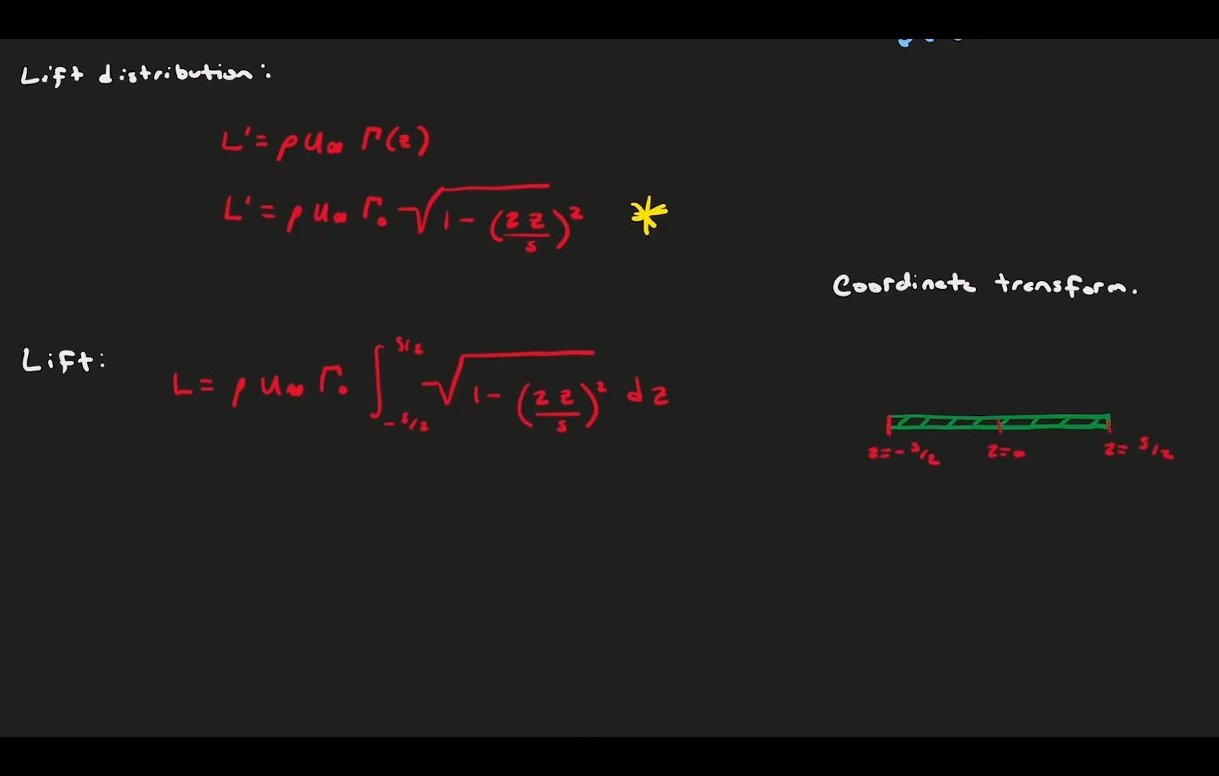
For an elliptical distribution, the induced downwash becomes constant across the entire span. This uniformity means every section of the wing experiences the same induced angle of attack reduction, creating a particularly efficient load distribution. The mathematics becomes tractable through coordinate transformation into a circular (θ) space, converting the integral equation into solvable forms.
Working through the integration yields expressions for total lift and induced drag as functions of the peak circulation strength Γ₀. The lift integrates to L = ½ρU∞Γ₀πs, where s is the wingspan. More importantly, the induced drag coefficient emerges as C_Di = C_L² / (πAR), where AR represents aspect ratio (span squared divided by wing area).
This drag formula reveals fundamental design drivers. Induced drag increases with the square of lift coefficient—flying slower (requiring higher lift) becomes dramatically less efficient. Conversely, induced drag decreases inversely with aspect ratio, providing powerful motivation for long, slender wings. Sailplanes with aspect ratios exceeding 30 exploit this relationship to minimize energy loss during unpowered flight.
Practical Solution Methods
Real wings rarely have perfectly elliptical planforms, and they often incorporate geometric twist, aerodynamic twist through varying airfoil sections, or taper ratios that deviate from the ideal. For these cases, analytical solutions become intractable, and engineers resort to iterative numerical schemes to solve the fundamental equation.
The standard approach begins with an initial guess for the circulation distribution—typically elliptical as a reasonable starting point. This guess allows calculation of the induced angle of attack distribution using the Biot-Savart integral. Subtracting the induced angle from the geometric angle gives the effective angle of attack at each spanwise station.
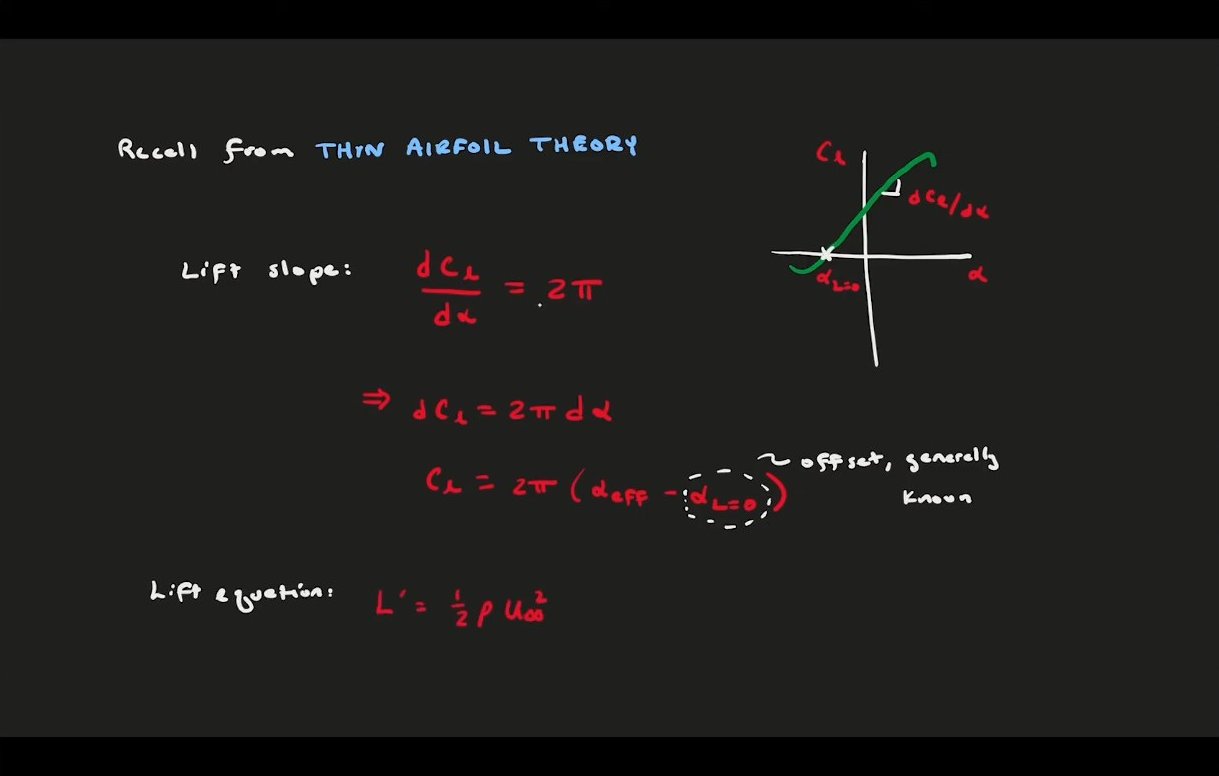
From the effective angle and the local airfoil's lift curve slope, the lift coefficient distribution follows. The Kutta-Joukowski theorem then converts these lift coefficients into a new circulation distribution. If this computed distribution matches the initial guess, the solution has converged. If not, the new distribution becomes the next guess, and the cycle repeats until convergence within acceptable tolerance.
Modern implementations discretize the span into panels or stations, converting the integral equation into a system of algebraic equations solvable by standard matrix methods. These vortex lattice codes can handle complex planforms, twist distributions, and even control surface deflections, all within the lifting line framework.
Design Implications and Performance Metrics
Once the circulation distribution is known, three critical performance metrics follow directly. The lift distribution L'(z) comes from the Kutta-Joukowski theorem as the product of density, velocity, and local circulation. Integrating this distribution across the span yields total lift, which must match the aircraft weight in steady level flight.
The induced drag distribution arises from the product of local lift and induced angle of attack—a subtle but profound result. Each wing section experiences drag proportional to how much its flow is deflected downward. Sections with high downwash angles, typically near the tips, contribute disproportionately to overall induced drag despite potentially carrying less lift.
The span efficiency factor e quantifies how closely a given wing approaches elliptical performance. The general induced drag formula becomes C_Di = C_L² / (πeAR), with e ≤ 1. Rectangular wings achieve e ≈ 0.7, while tapered planforms can reach e ≈ 0.95. Only the elliptical distribution achieves e = 1, though wings with specific taper ratios approach this closely enough for practical purposes.
Limitations and Modern Extensions
Lifting line theory rests on assumptions that limit its applicability. The model assumes the flow remains attached, making it unsuitable for predicting stall or post-stall behavior. It requires moderate to high aspect ratios—typically AR > 4—where spanwise flow remains negligible compared to chordwise flow. Below this threshold, three-dimensional effects violate the theory's foundational assumptions.
Highly swept wings, delta wings, and other low-aspect-ratio configurations demand more sophisticated treatment. These planforms generate strong spanwise flow components and exploit vortex lift mechanisms that lifting line theory cannot capture. Numerical methods like vortex lattice, panel codes, or computational fluid dynamics become necessary for accurate predictions.
Despite these limitations, lifting line theory remains remarkably relevant. Commercial transport aircraft, general aviation planes, and unmanned aerial vehicles typically operate in the theory's valid regime. The method provides rapid first-order estimates during conceptual design, guides preliminary sizing decisions, and offers physical insight that purely numerical methods sometimes obscure.
Modern extensions incorporate compressibility corrections, account for winglets and non-planar geometries, and couple with boundary layer calculations to predict viscous effects. These enhancements preserve the theory's computational efficiency while expanding its range of applicability, ensuring its continued use in contemporary aircraft design.
Historical Impact and Continuing Relevance
When Prandtl introduced lifting line theory in 1911, it represented the first rigorous method for predicting finite wing performance without empirical data. The theory's predictions—particularly regarding aspect ratio effects and optimal span loading—transformed wing design within a decade. Aircraft evolved from short, stubby wings to the longer, more efficient planforms that dominated aviation through the propeller era.
The theory's influence extends beyond numerical predictions. It established the conceptual framework aerodynamicists use to think about three-dimensional wing flow: bound circulation generating lift, trailing vorticity inducing downwash, and the fundamental trade-off between span (minimizing induced drag) and structural weight. These concepts permeate modern aerodynamics education and practice.
Aircraft like the Spitfire employed elliptical wings explicitly to minimize induced drag, though manufacturing complexity eventually favored simpler tapered designs that approached elliptical efficiency. Modern sailplanes and high-altitude research aircraft continue pushing aspect ratios higher, chasing the theoretical efficiency limits Prandtl's work revealed over a century ago.
In an era of advanced computational tools, lifting line theory persists because it offers what raw computation cannot: understanding. The closed-form solutions for elliptical loading, the clear dependence of induced drag on aspect ratio, and the visualization of load distribution provide intuition that guides designers toward promising configurations before detailed analysis begins. This combination of physical insight and computational efficiency ensures the method's relevance well into the future of aerospace engineering.
Key takeaways
- → Prandtl's lifting line theory models finite wings as vortex systems, replacing physical surfaces with bound and trailing vortex filaments to predict three-dimensional flow effects.
- → The elliptical circulation distribution produces uniform downwash, minimizing induced drag for any given lift and span—a fundamental optimality result driving wing planform design.
- → Induced drag increases with lift coefficient squared and decreases inversely with aspect ratio, creating powerful incentives for long, slender wings in efficiency-critical applications.
- → The fundamental equation relates geometric angle of attack to circulation distribution through an integro-differential equation solvable by iterative numerical methods for arbitrary wing geometries.
- → Lifting line theory applies to moderate-to-high aspect ratio, unswept wings at attached flow conditions, but fails for delta wings and highly swept configurations requiring vortex lift.
- → Despite century-old origins, the theory remains essential in modern aircraft design for rapid performance estimates, conceptual sizing, and providing physical insight into three-dimensional wing aerodynamics.