Annotated transcription · 9 min read
Deriving the Fundamental Equations of One-Dimensional Gas Flow
How conservation laws simplify when flow is confined to a single direction.
What One-Dimensional Flow Really Means
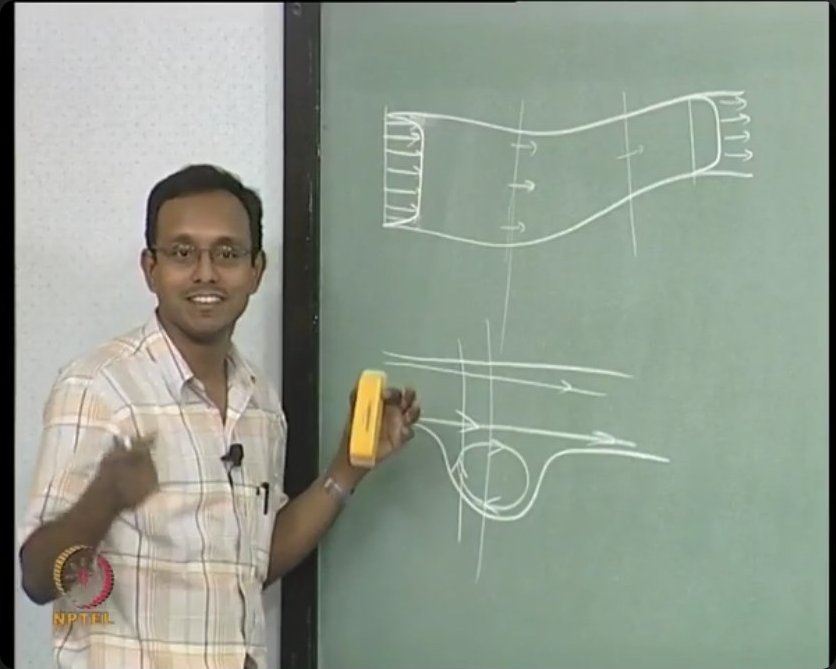
In fluid dynamics, perfectly one-dimensional flow does not exist in nature. Yet the approximation proves invaluable for analyzing ducts, nozzles, and jet exhausts. The central assumption is that flow properties vary only along one spatial direction—the streamwise coordinate—while remaining uniform across any perpendicular cross-section. This simplification holds when velocity components perpendicular to the main flow direction are negligibly small compared to the axial velocity, and when changes in cross-sectional shape do not induce significant transverse motion.
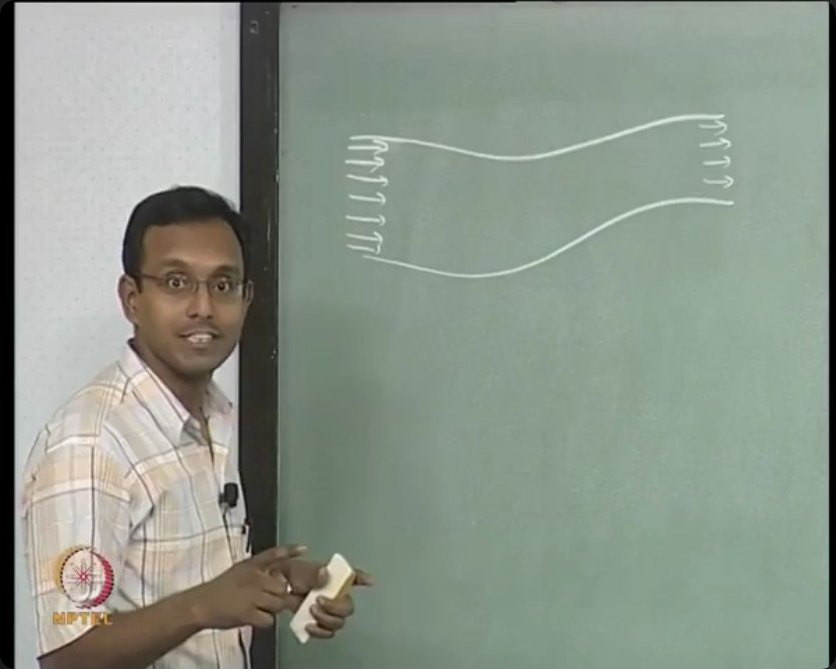
Consider flow through a converging-diverging nozzle. Near the throat and in straight sections, streamlines run nearly parallel to the walls, and the perpendicular velocity components remain small. Even where the duct curves or changes area, if the streamline curvature is gentle and separation does not occur, treating the flow as quasi-one-dimensional remains reasonable. The key is whether neglecting transverse variations introduces acceptable error for the problem at hand.
Stream Tubes as Natural Control Volumes
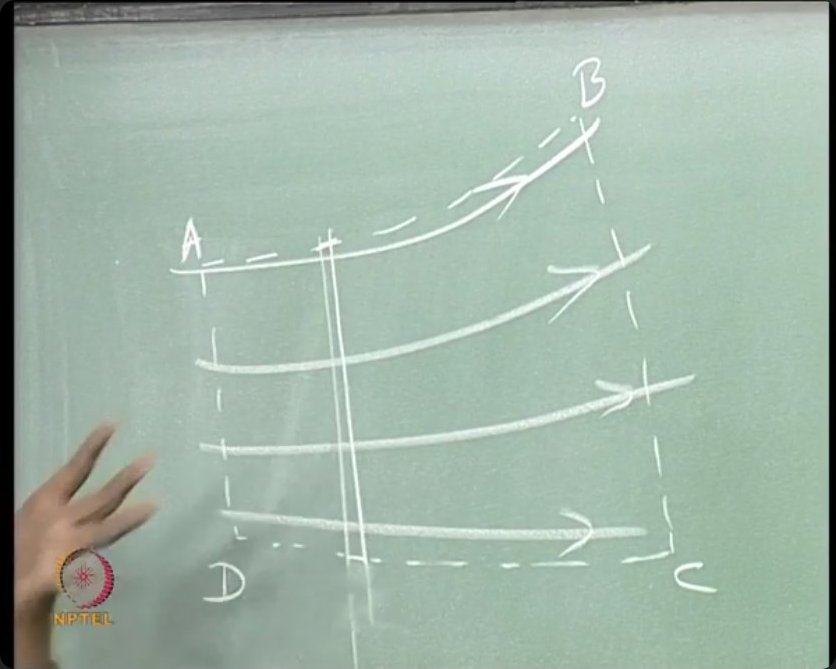
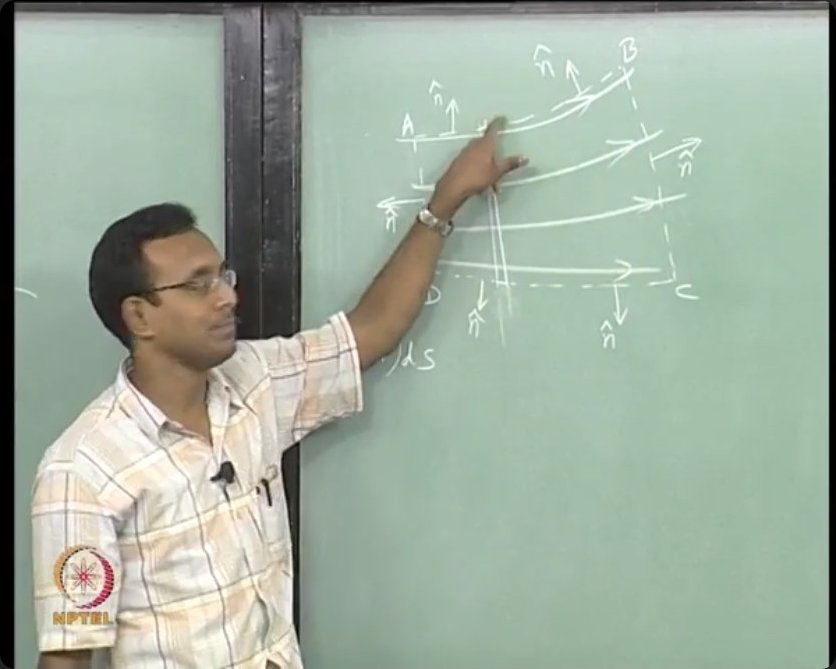
A stream tube offers an elegant geometrical construct for one-dimensional analysis. Imagine tracing a closed loop in a flow field and following all streamlines that pass through that loop. These streamlines collectively form a tube through which fluid passes, and by definition, no mass crosses the tube's lateral surface—flow entering one end must exit the other. This makes stream tubes ideal control volumes because boundary conditions simplify dramatically.
When a control volume is chosen to coincide with a stream tube, the velocity vector at any point on the lateral surface is tangent to that surface. Consequently, the dot product of velocity with the outward normal vanishes everywhere except at the inlet and exit planes. This geometric property eliminates entire terms in the integral conservation equations, making stream tubes particularly useful for deriving simplified forms of mass, momentum, and energy balances.
Conservation of Mass in One Dimension
The continuity equation for steady one-dimensional flow states that mass flux remains constant along a stream tube. Beginning with the general integral form of mass conservation and applying the assumption that velocity is perpendicular to each cross-section, the surface integral reduces to contributions only from the inlet and outlet. At these planes, the product of density, velocity, and area must balance.
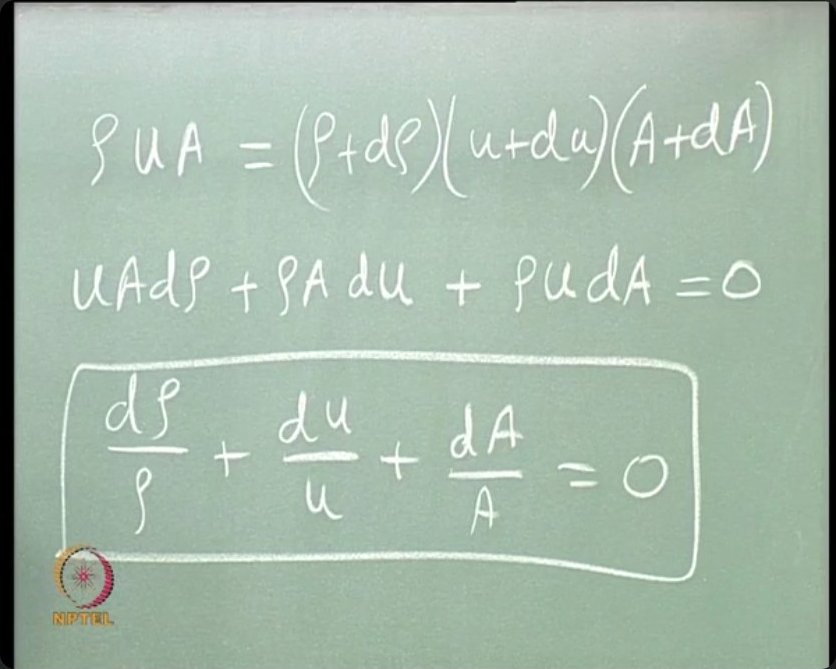
Mathematically, this yields ρuA = constant, where ρ is density, u is velocity magnitude, and A is cross-sectional area. This relation implies that if area decreases and density remains nearly constant—as in incompressible flow—velocity must increase to maintain constant mass flow rate. The expression ρuA represents the mass flow rate, with dimensions of mass per unit time, and serves as a fundamental constraint in all one-dimensional flow calculations.
For differential analysis, considering an infinitesimal control volume of length dx yields a logarithmic derivative form: dρ/ρ + du/u + dA/A = 0. This differential equation reveals how fractional changes in density, velocity, and area are coupled. It forms the foundation for understanding area-velocity relationships in compressible flows, where density variations cannot be ignored.
Momentum Balance and Pressure Forces
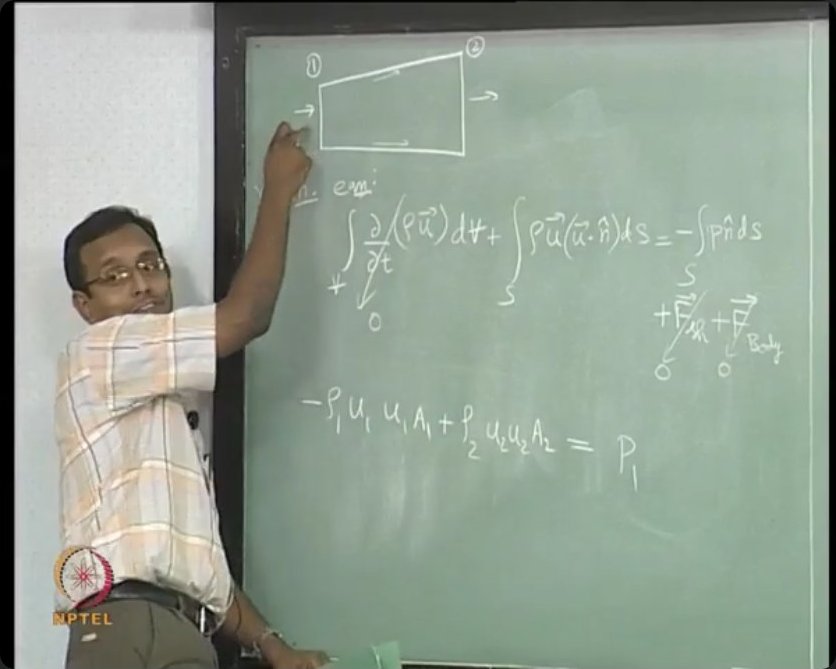
The momentum equation for one-dimensional flow accounts for convective momentum transport and pressure forces acting on the control volume. Starting from the integral momentum theorem, steady flow eliminates time-dependent accumulation terms. At the inlet and outlet, momentum flux equals ρu²A, reflecting the mass flux multiplied by velocity. Pressure forces act on all surfaces, but their contributions differ depending on control volume geometry.
On the end caps perpendicular to the flow, pressure exerts a force equal to PA along the streamwise direction. On the lateral surface of a stream tube with varying area, pressure acts perpendicular to the surface. Only the component of this distributed pressure force aligned with the flow direction contributes to the momentum balance. For a frustum-shaped section, this component integrates to an effective force proportional to the pressure multiplied by the change in area.
The resulting integral momentum equation takes the form: ρ₁u₁²A₁ + P₁A₁ = ρ₂u₂²A₂ + P₂A₂ + Fₓ, where Fₓ represents the net streamwise force exerted by pressure on the lateral surface. This term vanishes for constant-area ducts, where lateral pressure forces cancel due to symmetry. For constant-area flow, the momentum equation simplifies to ρ₁u₁² + P₁ = ρ₂u₂² + P₂, a form reminiscent of the Bernoulli equation but without requiring inviscid or incompressible assumptions.
Differential Form of the Momentum Equation
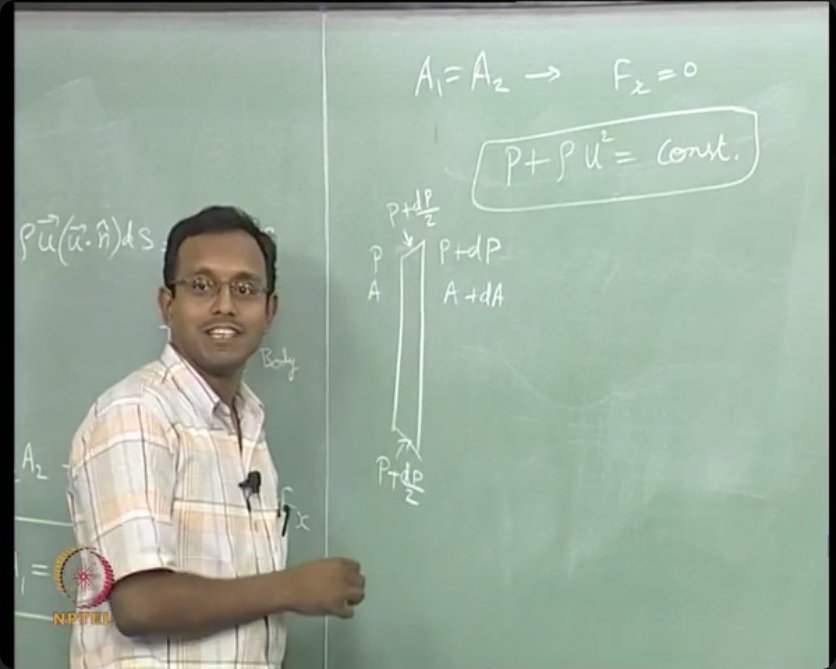
For an infinitesimal control volume spanning from x to x + dx, the pressure force on the lateral surface becomes (P + dP/2) dA, where the average pressure acts over the differential area change. Applying the momentum balance and expanding all terms to first order in differentials yields a relation involving dP, du, and dA. Products of differential quantities are neglected as second-order small compared to the retained terms.
After algebraic manipulation and substitution of the continuity equation to eliminate area terms, the differential momentum equation emerges as: dP + ρu du = 0. This compact form, known as Euler's equation for steady flow along a streamline, directly couples pressure changes to velocity changes. It reveals that when velocity increases, pressure must decrease, and vice versa—a fundamental principle underlying nozzle and diffuser behavior.
Physical Interpretation and Incompressible Limits
Examining the differential continuity equation dρ/ρ + du/u + dA/A = 0 provides insight into area-velocity relationships. For incompressible flow where density remains constant, dρ = 0, and the equation reduces to du/u = -dA/A. This means that fractional changes in velocity and area are equal and opposite: decreasing area accelerates the flow, while increasing area decelerates it. This behavior is familiar from everyday experience, such as pinching a garden hose to increase water jet velocity.
In compressible flow, however, density variations introduce a third term. The relationship between area change and velocity change depends on whether density increases or decreases. For subsonic flow, density changes tend to be small, and the incompressible result approximately holds. But in supersonic flow, density variations become large and coupled to velocity in unexpected ways. The sign of the area-velocity relationship can reverse when the flow speed exceeds the speed of sound, leading to the counterintuitive behavior of converging-diverging nozzles required to accelerate gases to supersonic speeds.
Choosing Control Volumes Strategically
Selecting an appropriate control volume is as much art as science in gas dynamics. Two primary approaches exist: finite control volumes spanning from one station to another, and infinitesimal control volumes yielding differential equations. Finite control volumes suit integral analysis, providing relations between known inlet and outlet conditions without requiring detailed knowledge of the flow field in between. They are ideal for performance calculations, such as determining thrust or pressure recovery.
Differential control volumes, conversely, reveal local behavior and gradient relationships. They enable derivation of governing differential equations that describe how properties evolve spatially. These equations are essential for understanding flow physics and for constructing numerical solution methods. The choice between integral and differential forms depends on the problem: integral forms for overall performance, differential forms for detailed distributions.
Key takeaways
- → One-dimensional flow assumes velocity components perpendicular to the main flow direction are negligible, and properties are uniform across each cross-section.
- → Stream tubes serve as natural control volumes because no mass crosses their lateral surfaces, simplifying conservation equations.
- → The continuity equation ρuA = constant implies that mass flow rate remains unchanged along a stream tube in steady flow.
- → The differential continuity equation dρ/ρ + du/u + dA/A = 0 couples fractional changes in density, velocity, and area.
- → The momentum equation for constant-area flow reduces to ρ₁u₁² + P₁ = ρ₂u₂² + P₂, analogous to Bernoulli's equation but applicable to compressible flows.
- → Euler's equation dP + ρu du = 0 directly relates pressure and velocity gradients in one-dimensional steady flow.
- → In incompressible flow, decreasing area accelerates the flow, but compressibility effects can reverse this relationship in supersonic conditions.