Annotated transcription · 14 min read
The Promise and Perils of Directed-Energy Weapons
Why lasers and microwaves may reshape modern warfare—or remain perpetually five years away.
Beyond Kinetic Warfare
For thousands of years, humanity has solved military problems by throwing things. Whether rocks, arrows, bullets, or cruise missiles, the fundamental principle has remained constant: accelerate a projectile, aim it at a target, and hope the kinetic energy transfer does the job. This approach has been refined to astonishing degrees—modern missiles can strike within meters after traveling hundreds of kilometers—but the basic physics haven't changed.
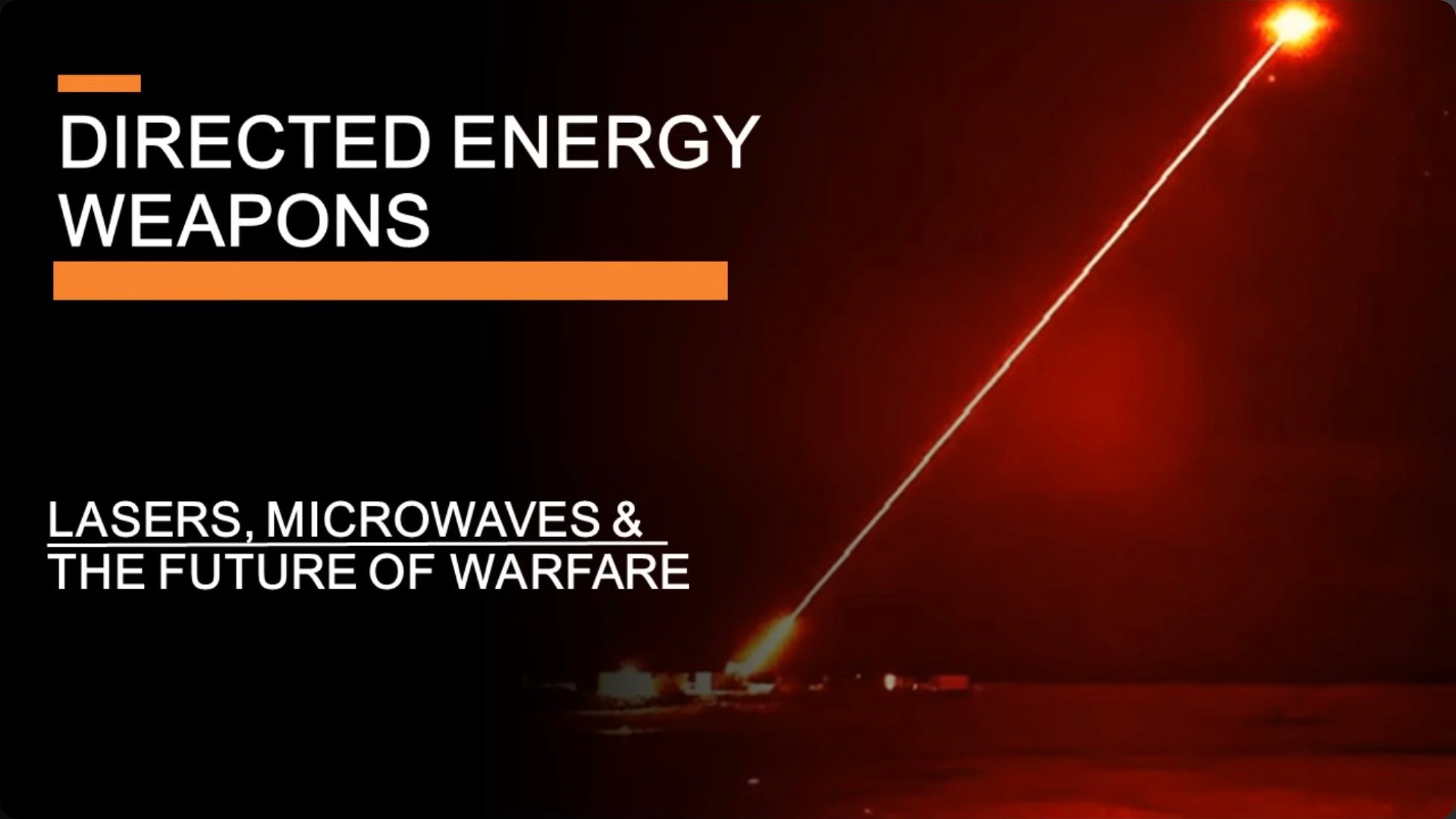
Directed-energy weapons represent a fundamental departure. Instead of imparting energy to a projectile that then carries it to the target, these systems transmit energy directly as a beam. The two dominant technologies are high-energy lasers, which concentrate light to generate intense thermal effects, and high-powered microwaves, which target electronic systems with electromagnetic pulses. Both travel at the speed of light, both can theoretically fire indefinitely given sufficient power, and both promise to upend the economics of modern combat.
Historical Development and Cold War Dreams
The concept isn't entirely new. During the Cold War, both superpowers invested heavily in directed-energy research. The Soviet 1K17, sometimes called the world's first laser tank, mounted a high-powered laser intended to disable enemy optical equipment. While technically functional, the system was hobbled by the era's technological limits: massive power requirements, constrained range, and the reality that a tank-sized platform dedicated to blinding sensors made little sense when the same chassis could simply destroy the enemy vehicle outright.
American efforts were even more ambitious—and arguably more unhinged. Project Excalibur envisioned nuclear-pumped X-ray lasers wrapped around a warhead. The concept was to detonate the nuke in space, and in the microseconds before the weapon vaporized itself, focus X-ray energy into beams that would destroy incoming Soviet missiles. Neither this nor similar concepts ever reached deployment, and after the Cold War such doomsday-scale projects fell out of favor.

Through the 1990s and 2000s, programs continued but struggled to deliver operational capability. The most famous example is the YAL-1 Airborne Laser, which mounted a chemical laser in a modified Boeing 747 to shoot down ballistic missiles during their boost phase. After extensive testing, the program was terminated in 2014. The conclusion: keeping a jumbo jet circling potential launch sites around the clock was impractical, and the system's performance didn't justify the cost.
The Fundamental Value Proposition
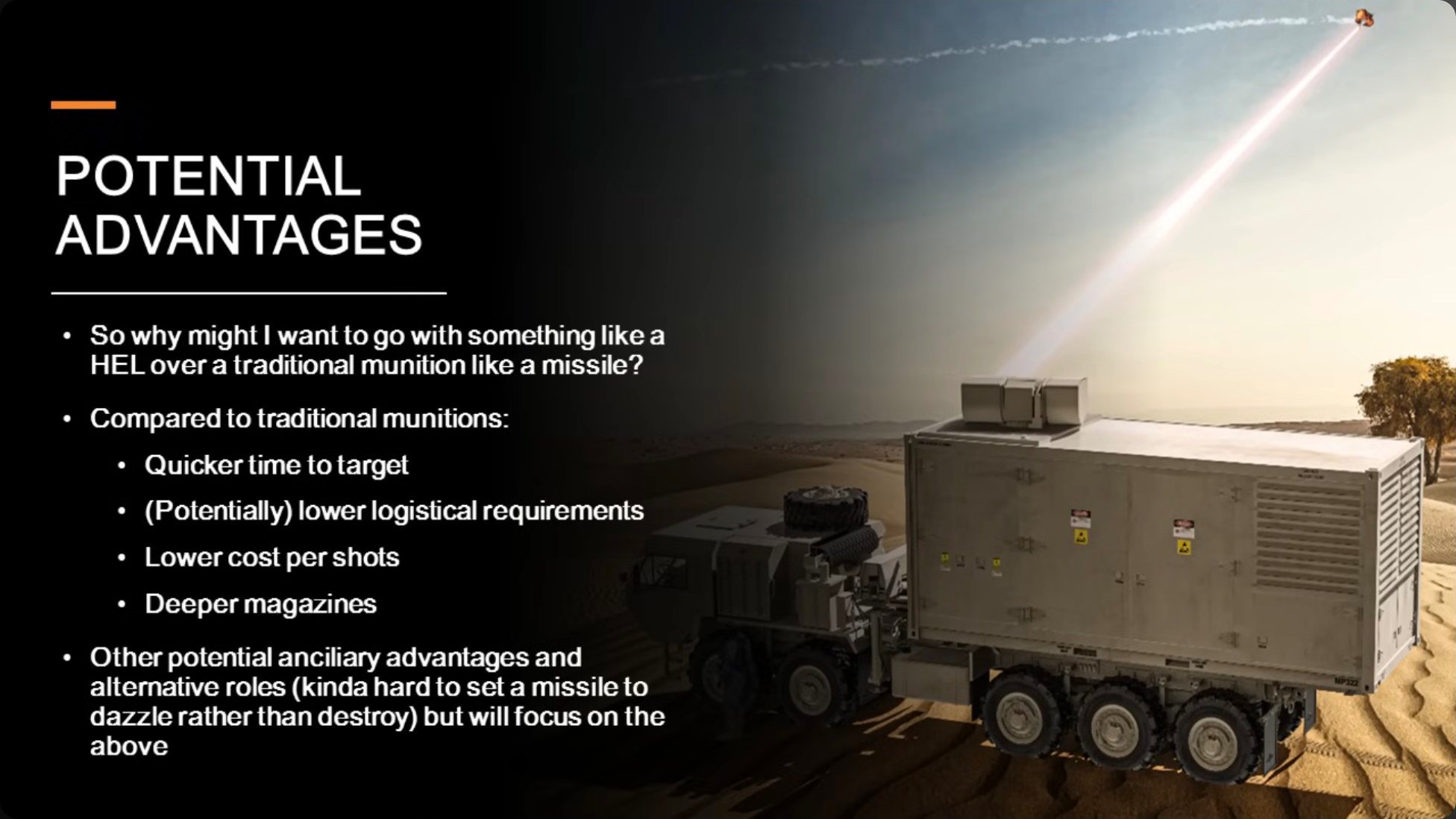
Modern interest in directed-energy weapons stems from three compelling advantages. First is cost per engagement. Firing a defensive missile might cost tens of thousands to millions of dollars per shot. Generating enough electricity to fire a laser once costs orders of magnitude less—potentially just dollars. When defending against cheap drones or mass attacks, this economic asymmetry becomes critical.
Second is time to target. At tactically relevant ranges, a laser beam arrives effectively instantaneously. There's no projectile flight time, no ballistic arc to compute, no midcourse corrections. If the targeting solution is good and the beam is held on target, engagement happens at light speed.
Third is magazine depth. A missile launcher empties when the last round is expended. Assuming adequate power generation and thermal management, a laser can continue engaging targets indefinitely. A German demonstration system reportedly destroys light drones in two to three seconds and can sustain engagements at a rate of six per minute as long as the system remains operational.
How Lasers and Microwaves Differ
Though both are directed-energy weapons, lasers and high-powered microwaves behave very differently. A high-energy laser concentrates coherent light into a narrow beam that applies thermal energy to a point target. Against most targets, the mechanism of damage is heat—burning through materials, detonating warheads, or causing structural failure. Power levels matter enormously: a 30-kilowatt laser might dazzle sensors, a 60-kilowatt system can destroy small drones at short range, but engaging cruise missiles at useful distances likely requires systems in the multi-hundred-kilowatt to megawatt range.
High-powered microwaves operate on entirely different principles. Rather than a focused point, they often illuminate a broader area. The damage mechanism targets electronics: at the right frequency, a microwave pulse can dump enormous energy into circuit boards, processors, and other components, degrading or destroying them outright. A building struck by a sufficiently powerful HPM might show no external damage, yet every computer inside could be rendered inoperable.
This fundamental difference shapes applications. Lasers excel against physical targets where thermal damage is relevant—drones, small boats, missiles with exposed surfaces. Microwaves excel against swarms of electronically-dependent systems or hardened targets where frying the internals is more practical than burning through armor.
Ground-Based Systems and Force Protection
Current development efforts concentrate heavily on defensive applications for ground forces. The modern battlefield presents an acute problem: cheap precision is everywhere. First-person-view drones, loitering munitions, and indirect fire threaten both maneuver forces and fixed installations. Existing solutions—missiles and guns—work, but missiles are expensive and guns have limited magazine depth. Directed energy offers a potential third option.
The U.S. Army's Directed Energy Maneuver Short-Range Air Defence (DE M-SHORAD) program mounts a 50-kilowatt laser on a Stryker chassis. Tests have reportedly demonstrated the ability to engage and defeat multiple mortar rounds and simulate real-world scenarios. The concept is to give combat brigades a mobile system that can shoot down incoming threats without expending costly interceptors.
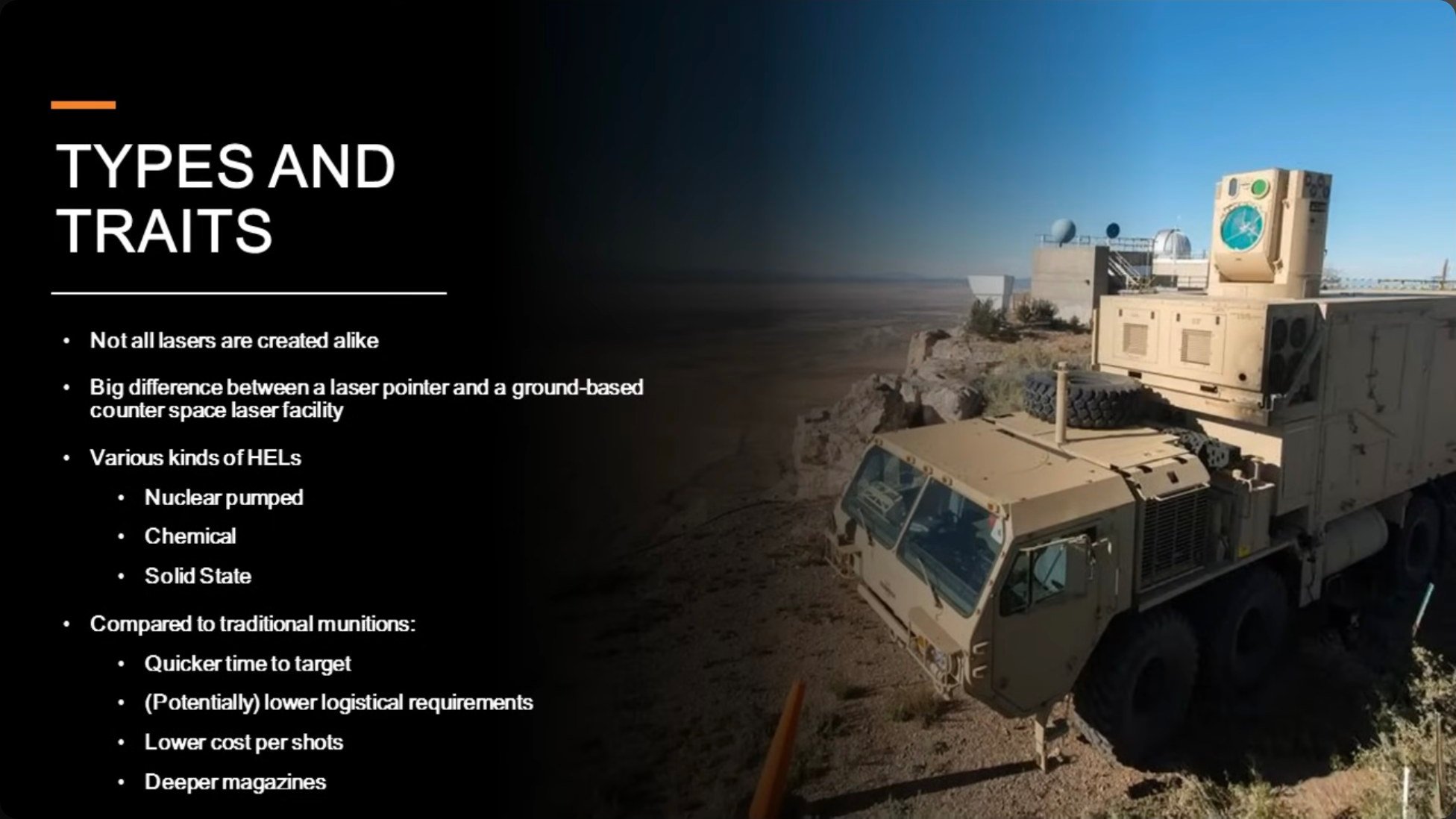
Larger systems intended for semi-fixed or fixed-site defence trade mobility for power. The Indirect Fire Protection Capability High Energy Laser—nicknamed Valkyrie—reportedly generates 300 kilowatts, enabling engagement of cruise missiles in addition to smaller threats. Four prototypes are expected in fiscal year 2025. Israel's Iron Beam, a 100-kilowatt system designed to complement Iron Dome, similarly aims to provide extremely low cost-per-shot defence against mortars, rockets, and artillery at ranges around seven kilometres.
High-powered microwave systems address a different niche: drone swarms. The U.S. Air Force's Tactical High-Power Microwave Operational Responder (THOR) fits inside a shipping container and is designed to engage multiple drones simultaneously by flooding an area with microwave energy. Rather than picking off individual targets sequentially, THOR decides a segment of sky should stop working electronically. The system completed testing and has informed a follow-on program called Mjolnir.
Naval Applications and Magazine Depth
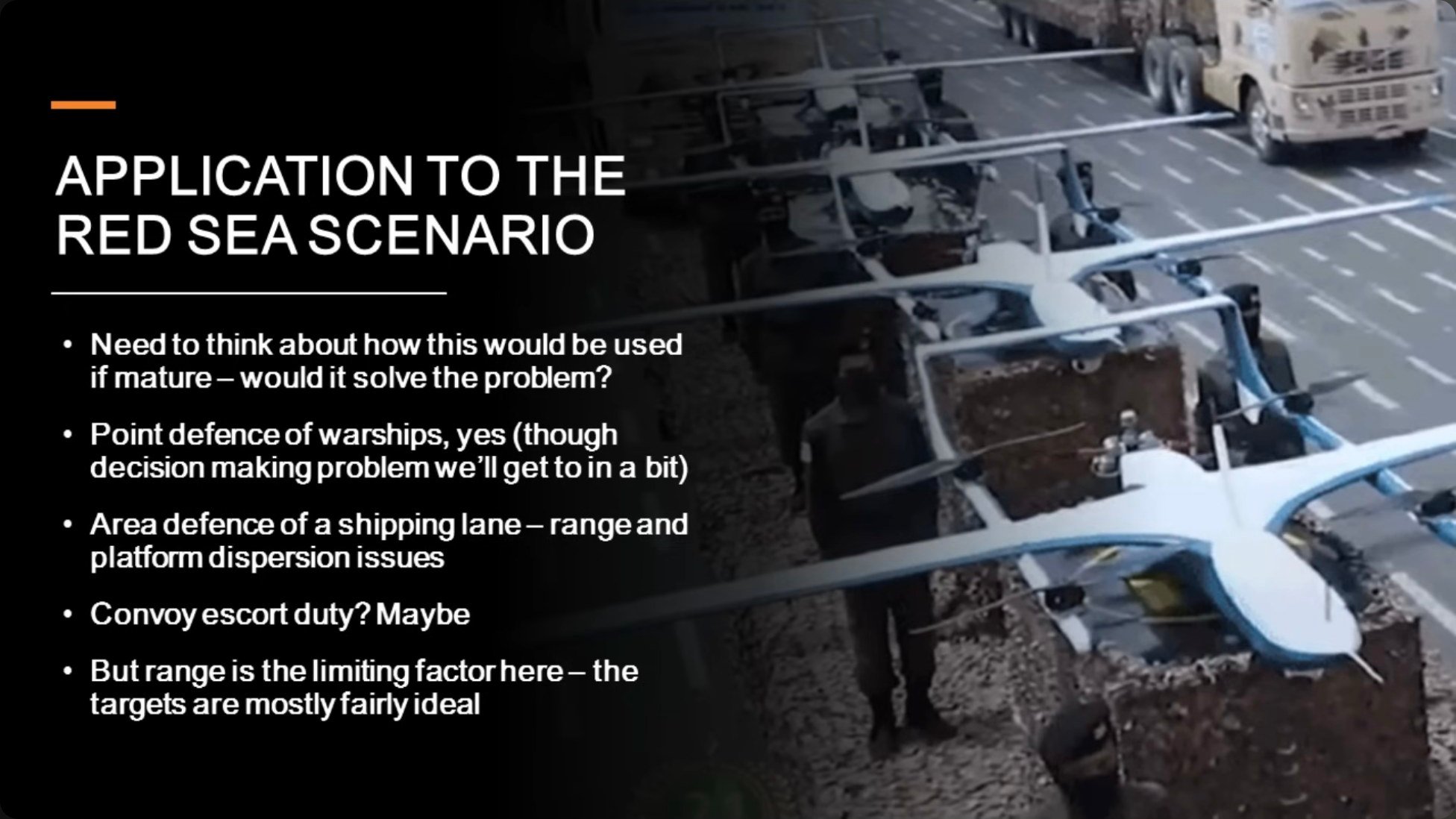
Surface warships face an especially acute version of the directed-energy value proposition. Modern naval air defence relies on vertical launch systems that can ripple-fire interceptors rapidly—but once the magazine is empty, the ship must return to port. Combat operations in the Red Sea have demonstrated this constraint vividly: vessels defending against sustained Houthi drone and missile attacks have had to withdraw for reloading despite remaining otherwise combat-capable.
Directed-energy systems could fundamentally alter this calculus. A warship with sufficient onboard power generation could theoretically engage threats indefinitely without depleting physical munitions. Moreover, because many modern warships use the same vertical launch cells for both defensive interceptors and offensive strike weapons, increasing reliance on energy weapons for defence could free up cells for offensive firepower.
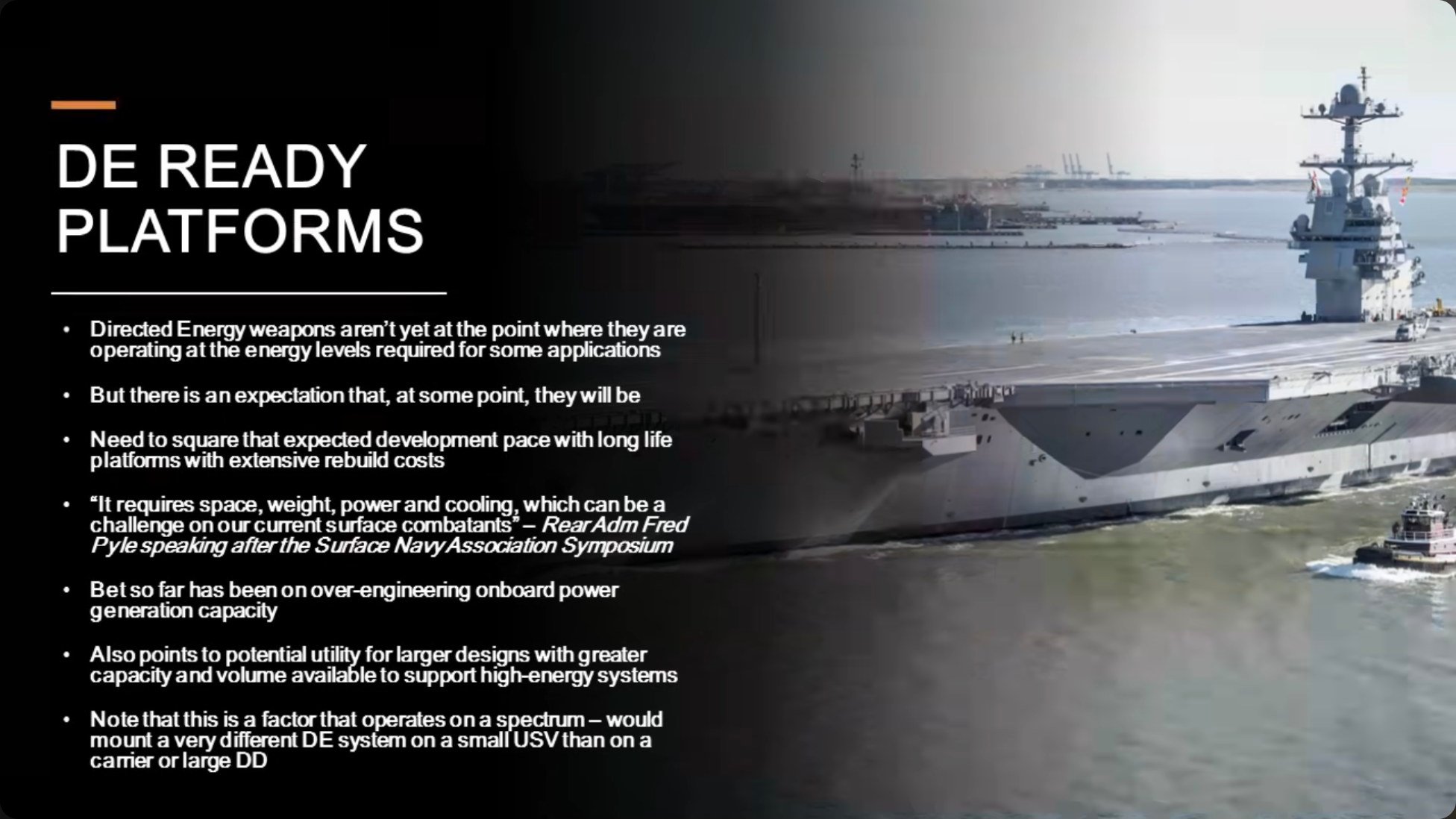
Ships also enjoy engineering advantages. Generating sufficient electrical power is easier aboard a vessel with large diesel generators or nuclear reactors than on a truck or aircraft. Volume and mass allowances are more generous. Cooling—a critical challenge for sustained laser operation—can leverage seawater. Consequently, many next-generation warship designs explicitly incorporate excess power generation capacity to accommodate future directed-energy systems even if those systems aren't yet mature enough for deployment.
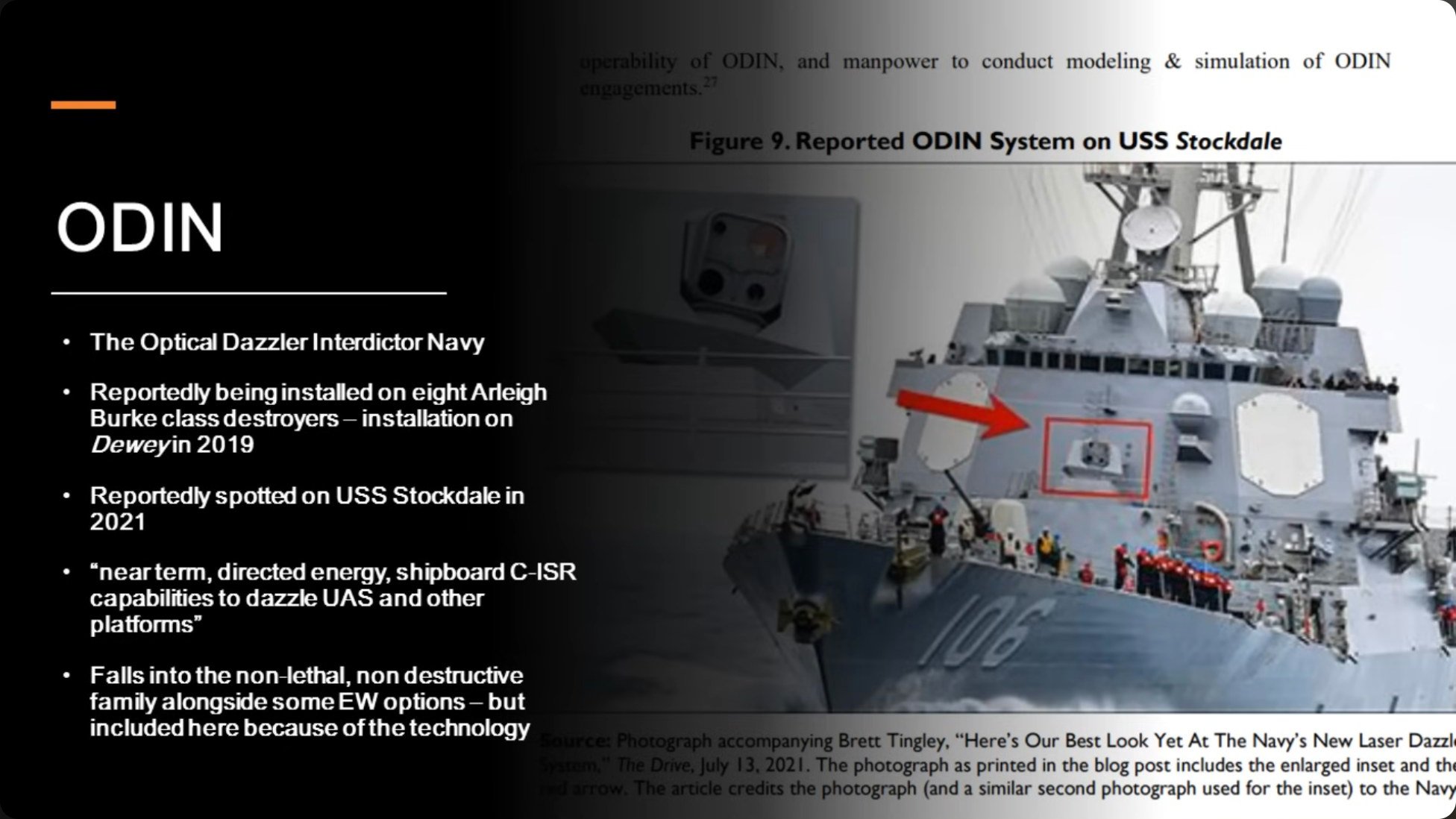
The U.S. Navy has deployed the Optical Dazzler Interdictor Navy (ODIN) on multiple Arleigh Burke-class destroyers. Rather than a destructive weapon, ODIN is a dazzler designed to degrade the sensors of unmanned aerial systems and other intelligence-gathering platforms. The value lies in non-escalatory denial: instead of shooting down a drone conducting surveillance in international waters—potentially provoking a diplomatic incident—ODIN simply blinds it.
More powerful systems are in development. The High Energy Laser with Integrated Optical Dazzler and Surveillance (HELIOS) is a 60-kilowatt system with growth potential to 150 kilowatts, designed to engage small drones and fast attack craft while integrating into the Aegis combat system. Testing in 2021 reportedly included tracking and engaging a high-speed target fed from Aegis sensors. The follow-on High Energy Laser Counter Anti-ship Cruise Missile Program (HELCAP) aims for 300+ kilowatts and the ability to defeat cruise missiles—a significantly harder target requiring both higher power and sophisticated beam control in high-clutter environments.
Aerospace and Counter-Space Roles
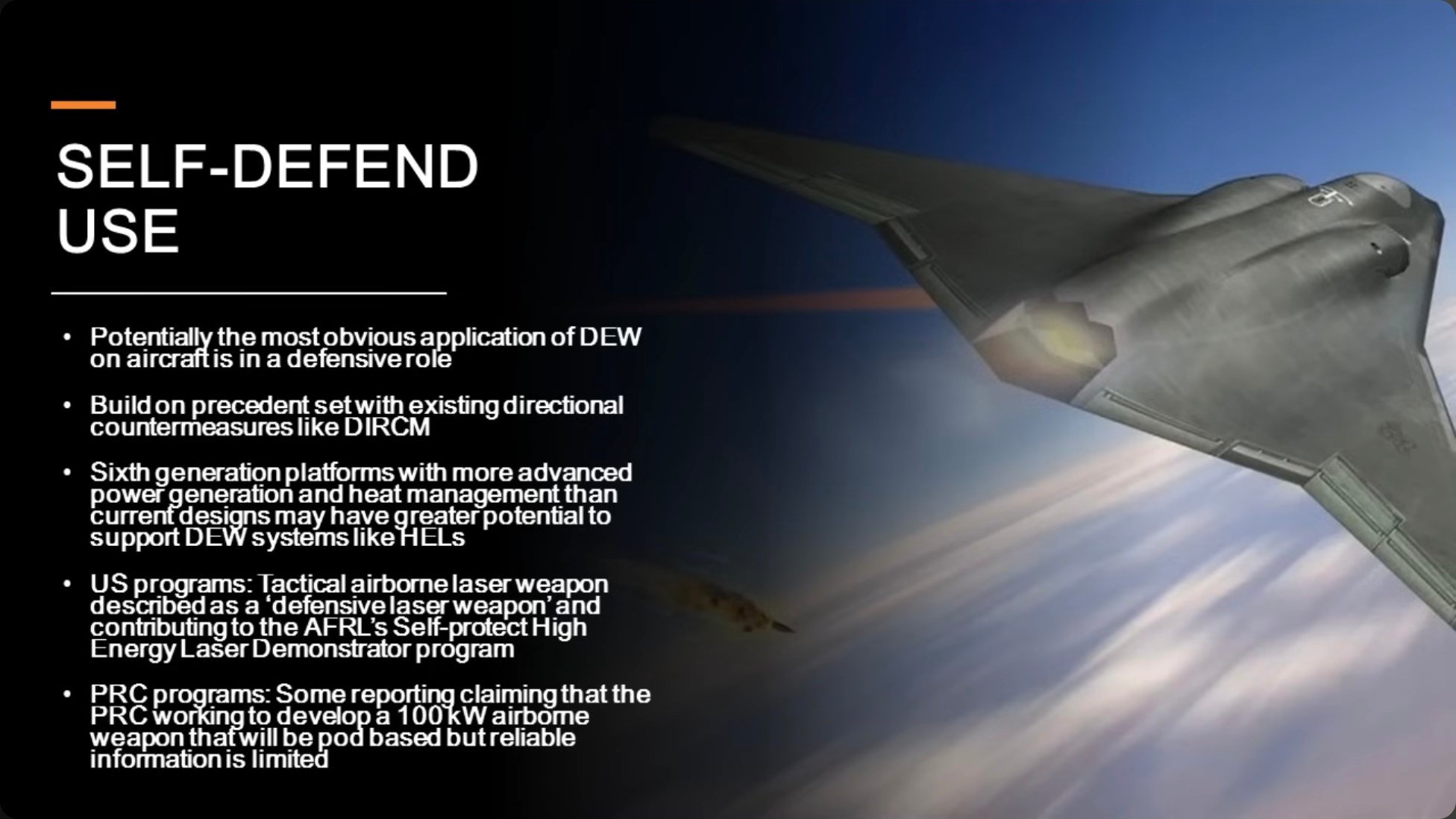
Aircraft represent perhaps the most challenging platform for directed-energy integration. Power generation aboard fighters and bombers is constrained compared to ships, cooling is difficult at altitude, and weight penalties matter enormously. Yet defensive applications remain compelling: if sixth-generation fighters are going to be extremely expensive, layering on additional survivability features—including directed-energy self-defence—makes economic sense.
The U.S. Air Force Research Laboratory's Self-protect High Energy Laser Demonstrator (SHiELD) program aims to develop a pod-mounted defensive laser for tactical aircraft. Testing reportedly demonstrated a ground-based surrogate shooting down multiple air-launched missiles. Lockheed Martin delivered a compact laser unit in 2022, described as one-sixth the size of earlier ground-based systems. Integration onto operational aircraft remains years away, but the trajectory suggests airborne defensive lasers are transitioning from science fiction to plausible near-term capability.
Offensive applications also exist. The Counter-Electronics High-Powered Microwave Advanced Missile Project (CHAMP) demonstrated in 2012 the concept of a cruise missile carrying a microwave emitter that could disable multiple ground targets sequentially during a single flight. Unlike jamming, the effects are permanent or long-lasting; unlike a kinetic warhead, one missile can service multiple targets. Follow-on programs reportedly explore integrating similar systems into stealthy long-range platforms, potentially enabling the aircraft to pop up from terrain-masking, emit a destructive pulse, and retreat without closing to weapon release range.
In space, directed energy offers both offensive and defensive potential. Ground-based lasers capable of dazzling satellites already exist and have been attributed to several nations. Conversely, mounting lasers on satellites themselves could enable space-to-space combat, although the technical challenges and strategic implications remain significant.
Countering Directed Energy
No weapons technology exists in a vacuum. If directed-energy systems proliferate, adversaries will inevitably develop countermeasures. Some are environmental: lasers struggle with clouds, atmospheric turbulence, and other weather phenomena that degrade beam coherence. Even advanced programs cite atmospheric conditions as ongoing technical challenges, and no amount of engineering changes the fact that you cannot shoot a laser through a cloud bank.
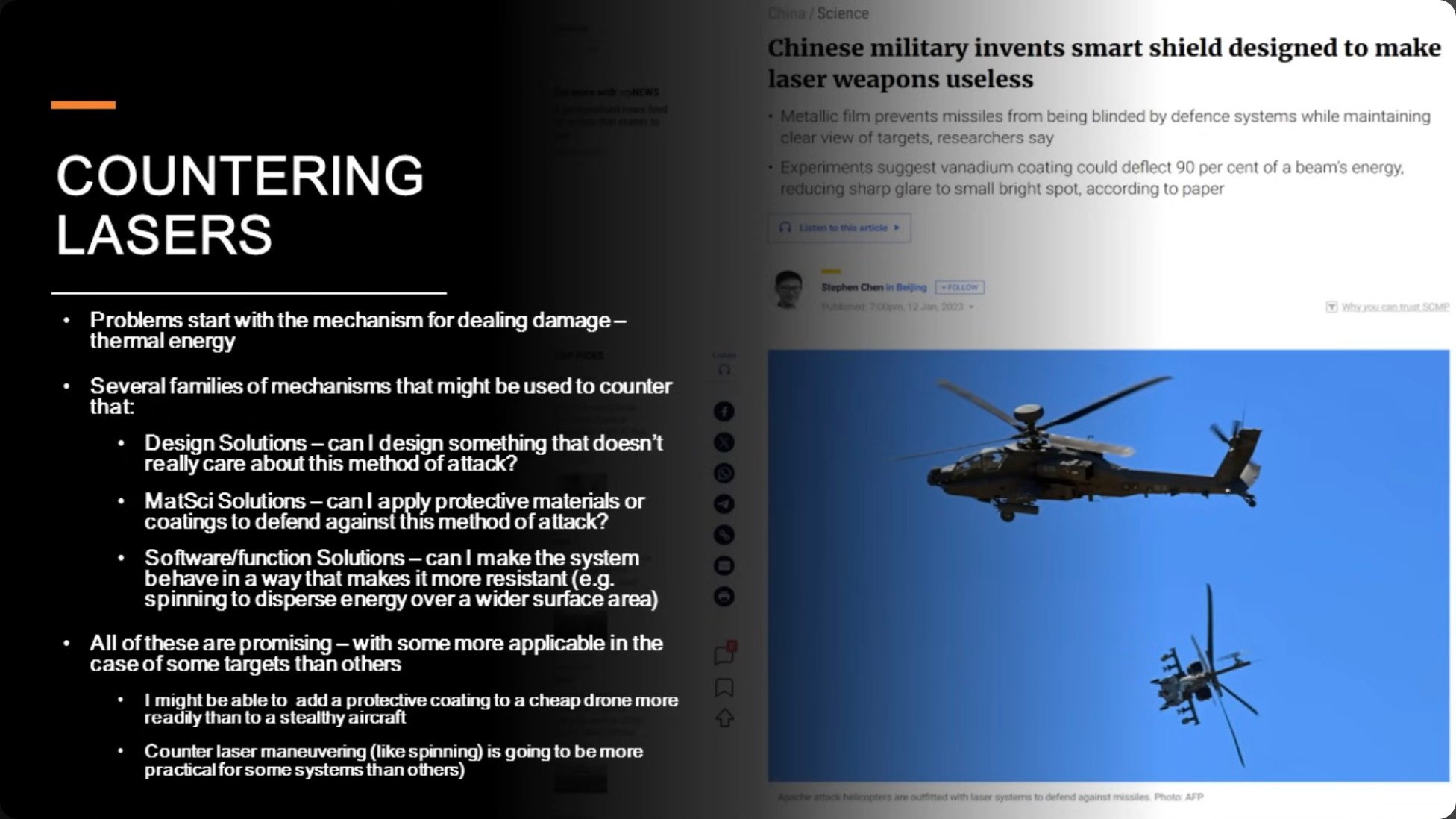
Material science offers other defences. Reflective coatings can reduce the energy a laser deposits on a surface. Ablative or thermally resistant materials can increase the dwell time required to achieve a destructive effect. For microwaves, shielding and hardening electronics provide protection. Even design changes—such as programming a missile to continuously roll, spreading laser exposure across a larger surface area rather than concentrating it on one spot—can significantly increase survivability.
Yet countermeasures impose costs. A commercial quadcopter converted into an FPV drone might cost a few hundred dollars precisely because it uses off-the-shelf components with no hardening. Adding microwave shielding, thermal protection, and redundant electronics increases weight, complexity, and expense. At some point, the ultra-cheap attritable drone becomes a moderately expensive specialised platform—closing the cost gap that made it attractive in the first place.
The Missile Tradeoff Problem
Even when directed-energy systems work as designed, doctrine and operational constraints may limit their use. Consider a warship commander facing an incoming cruise missile. The ship carries both long-range interceptor missiles and a shorter-range laser system. The missile option costs millions but reliably engages at extended range. The laser costs almost nothing per shot but only works at close range—say, within two kilometres.
Tactically, the commander would prefer to try the cheap option first and fall back to the expensive one if necessary. But the range brackets invert that logic. Letting the threat close to laser range means accepting that if the laser fails, there may be insufficient time or geometry to employ the missile backup. Given that warships cost billions and carry hundreds of crew, commanders will understandably default to the option with higher confidence—even if it's vastly more expensive.
This confidence problem means early-generation systems may be underutilised relative to their technical potential. Only as reliability improves, ranges extend, and operational experience accumulates will commanders feel comfortable relying on directed energy as a primary rather than supplementary capability. Until then, these weapons may serve niche roles or act as force-multipliers rather than wholesale replacements for kinetic systems.
Investment Risks and Industrial Realities
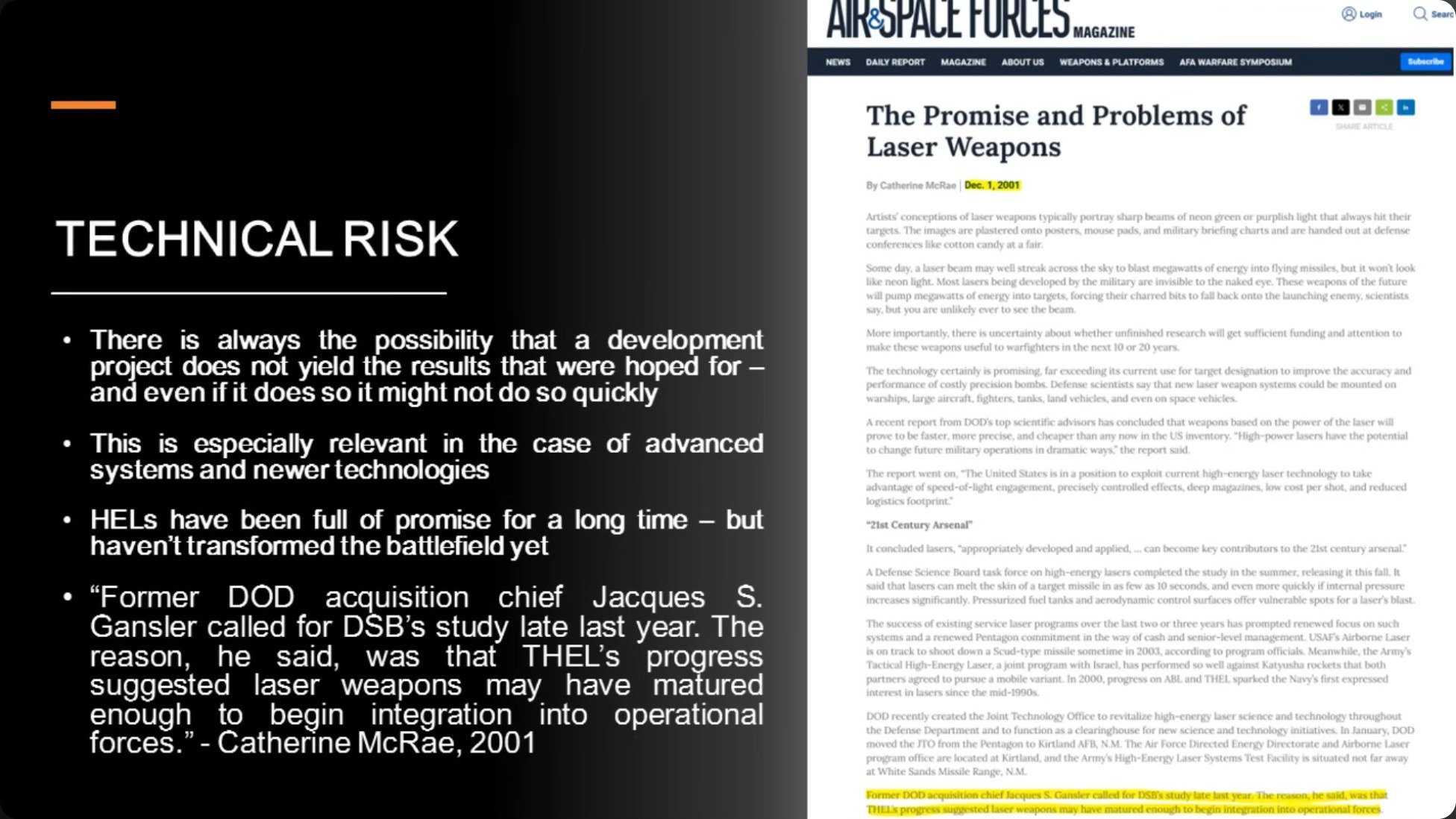
There's an old joke about fusion power: it's the energy source of the future, and always will be. The same has been said of military lasers. Predictions of imminent deployment have circulated for decades. A former U.S. acquisition chief declared in 2001 that lasers had matured enough to begin integration into operational forces—yet more than two decades later, deployment remains limited to a handful of demonstrators and low-power dazzlers.
Technical risk is inherent to developing any novel weapons system, but directed energy carries additional psychological challenges. High-powered microwaves fire without visible signature or dramatic effect, which may reduce perceived effectiveness among decision-makers accustomed to loud bangs and visible launches. Whether this genuinely influences funding decisions is debatable, but the observation highlights that military procurement isn't purely rational—spectacle and institutional culture matter.
Industrial base development presents another challenge. Even if a working prototype exists, scaling to production requires supply chains, skilled labor, and manufacturing infrastructure. The U.S. Navy's budget explicitly funds industrial base improvements for laser components—reducing lead times for optics, improving mirror production, supporting beam director fabrication. Without that parallel investment, a technologically successful program might still fail to field systems in meaningful numbers or at acceptable cost.
Conversely, underinvestment carries its own risks. If a nation develops but doesn't deploy a technology, competitors who acquire the knowledge may field it first using industrial capacity they built in anticipation. The strategic calculus isn't just whether the technology works, but whether the entire ecosystem—from R&D to production to training—can deliver operational capability faster than adversaries.
The Future Battlefield
Directed-energy weapons are unlikely to replace kinetic systems wholesale. Missiles, guns, and bombs will remain central to military arsenals for the foreseeable future. But directed energy doesn't need to replace everything to matter—it only needs to solve specific problems more effectively than alternatives.
The problems it addresses best are increasingly common. Cheap precision—whether FPV drones, loitering munitions, or mass rocket attacks—saturates modern battlefields. Defending against volume attacks using expensive interceptors creates unsustainable cost asymmetries. Directed-energy systems offer a potential escape from that trap, not by making defences impenetrable, but by making them affordable enough to sustain.
Even partial effectiveness may suffice. If directed-energy systems force adversaries to harden their munitions, increase costs, reduce attack volumes, or divert effort into countermeasures, they impose strategic costs regardless of individual engagement success rates. The goal isn't perfect defence—it's raising the bar enough that cheap mass attacks become prohibitively expensive.
That said, expectations should remain measured. Clouds, range limits, power constraints, and countermeasures will all impose boundaries on what directed energy can accomplish. Early systems will likely serve as complements to existing arsenals rather than replacements. The laser gun isn't replacing the AK-47 anytime soon. But for specific applications—point defence of high-value assets, counter-UAS operations, close-in ship defence—the technology may finally be crossing the threshold from perpetual promise to operational reality.
Key takeaways
- → Directed-energy weapons transmit energy directly as beams rather than through accelerated projectiles, offering near-instantaneous engagement and potentially much lower cost per shot than missiles.
- → High-energy lasers and high-powered microwaves differ fundamentally: lasers apply thermal damage to point targets, while microwaves target electronics over broader areas.
- → Modern ground and naval systems focus primarily on defensive roles—countering drones, cruise missiles, and rocket attacks—where cost-per-engagement economics matter most.
- → Countermeasures exist and will proliferate, but forcing adversaries to invest in hardening, shielding, and design changes may impose sufficient costs to provide strategic value even if systems aren't perfectly effective.
- → Operational deployment faces technical, doctrinal, and confidence challenges—commanders may hesitate to rely on shorter-range directed energy when proven long-range missile options exist.
- → Naval platforms may have inherent advantages for directed-energy integration due to greater power generation capacity, cooling potential, and volume allowances compared to land or air platforms.
- → Industrial base development matters as much as prototype success—scaling from laboratory demonstrators to fielded systems requires supply chains, manufacturing capacity, and skilled labor.