
Annotated transcription · 9 min read
The Physics and Engineering of Pneumatic Shock Wave Cannons
How extreme pressure differentials, valve dynamics, and stored air volume combine to create devastating kinetic effects.
The Fundamental Problem: Scaling Stored Energy
Compressed air systems deliver power based on three critical variables: pressure, volume, and release rate. While pressure receives most attention in casual discussions, volume plays an equally important role in determining total energy output. A cartridge holding compressed air at 4,500 PSI may sound impressive, but if that cartridge contains only 0.025 liters at atmospheric pressure, the total stored energy remains modest. By contrast, a tank holding ten times that volume at the same pressure contains ten times the energy — not merely ten percent more.
This distinction becomes crucial when designing pneumatic systems for maximum kinetic effect. A small paintball cartridge at 4,500 PSI contains far less destructive potential than a large industrial tank at even 570 PSI, simply because volume scales multiplicatively with pressure when calculating total gas mass. The engineering challenge lies in combining both: maintaining extreme pressure while dramatically increasing containment volume.
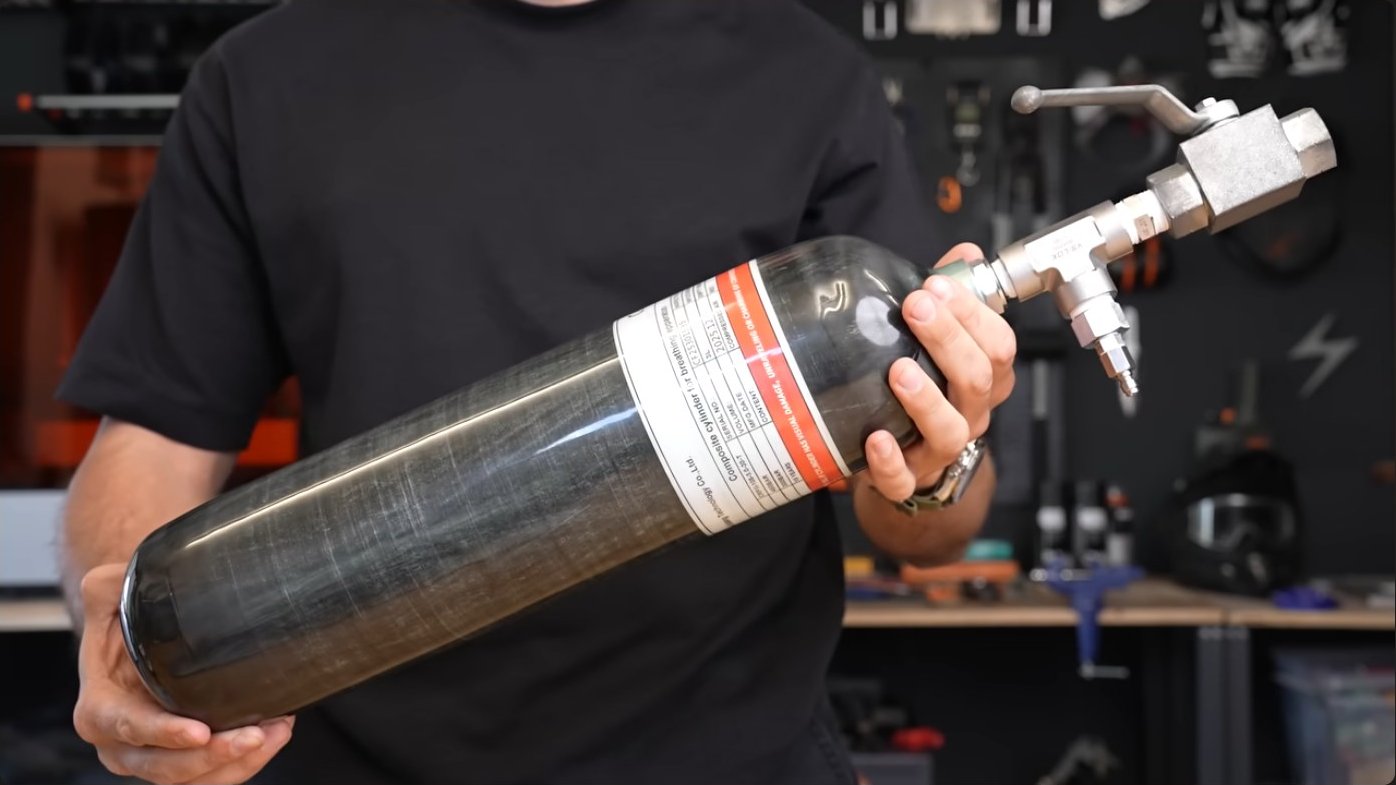
Moving from a 0.025-liter cartridge to a 3-liter tank represents a 120-fold increase in volume capacity. At 4,500 PSI, this larger tank holds approximately 918 liters of air at atmospheric pressure. This isn't just more powerful — it's a different category of energy storage entirely. The difference resembles comparing a firecracker to a quarter-stick of dynamite: both use the same chemical principles, but scale transforms the outcome.
Valve Dynamics and Flow Restriction
Storage capacity means nothing without efficient release. A valve that opens slowly bleeds pressure gradually, converting stored potential energy into heat and turbulence rather than directed kinetic force. The goal in shock wave generation is releasing all stored air as near-instantaneously as possible, creating a sharp pressure differential that propagates as a supersonic wave front.
Ball valves offer excellent flow characteristics when fully open, but their rotational mechanism creates friction under pressure. At 4,500 PSI, enormous forces act against the valve's sealing surfaces, resisting rotation. Manual operation becomes progressively slower as pressure increases — precisely the opposite of what shock wave generation requires. This creates an engineering paradox: the components rated for extreme pressure tend to be the same ones most resistant to rapid actuation.
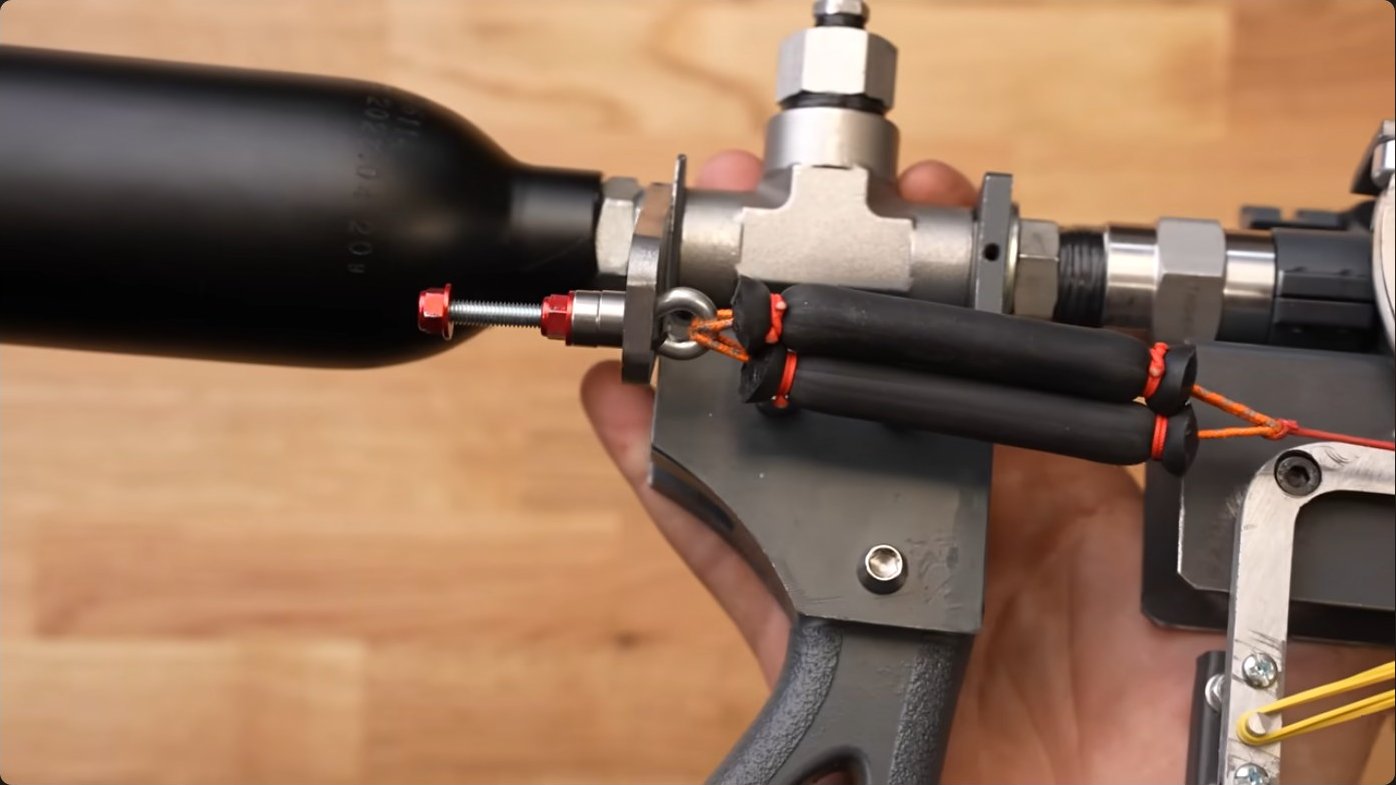
Alternative valve technologies exist — solenoid valves can actuate electronically, and quick-exhaust valves open in milliseconds — but most sacrifice either pressure rating or flow capacity. A solenoid valve rated for 4,500 PSI typically features a small orifice that restricts flow. A quick-exhaust valve with adequate flow may only handle 200 PSI. The solution involves mechanical assistance: using stored elastic energy to overcome valve friction.
Thick rubber bands used in spear guns can store substantial energy when pre-tensioned. By mechanically linking these bands to the valve lever and designing a trigger mechanism to hold them in tension, the valve can be forced open with significant force. At 330 percent extension, two bands generate approximately 40 kilograms of pulling force. This proves barely adequate at full pressure, requiring the addition of two more bands to achieve reliable fast opening.
The Trigger Mechanism and Mechanical Advantage
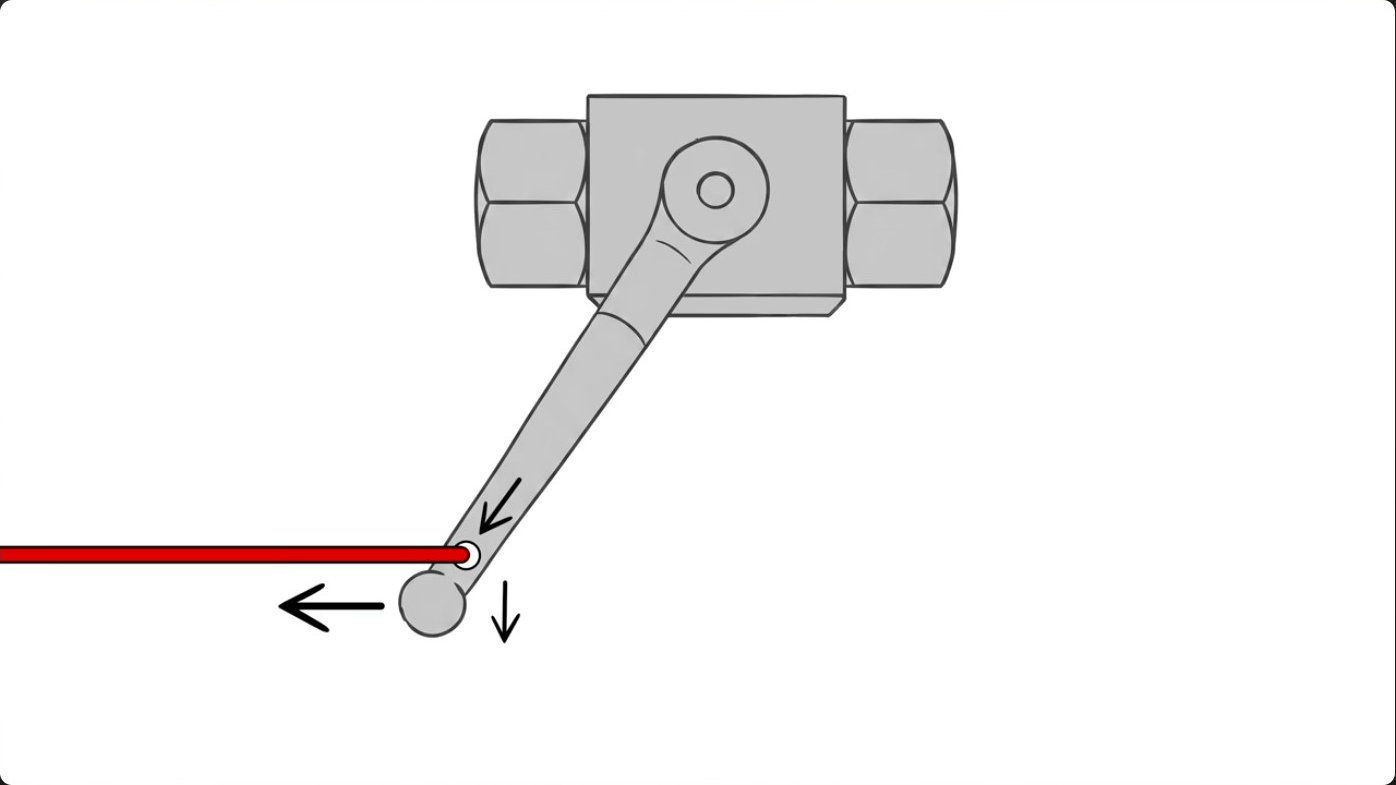
A standard ball valve lever extends straight outward, providing leverage for hand operation. But this geometry wastes elastic force throughout most of the rotation arc. When stretched elastic pulls at an angle other than perpendicular to the lever, only the perpendicular component contributes to rotation — the rest is wasted. At the beginning and end of rotation, when the band pull is nearly parallel to the lever, almost all force is wasted.
The solution lies in wrapping the rope or band around a curved lever profile. By machining the lever with a spiral shape, the attachment point continuously adjusts as the valve rotates, maintaining a perpendicular pull angle throughout the entire motion. This eliminates wasted force and ensures maximum torque application from the stored elastic energy at every point in the valve's travel.
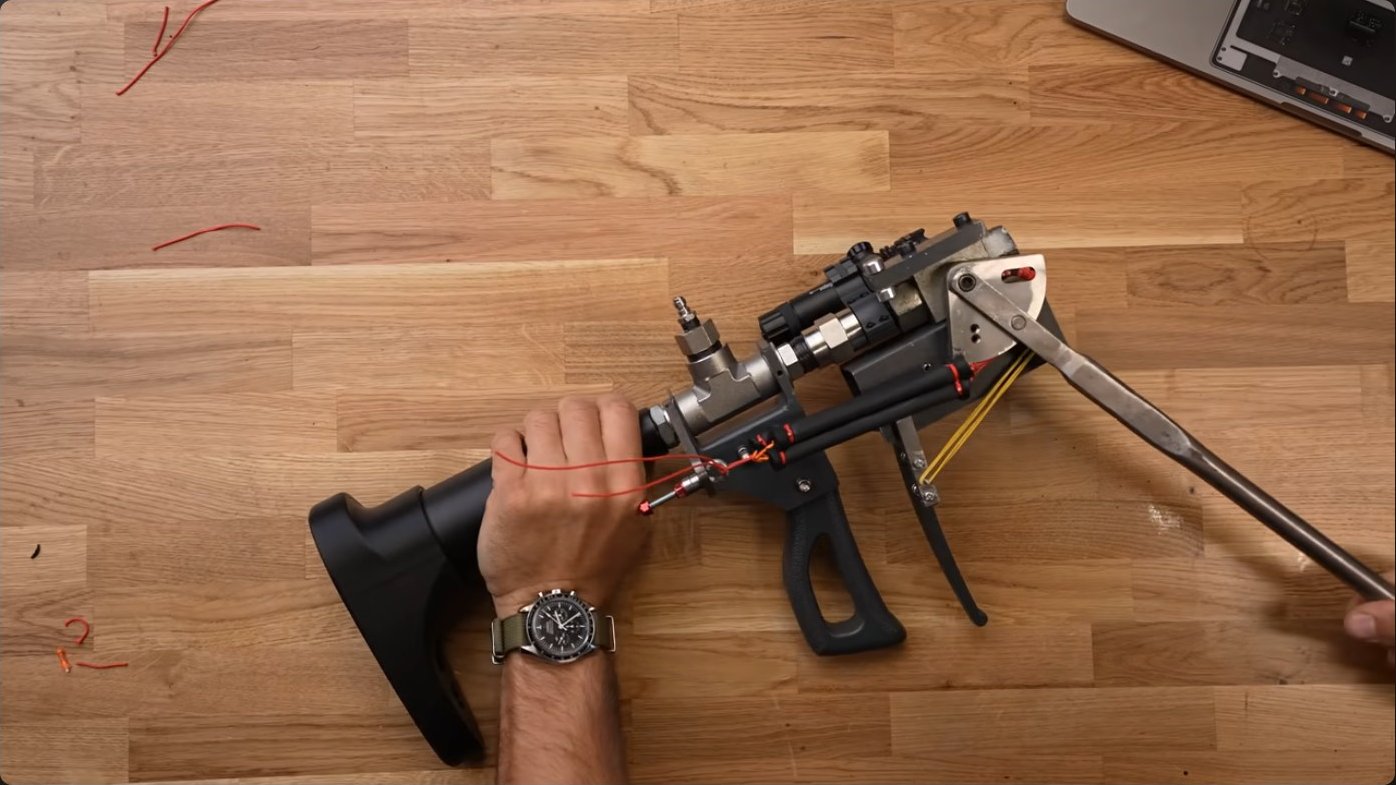
The trigger itself functions as a simple mechanical interlock. An L-shaped element sits in front of the valve lever, physically preventing rotation despite the elastic tension. When the trigger is pulled, this element pivots out of the way, instantly releasing the lever. The elastic bands then snap the valve from fully closed to fully open in a single frame of high-speed video — roughly 0.004 seconds based on 250 frames per second footage.
Pressure, Volume, and the Recoil Problem
Newton's third law guarantees that every action has an equal and opposite reaction. When 918 liters of air at 4,500 PSI exit through a nozzle at supersonic velocity, the cannon experiences an equal momentum impulse in the opposite direction. This recoil force increases with both pressure and volume, making the largest tank configurations genuinely dangerous to operate handheld.
Initial tests with a small 0.25-liter tank at 2,000 PSI produced noticeable but manageable recoil. Scaling to a 0.5-liter tank at 4,000 PSI more than doubled the kick, requiring two-handed operation and firm bracing. The 3-liter tank at full pressure generated enough recoil to bend steel mounting plates and physically move heavy tables, eventually launching the entire assembly backward with enough force to travel ten meters.
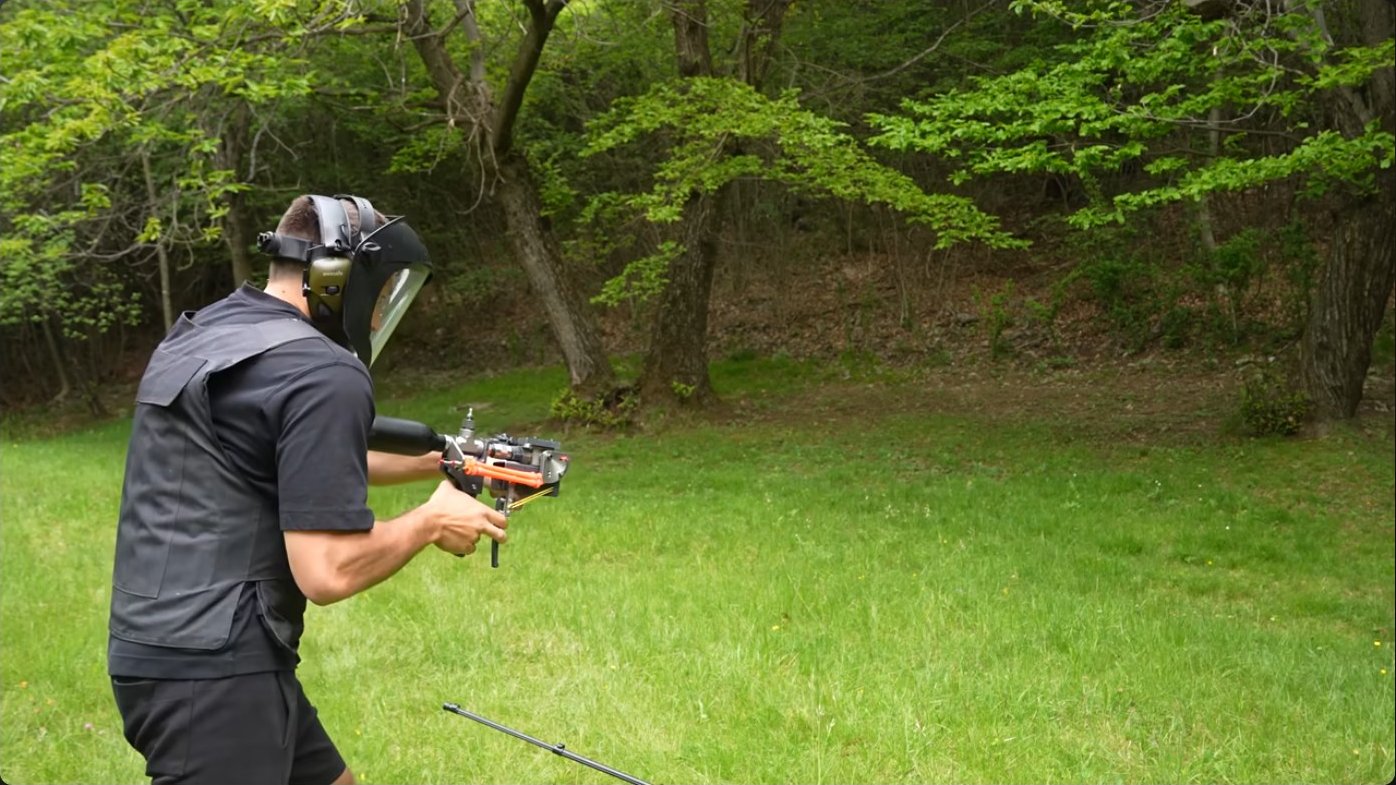
The recoil impulse can be estimated from the momentum of expelled air. At 4,500 PSI, the tank contains approximately 7.4 kilograms of air. If this exits at an average velocity of 300 meters per second (a conservative estimate given supersonic flow), the momentum transfer exceeds 2,200 newton-seconds — equivalent to the recoil of firing a 12-gauge shotgun shell roughly fifty times in under a tenth of a second.
This necessitated remote triggering for the largest tank tests. A cable attached to the trigger allowed actuation from behind cover, while the cannon itself was clamped to a heavy table with additional ballast. Even this proved insufficient — the recoil sheared mounting bolts, bent table legs, and launched the entire assembly despite 40 kilograms of added weight.
Shock Wave Formation and Acoustic Phenomena
When air decompresses from 4,500 PSI to atmospheric pressure effectively instantaneously, it expands by a factor of more than 300 to 1. This expansion occurs faster than sound can propagate through the surrounding air, creating a supersonic shock wave. The pressure discontinuity forms a sharp boundary — essentially a moving wall of compressed air — that propagates outward from the nozzle.
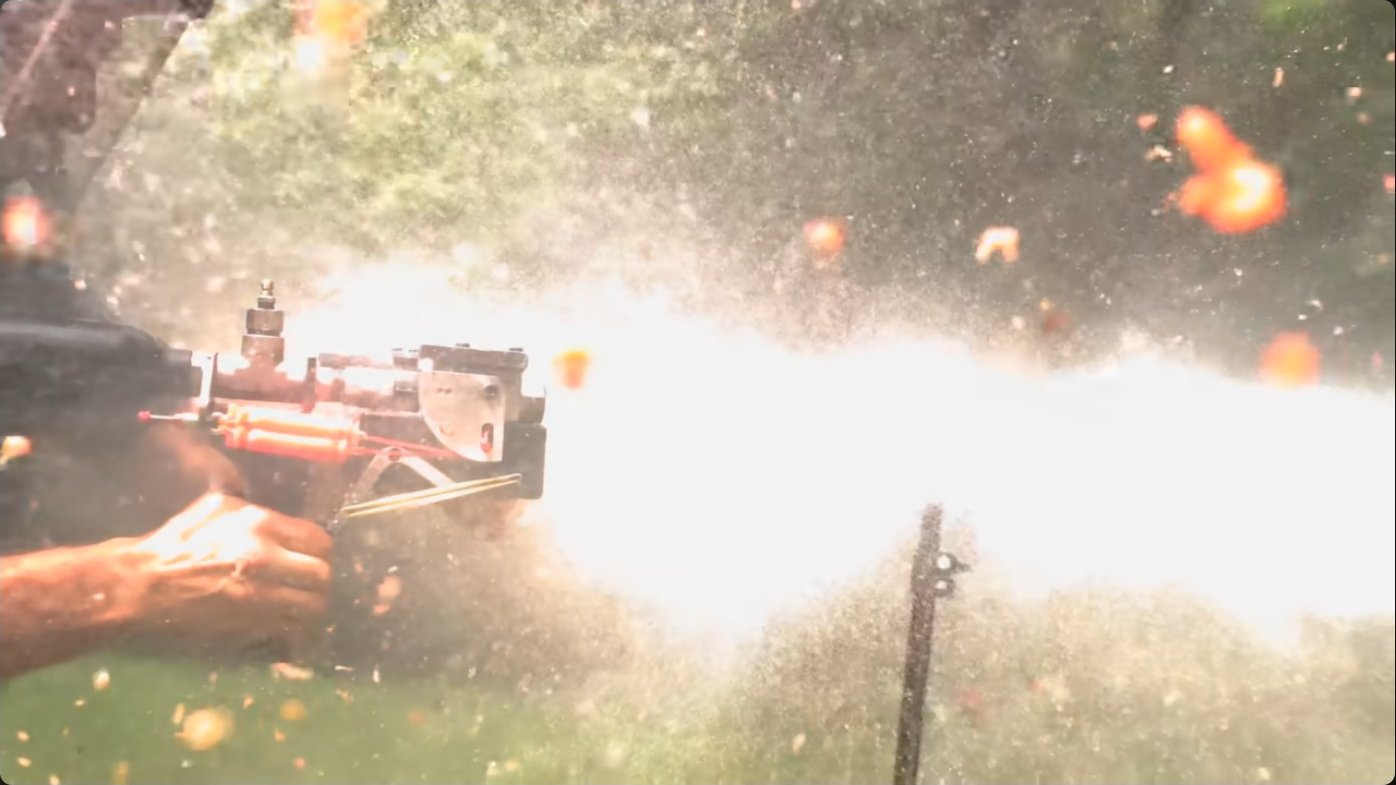
High-speed photography reveals the shock structure in remarkable detail. Immediately after valve opening, the escaping air cools adiabatically — expansion converts pressure energy into kinetic energy, dramatically lowering temperature. The cooling is sufficient to drop the air temperature below the dew point, instantly condensing moisture and forming a visible cloud of ice crystals. This appears as a blue-white flash at the nozzle exit.
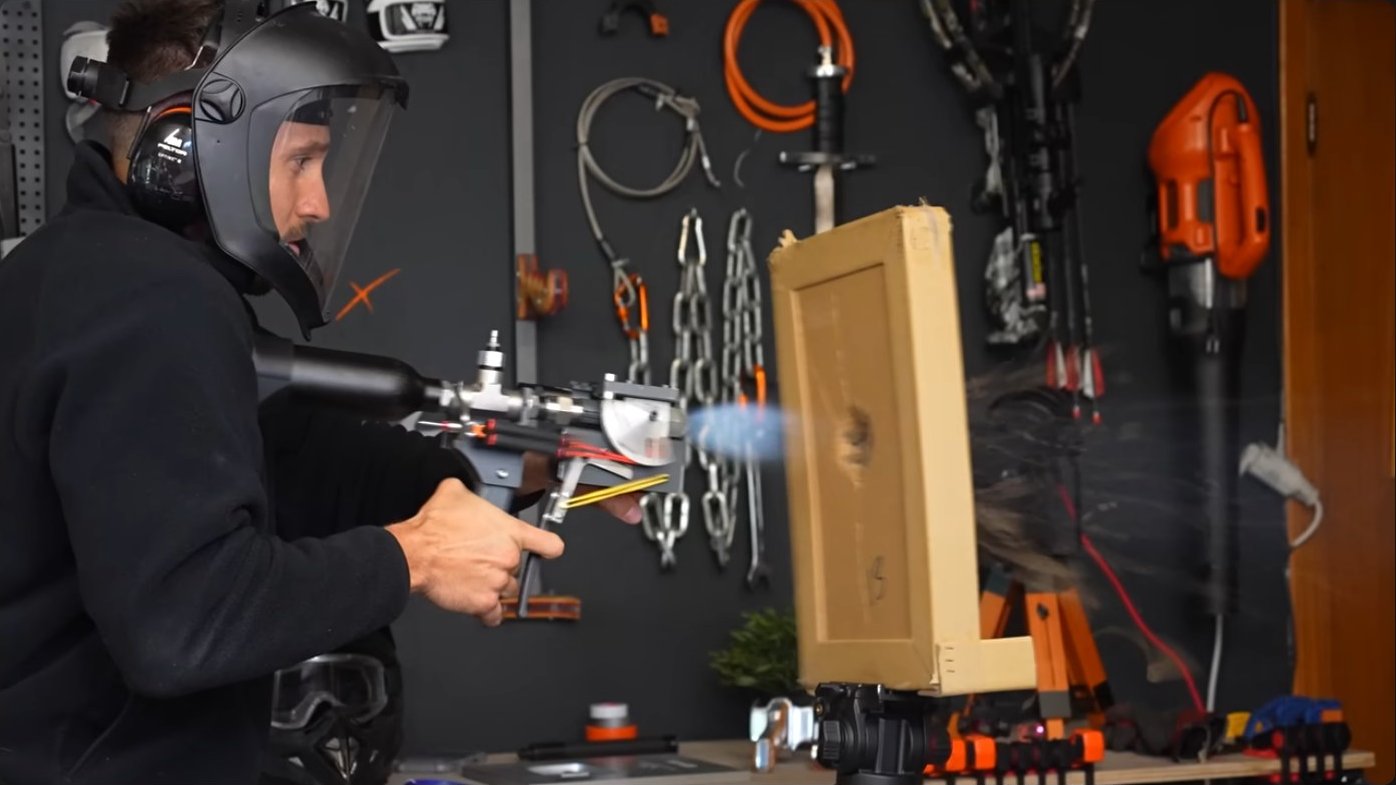
Behind this initial condensation front, the exhaust forms characteristic shock diamonds — a regular pattern of bright and dark bands perpendicular to the flow direction. These occur when exhaust pressure oscillates above and below atmospheric pressure as the jet equilibrates with its surroundings. At the boundaries of each oscillation, oblique shock waves form, creating visible compression regions that appear as bright diamonds due to increased density.
The acoustic signature mirrors that of supersonic firearms. The initial shock wave produces a sharp crack — the pneumatic equivalent of a muzzle blast. This sound exceeds 140 decibels at close range, well into the range of immediate hearing damage. The sustained roar of escaping air follows, though this secondary noise is less intense than the initial shock.
Terminal Effects and Range Limitations
The destructive effect of a pneumatic shock wave depends critically on distance. At point-blank range — defined here as the nozzle directly touching or within centimeters of the target — the pressure differential is enormous. The target experiences the full 4,500 PSI pressure over the contact area before the air can expand and dissipate. This creates localized pressures sufficient to rupture organic materials catastrophically.
Standoff distance degrades effectiveness rapidly. At even one meter range, the expanding air has dispersed over a much larger area. The peak pressure the target experiences may drop to a fraction of the initial chamber pressure. Tests with small-volume tanks showed essentially zero effect beyond half a meter, while larger volumes maintained some effectiveness to perhaps two meters. This represents a fundamental limitation: without a projectile, pneumatic systems cannot concentrate energy at distance.
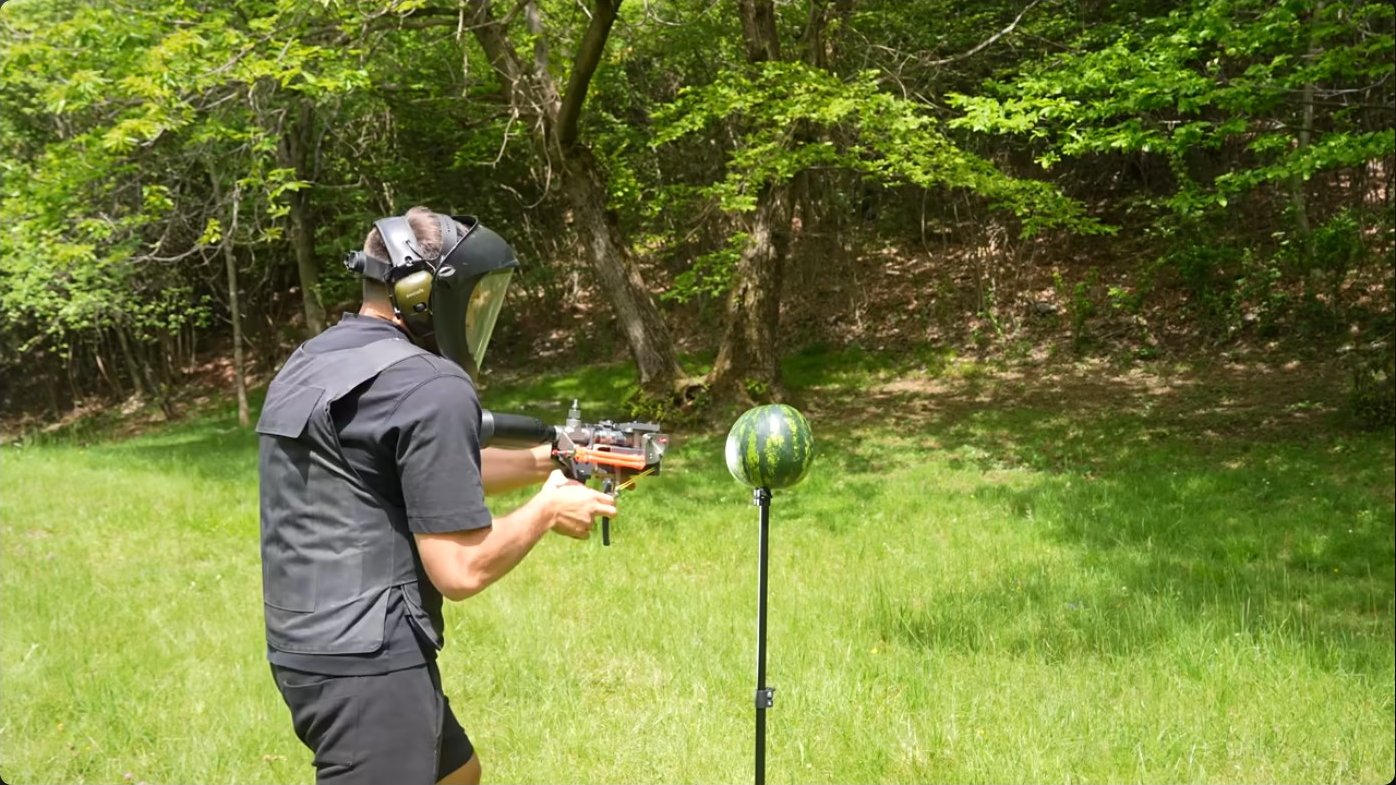
Increasing stored volume extends effective range somewhat, but cannot overcome the cubic expansion problem. A 3-liter tank showed marginally better standoff performance than a 0.25-liter tank, destroying targets at distances where the smaller tank had no effect. This suggests that while pressure determines peak force at contact, volume determines how far that force can project before dissipating below the threshold for damage.
Target material properties also matter significantly. Soft, fluid-filled targets like watermelons responded to shock waves even at distances where rigid targets were unaffected. The hydraulic coupling of the shock into liquid allows pressure to propagate through the target volume, rupturing it from within. Conversely, rigid targets like ballistic gel heads absorbed far more energy without catastrophic failure, though still sustaining severe surface damage.
Practical Engineering Challenges
Building pneumatic systems at this scale introduces numerous practical obstacles beyond pure physics. First among these: fill time. A standard paintball compressor might output 3 cubic feet per minute at 3,000 PSI. Filling a 3-liter tank to 4,500 PSI under these conditions requires well over four hours. This makes iterative testing essentially impractical — each test shot demands half a day of preparation.
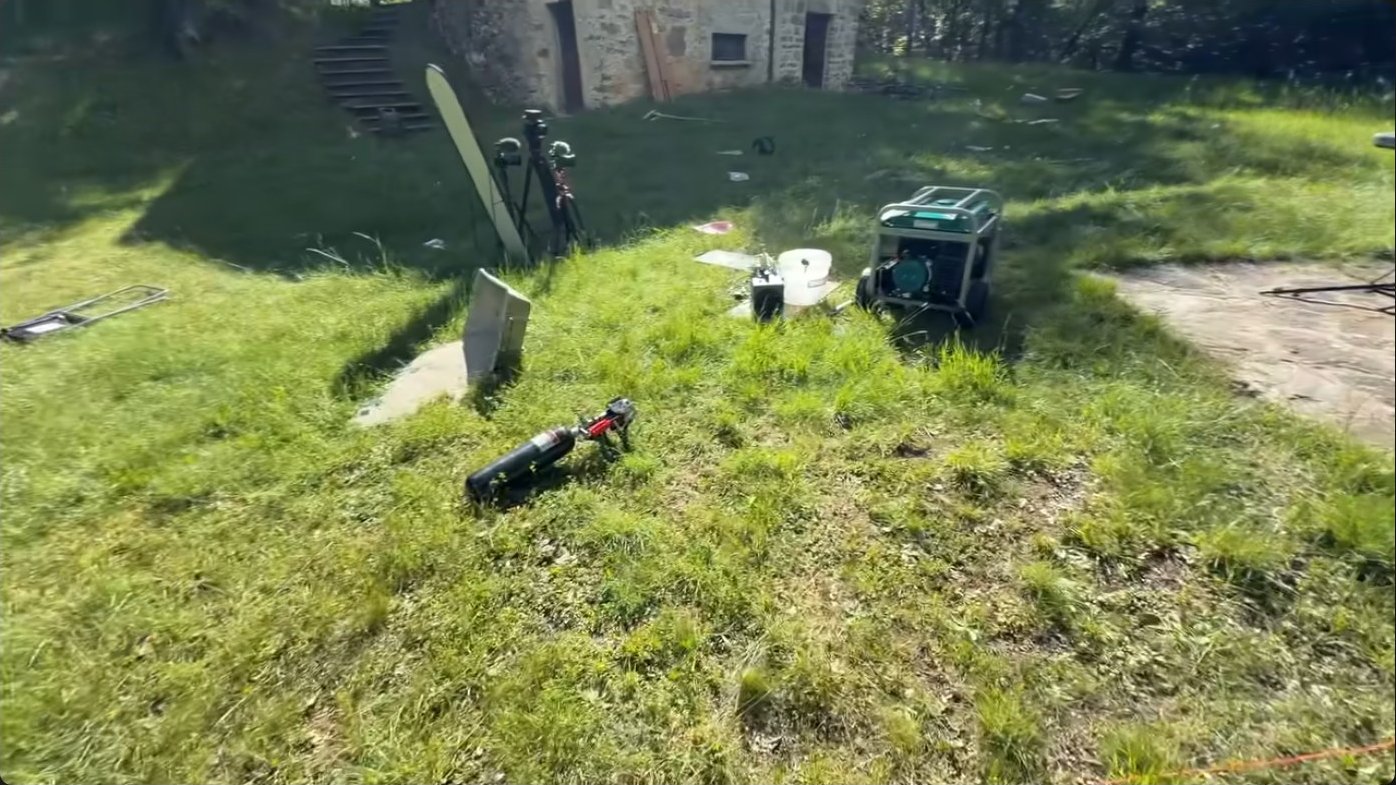
Upgrading to a water-cooled compressor with higher flow reduced fill time to approximately twenty minutes at maximum pressure. This remains substantial but enables multiple shots per session. The compressor itself requires 2,000 watts of electrical power, necessitating a gasoline generator when operating in remote locations without grid access. The system becomes progressively less portable as capacity increases.
Component failure modes proved more violent than anticipated. When stressed beyond their design limits, mechanical elements don't simply bend — they fracture explosively. Steel mounting plates sheared rather than deforming plastically. Table legs buckled in a fraction of a second. The entire assembly became a projectile when insufficiently secured. This behavior demands substantial safety margins and conservative engineering.
Perhaps most surprising: the nonlinear relationship between pressure and force requirements. Doubling system pressure did not double the force needed to open the valve against internal pressure — it more than tripled it in testing. This suggests friction effects and seal deformation create quadratic rather than linear scaling, making extreme-pressure operation disproportionately difficult.
Testing Results and Destructive Capacity
Controlled testing against standardized targets provided quantitative data on destructive effects. A small 0.25-liter tank at 4,000 PSI delivered sufficient energy to rupture a watermelon at point-blank range, but produced no visible effect at one meter distance. The target simply remained intact, suggesting the shock wave had dissipated below the failure threshold for the target material.
Scaling to a 0.5-liter tank at identical pressure extended effective range slightly and increased damage severity. The same watermelon target at point-blank didn't just rupture — it effectively vaporized, with fragments landing ten meters from the impact point. This suggests a threshold effect: once sufficient energy is delivered to rupture the target completely, excess energy accelerates the fragments rather than merely splitting the target.
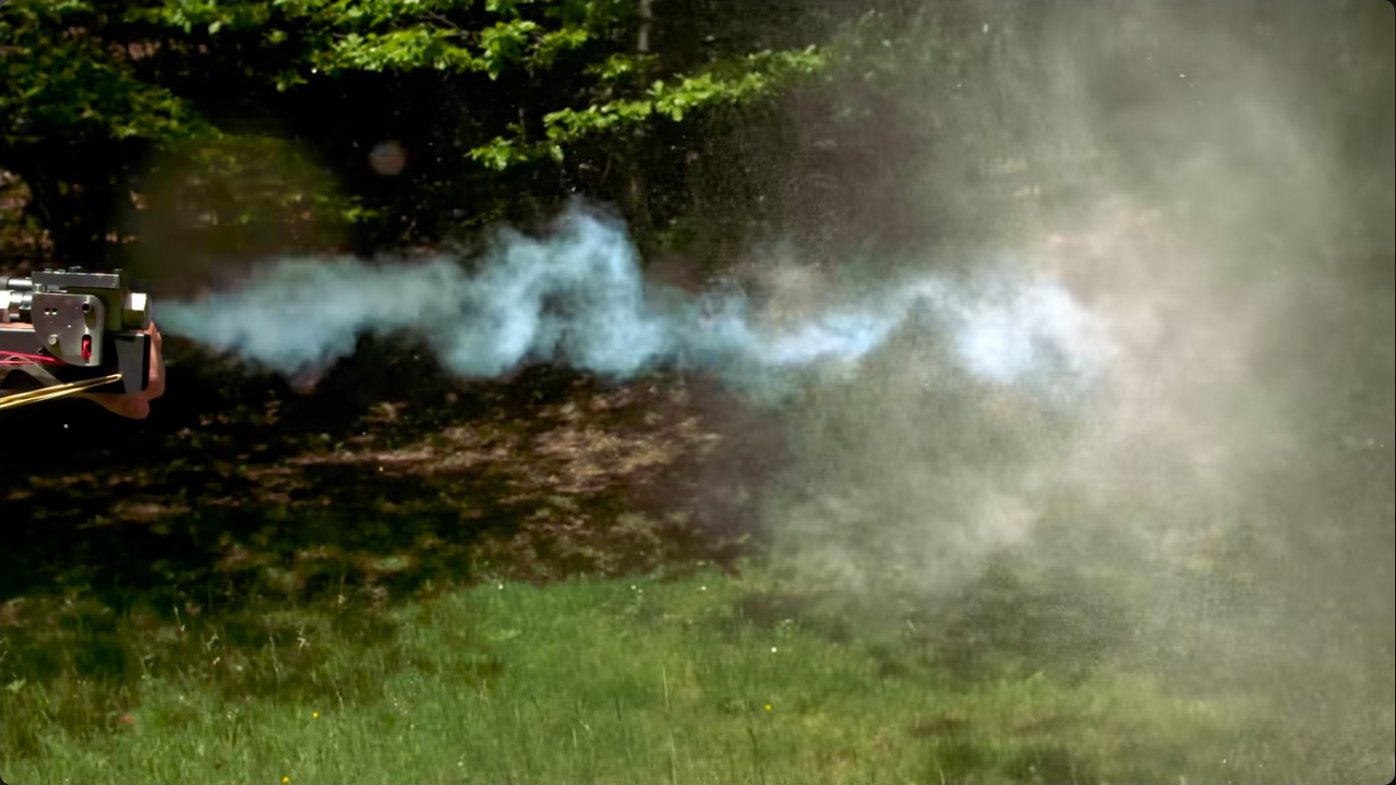
The 3-liter tank represented a step change in destructive capacity. At full pressure, it delivered enough energy to destroy a ballistic gel head completely, scattering components over a 30-meter radius despite a 40-kilogram mounting system. The shock wave was powerful enough to launch the entire cannon assembly backward ten meters, bending steel components and buckling the mounting table.
Penetration characteristics differed markedly from conventional projectiles. Rather than drilling a neat hole, the shock wave created large-diameter damage with irregular boundaries. Soft targets disintegrated rather than showing puncture wounds. Hard targets exhibited surface cratering and spalling. The damage pattern suggests extreme localized overpressure followed by rapid pressure decay, creating a fundamentally different failure mode than kinetic penetrators.

Safety Considerations and Risk Mitigation
Compressed air at these pressures stores energy densities approaching low explosives. A 3-liter tank at 4,500 PSI contains approximately 2.7 megajoules — comparable to 650 grams of TNT. Unlike chemical explosives, this energy releases relatively slowly, but catastrophic tank failure would still produce lethal fragmentation over a wide radius.
Carbon fiber overwrapped pressure vessels provide substantial safety margins when used within their rated specifications. These tanks fail progressively rather than explosively — the carbon fiber develops cracks that leak air rather than shattering the aluminum liner. However, any modification, impact damage, or operation beyond rated pressure transforms this failure mode into something far more hazardous.
Recoil management proved equally critical to operator safety. Attempting to shoulder-fire the 3-liter system would likely result in serious injury from the recoil impulse alone. Remote triggering becomes mandatory beyond certain energy thresholds, not merely convenient. Even with remote operation, the cannon must be secured sufficiently to prevent it from becoming a projectile — a lesson learned after the mounting system failed catastrophically during testing.
Acoustic trauma presents a less obvious but equally real hazard. The crack of supersonic release exceeds safe exposure levels by a substantial margin. Hearing protection is non-negotiable, and double protection — both earplugs and earmuffs — is advisable at close range. The temporary threshold shift from even a single shot without protection can cause permanent hearing damage.
Theoretical Limits and Future Development
Current results suggest the system has not yet reached fundamental physical limits, only practical engineering constraints. Higher pressures are achievable — specialty industrial systems operate above 10,000 PSI. Larger tanks exist, with paintball facilities using 50-liter supply bottles. The combination would scale destructive power substantially, though operational challenges scale equally.
The primary bottleneck appears to be valve technology. Current ball valve designs struggle to open rapidly enough against extreme pressure differentials. At higher pressures, friction increases superlinearly, requiring disproportionate actuation force. Alternative approaches might include burst disc systems, explosive valve actuation, or high-flow poppet valves, each introducing new engineering challenges.
Nozzle geometry also deserves investigation. Current tests used simple straight tubes, but converging-diverging nozzle designs could accelerate the air to higher velocities, concentrating energy more effectively. Laval nozzle profiles optimize for supersonic flow, potentially improving both range and destructive effect without increasing stored energy.
Ultimately, pure pneumatic systems face diminishing returns compared to hybrid approaches. Adding even a lightweight projectile — a sabot containing no explosives, merely accelerated by the air — would extend effective range dramatically. This transforms the system from a shock wave generator into a high-velocity launcher, solving the standoff problem through entirely different physics.
Key takeaways
- → Pneumatic destructive power scales with the product of pressure, volume, and valve opening speed — all three factors must be maximized for extreme effects.
- → Valve actuation at extreme pressures requires mechanical assistance; friction scales nonlinearly with pressure, making rapid opening progressively more difficult.
- → Shock wave effectiveness degrades rapidly with distance due to cubic expansion; pneumatic systems without projectiles have inherently limited range.
- → Recoil forces from large-volume high-pressure systems can exceed those of heavy firearms, requiring remote operation and substantial securing mechanisms.
- → Stored energy in compressed gas at these scales approaches low-explosive energy densities, demanding careful attention to failure modes and safety margins.